
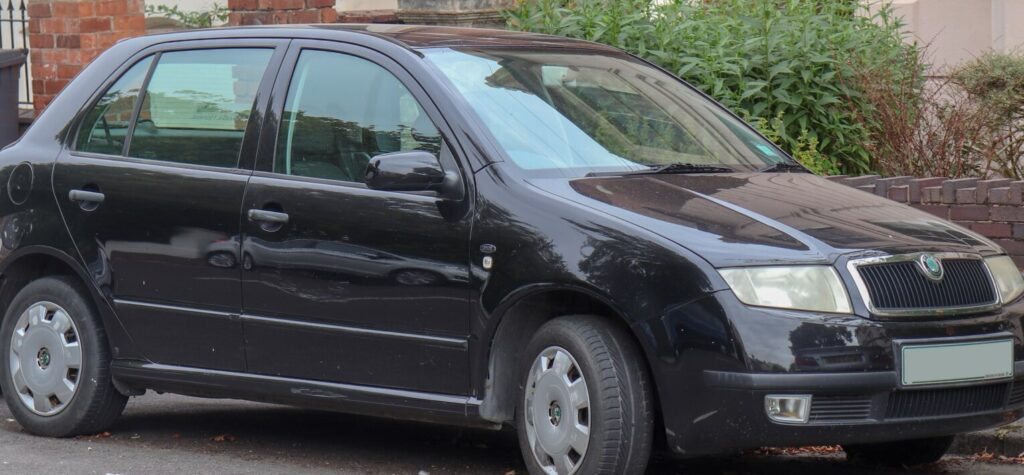
The Skoda Fabia I (6Y) 1.4 TDI, producing 75 horsepower, was a key variant in Skoda’s lineup from April 2003 to October 2004. Positioned as an entry-level diesel option within the first generation Fabia (6Y) range, it aimed to provide fuel efficiency and practicality to budget-conscious buyers. The 6Y Fabia itself was built on the Volkswagen Group’s PQ24 platform, shared with the Volkswagen Polo Mk4 and SEAT Ibiza Mk2, representing Skoda’s increasing integration into the wider VW empire and a step up in build quality and design compared to its predecessors. This particular 1.4 TDI model was primarily sold in European markets, where diesel engines enjoyed significant popularity due to favorable taxation and fuel costs.
Technical Specifications
| Brand | Skoda |
| Model | Fabia |
| Generation | Fabia I (6Y) |
| Type (Engine) | 1.4 TDI (75 Hp) |
| Start of production | April, 2003 |
| End of production | October, 2004 |
| Powertrain Architecture | Internal Combustion engine |
| Body type | Hatchback |
| Seats | 5 |
| Doors | 5 |
| Fuel consumption (urban) | 5.6 l/100 km (42 US mpg, 50.4 UK mpg, 17.9 km/l) |
| Fuel consumption (extra urban) | 4 l/100 km (58.8 US mpg, 70.6 UK mpg, 25 km/l) |
| Fuel Type | Diesel |
| Acceleration 0 – 100 km/h | 14.2 sec |
| Acceleration 0 – 62 mph | 14.2 sec |
| Acceleration 0 – 60 mph | 13.5 sec |
| Maximum speed | 168 km/h (104.39 mph) |
| Weight-to-power ratio | 15.1 kg/Hp, 66.4 Hp/tonne |
| Weight-to-torque ratio | 5.8 kg/Nm, 172.6 Nm/tonne |
| Power | 75 Hp @ 4000 rpm |
| Power per litre | 52.7 Hp/l |
| Torque | 195 Nm @ 2200 rpm (143.82 lb.-ft. @ 2200 rpm) |
| Engine layout | Front, Transverse |
| Engine Model/Code | AMF |
| Engine displacement | 1422 cm3 (86.78 cu. in.) |
| Number of cylinders | 3 |
| Engine configuration | Inline |
| Cylinder Bore | 79.5 mm (3.13 in.) |
| Piston Stroke | 95.5 mm (3.76 in.) |
| Compression ratio | 19:1 |
| Number of valves per cylinder | 2 |
| Fuel injection system | Pump-nozzle (Unit Injector) |
| Engine aspiration | Turbocharger, Intercooler |
| Valvetrain | OHC |
| Engine oil capacity | 3.8 l (4.02 US qt | 3.34 UK qt) |
| Coolant | 6.2 l (6.55 US qt | 5.46 UK qt) |
| Kerb Weight | 1130 kg (2491.22 lbs.) |
| Max. weight | 1645 kg (3626.6 lbs.) |
| Max load | 515 kg (1135.38 lbs.) |
| Trunk (boot) space – minimum | 260 l (9.18 cu. ft.) |
| Trunk (boot) space – maximum | 1015 l (35.84 cu. ft.) |
| Fuel tank capacity | 45 l (11.89 US gal | 9.9 UK gal) |
| Length | 3960 mm (155.91 in.) |
| Width | 1645 mm (64.76 in.) |
| Height | 1450 mm (57.09 in.) |
| Wheelbase | 2462 mm (96.93 in.) |
| Front track | 1419 mm (55.87 in.) |
| Rear (Back) track | 1408 mm (55.43 in.) |
| Drivetrain Architecture | The Internal combustion engine (ICE) drives the front wheels of the vehicle. |
| Drive wheel | Front wheel drive |
| Number of gears and type of gearbox | 5 gears, manual transmission |
| Front suspension | Coil spring |
| Rear suspension | Coil spring |
| Front brakes | Disc |
| Rear brakes | Disc |
| Assisting systems | ABS (Anti-lock braking system) |
| Steering type | Steering rack and pinion |
| Power steering | Hydraulic Steering |
| Tires size | 185/60 R14 |
| Wheel rims size | 6J X 14 |
Powertrain & Engine Architecture
The heart of this Fabia variant is the 1.4-liter, three-cylinder AMF diesel engine. This engine is a direct injection diesel, utilizing the pump-nozzle (Unit Injector) technology developed by Bosch. This system delivers fuel directly into the combustion chamber at extremely high pressure, promoting efficient combustion and reducing emissions. The engine features an overhead camshaft (OHC) valvetrain with two valves per cylinder. A turbocharger with an intercooler is employed to boost power output and improve torque across the rev range. The 195 Nm (143.82 lb.-ft.) of torque, available from just 2200 rpm, is a key characteristic of this engine, providing good low-end grunt for everyday driving. The engine was paired with a five-speed manual transmission, which was the most common configuration. While an automatic transmission was offered on some Fabia models, it was less frequently paired with the 1.4 TDI due to the engine’s relatively modest power output.
Driving Characteristics
The 1.4 TDI 75 hp Fabia offered a practical, if not particularly exciting, driving experience. Acceleration was modest, taking around 14.2 seconds to reach 62 mph (100 km/h). The focus was on fuel economy and usability rather than outright performance. The turbocharger helped to mitigate some of the power deficit, providing a noticeable boost in acceleration when overtaking or climbing hills. The five-speed manual transmission was well-matched to the engine’s characteristics, allowing drivers to keep the engine in its optimal torque band. Compared to the more powerful 1.4 16V petrol engine or the later 1.9 TDI variants, the 1.4 TDI felt noticeably slower, but it offered significantly better fuel economy. The gear ratios were tuned for efficiency, prioritizing lower engine speeds at cruising speeds.
Equipment & Trim Levels
The 1.4 TDI typically came equipped with a fairly basic level of trim. Standard features generally included central locking, power steering, front airbags, and an adjustable steering column. Interior upholstery was typically cloth, and the dashboard featured a simple, functional design. Optional extras included air conditioning, alloy wheels, and a radio/CD player. The trim level often dictated the availability of these options. Higher trim levels, such as ‘Classic’ or ‘Comfort’, offered more features as standard, but the 1.4 TDI was often positioned as the entry point to the Fabia range, meaning buyers often had to specify extras to achieve their desired level of comfort and convenience.
Chassis & Braking
The Fabia I utilized a relatively simple chassis design. Front suspension consisted of coil springs and independent suspension, while the rear featured a torsion beam axle with coil springs. This setup provided a comfortable ride, although it wasn’t particularly sporty. Brakes were disc brakes on all four wheels, providing adequate stopping power for the vehicle’s weight and performance. An Anti-lock Braking System (ABS) was standard, enhancing safety. Stabilizer bars were fitted to both the front and rear axles to reduce body roll during cornering. The suspension tuning was geared towards comfort and practicality, rather than aggressive handling.
Market Reception & Comparison
The 1.4 TDI Fabia was generally well-received by critics as a sensible and economical choice. It was praised for its fuel efficiency and low running costs, making it an attractive option for those seeking a practical and affordable hatchback. However, it was often criticized for its lack of power and somewhat agricultural engine noise. Compared to the petrol-powered Fabia variants, the 1.4 TDI offered significantly better fuel economy but less performance. The later 1.9 TDI models provided a substantial power upgrade, but at a higher price point. The 1.4 TDI’s main appeal lay in its balance of affordability, fuel efficiency, and practicality.
Legacy
The 1.4 TDI engine, particularly the AMF code, proved to be a relatively reliable unit when properly maintained. Common issues included turbocharger failure and problems with the fuel injection pump. However, these were often related to infrequent servicing or poor fuel quality. Today, the Fabia I 1.4 TDI can be found as an affordable used car, often appealing to first-time drivers or those seeking a cheap and economical runabout. Its simplicity and relatively low maintenance costs make it a viable option for those willing to accept its modest performance. Parts availability remains good, thanks to the widespread use of the engine across the Volkswagen Group range. While not a performance icon, the 1.4 TDI Fabia played a significant role in establishing Skoda as a credible and value-for-money brand in the European market.
