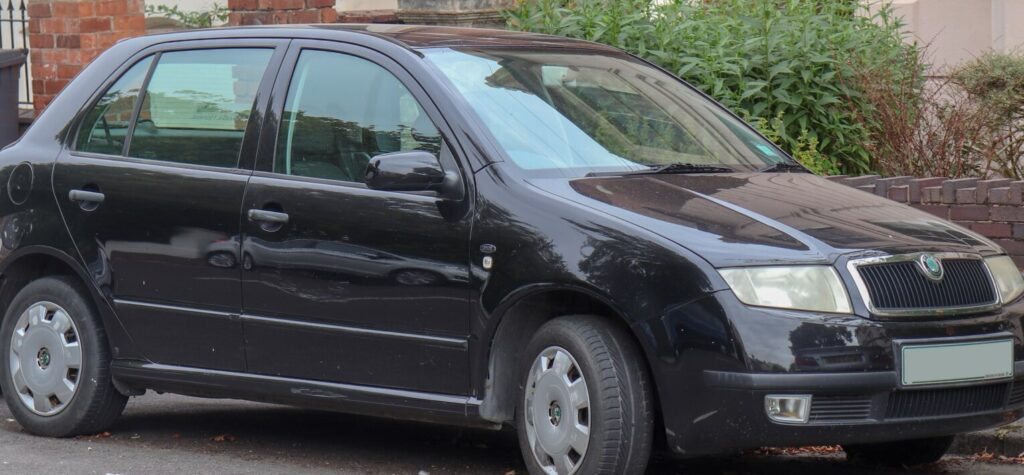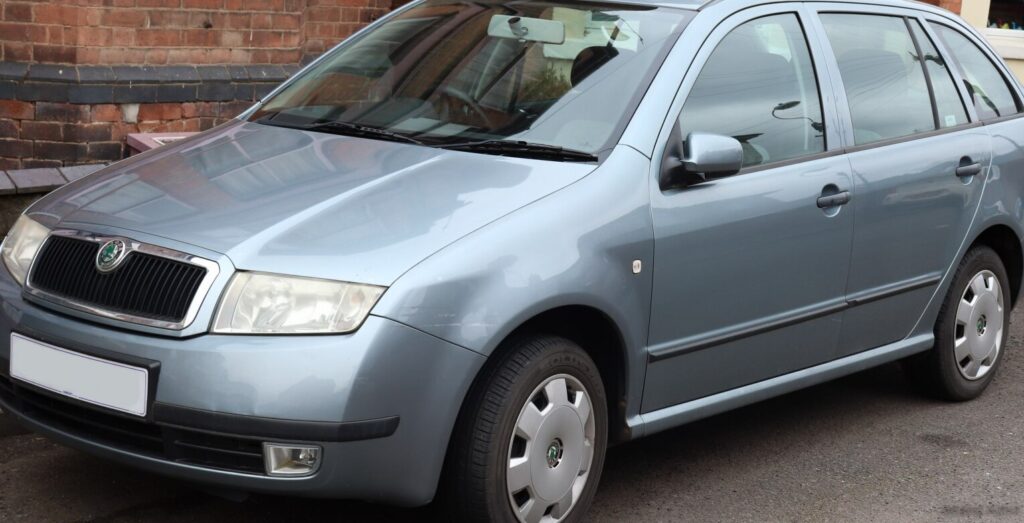
The Skoda Fabia I Combi (6Y) 1.2 i, producing 64 horsepower, was a station wagon variant offered between January 2003 and July 2004. Positioned as the entry-level engine option within the first generation Fabia Combi range (based on the Volkswagen Group’s PQ6 platform, also known as the 6Y series), it catered to buyers prioritizing fuel efficiency and affordability over outright performance. This model aimed to provide a practical and economical family vehicle, particularly in European markets where compact estates were popular. It represented Skoda’s continued effort to establish itself as a mainstream manufacturer offering value for money.
Technical Specifications
| Brand | Skoda |
| Model | Fabia |
| Generation | Fabia I Combi (6Y) |
| Type (Engine) | 1.2 i (64 Hp) |
| Start of production | January, 2003 |
| End of production | July, 2004 |
| Powertrain Architecture | Internal Combustion engine |
| Body type | Station wagon (estate) |
| Seats | 5 |
| Doors | 5 |
| Fuel consumption (urban) | 7.7 l/100 km (30.5 US mpg) |
| Fuel consumption (extra urban) | 5.1 l/100 km (46.1 US mpg) |
| Fuel consumption (combined) | 6 l/100 km (39.2 US mpg) |
| Fuel Type | Petrol (Gasoline) |
| Acceleration 0 – 100 km/h | 16.3 sec |
| Acceleration 0 – 62 mph | 16.3 sec |
| Acceleration 0 – 60 mph | 15.5 sec |
| Maximum speed | 162 km/h (100.66 mph) |
| Weight-to-power ratio | 17.1 kg/Hp |
| Weight-to-torque ratio | 9.8 kg/Nm |
| Power | 64 Hp @ 5400 rpm |
| Torque | 112 Nm @ 3000 rpm (82.61 lb.-ft. @ 3000 rpm) |
| Engine layout | Front, Transverse |
| Engine Model/Code | AZQ |
| Engine displacement | 1198 cm3 (73.11 cu. in.) |
| Number of cylinders | 3 |
| Engine configuration | Inline |
| Cylinder Bore | 76.5 mm (3.01 in.) |
| Piston Stroke | 86.9 mm (3.42 in.) |
| Compression ratio | 10.5:1 |
| Number of valves per cylinder | 4 |
| Fuel injection system | Multi-port manifold injection |
| Engine aspiration | Naturally aspirated engine |
| Valvetrain | OHC |
| Engine oil capacity | 2.8 l (2.96 US qt | 2.46 UK qt) |
| Coolant capacity | 5.1 l (5.39 US qt | 4.49 UK qt) |
| Kerb Weight | 1095 kg (2414.06 lbs.) |
| Max. weight | 1610 kg (3549.44 lbs.) |
| Max load | 515 kg (1135.38 lbs.) |
| Trunk (boot) space – minimum | 426 l (15.04 cu. ft.) |
| Trunk (boot) space – maximum | 1225 l (43.26 cu. ft.) |
| Fuel tank capacity | 45 l (11.89 US gal | 9.9 UK gal) |
| Length | 4222 mm (166.22 in.) |
| Width | 1646 mm (64.8 in.) |
| Height | 1452 mm (57.17 in.) |
| Wheelbase | 2462 mm (96.93 in.) |
| Front track | 1419 mm (55.87 in.) |
| Rear track | 1408 mm (55.43 in.) |
| Drivetrain Architecture | Front wheel drive |
| Number of gears | 5 |
| Gearbox type | Manual transmission |
| Front suspension | Coil spring |
| Rear suspension | Coil spring |
| Front brakes | Disc |
| Rear brakes | Drum |
| Steering type | Steering rack and pinion |
| Power steering | Hydraulic |
| Tires size | 165/70 R14 |
Introduction
The Fabia Combi 1.2 i represented Skoda’s attempt to offer a practical and affordable estate car to the European market. Introduced in 2003 as part of the 6Y series, it built upon the success of the hatchback version, adding the versatility of a larger cargo area. The 1.2-liter engine was the base option, designed for buyers who prioritized economy and low running costs. It slotted in below the more powerful 1.4 and 2.0-liter petrol engines, as well as the diesel options, making it the most accessible trim level.
Powertrain & Engine Architecture
The heart of the Fabia Combi 1.2 i was the AZQ engine code, a 1.2-liter inline three-cylinder petrol engine. This engine featured multi-point fuel injection and an overhead camshaft (OHC) valvetrain. While relatively simple in design, it was engineered for reliability and fuel efficiency. The three-cylinder configuration contributed to its compact size and reduced weight. The engine produced 64 horsepower at 5400 rpm and 112 Nm (82.61 lb-ft) of torque at 3000 rpm. The engine was typically paired with a five-speed manual transmission, although an automatic option was available in some markets. The automatic transmission was a traditional hydraulic automatic, offering smooth but less efficient gear changes compared to modern automatics.
Driving Characteristics
The 1.2-liter engine in the Fabia Combi provided adequate, but not exhilarating, performance. Acceleration from 0 to 60 mph took around 15.5 seconds, and top speed was limited to 100.66 mph. The engine felt strained when fully loaded or climbing hills, requiring frequent downshifts. The five-speed manual transmission helped to keep the engine in its optimal power band, but the overall driving experience was geared towards economy rather than sporty handling. Compared to the 1.4 or 2.0-liter versions, the 1.2 i felt noticeably slower and less refined. The automatic transmission further dulled performance, increasing acceleration times and reducing fuel economy.
Equipment & Trim Levels
The 1.2 i trim level typically came with basic equipment, reflecting its position as the entry point to the Fabia Combi range. Standard features generally included power steering, central locking, front airbags, and an adjustable steering column. Interior upholstery was typically cloth, and the dashboard featured a simple, functional design. Optional extras included air conditioning, alloy wheels, and a radio/CD player. Higher trim levels offered features like electric windows, heated mirrors, and upgraded interior trim.
Chassis & Braking
The Fabia Combi 1.2 i utilized a relatively simple chassis setup. Front suspension consisted of coil springs and independent suspension, while the rear featured a torsion beam axle with coil springs. The braking system employed disc brakes on the front wheels and drum brakes on the rear. This configuration was typical for cars in this weight class and price range. The steering was a hydraulic power-assisted rack and pinion system, providing reasonable steering feel and maneuverability. Stabilizer bars were present, but were relatively thin compared to those found on higher-spec models.
Market Reception & Comparison
The Fabia Combi 1.2 i was generally well-received by critics as a practical and affordable family car. However, its performance was often criticized as being underpowered, particularly when the vehicle was fully loaded. Fuel economy was a strong point, making it an attractive option for budget-conscious buyers. Compared to rivals like the Renault Clio Estate and Peugeot 206 SW, the Fabia Combi offered a similar level of practicality and affordability, but often with a slightly more spacious interior. The 1.4-liter Fabia Combi offered a noticeable performance improvement, but at a higher price point. The diesel variants provided even better fuel economy, but were more expensive to purchase and maintain.
Legacy
The AZQ 1.2-liter engine, while not known for its performance, proved to be a relatively reliable unit. Common issues were generally minor, such as oil leaks and sensor failures. Today, the Fabia Combi 1.2 i can be found on the used car market at very affordable prices. Its simplicity and low running costs make it an attractive option for first-time car buyers or those seeking a cheap and practical estate car. However, potential buyers should be aware of its limited performance and the age-related wear and tear that is common with older vehicles. Parts availability is generally good, thanks to the widespread use of the PQ6 platform across various Volkswagen Group models.