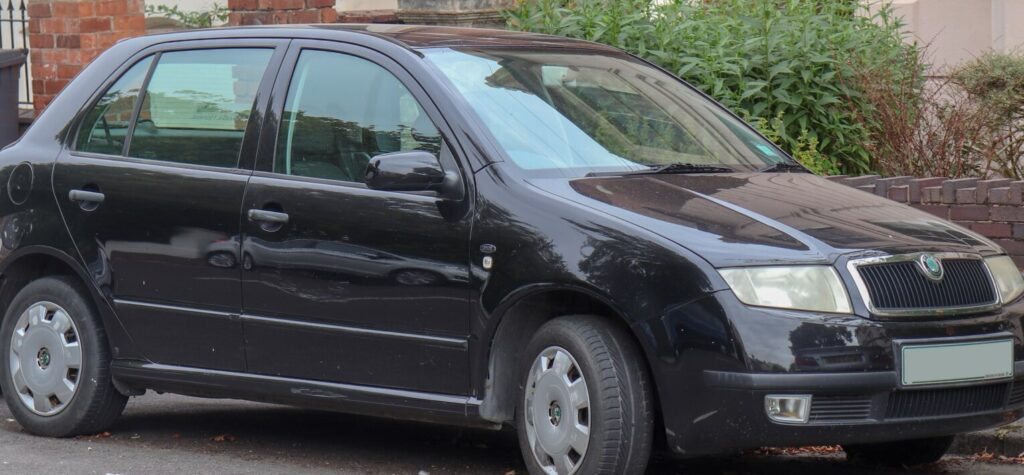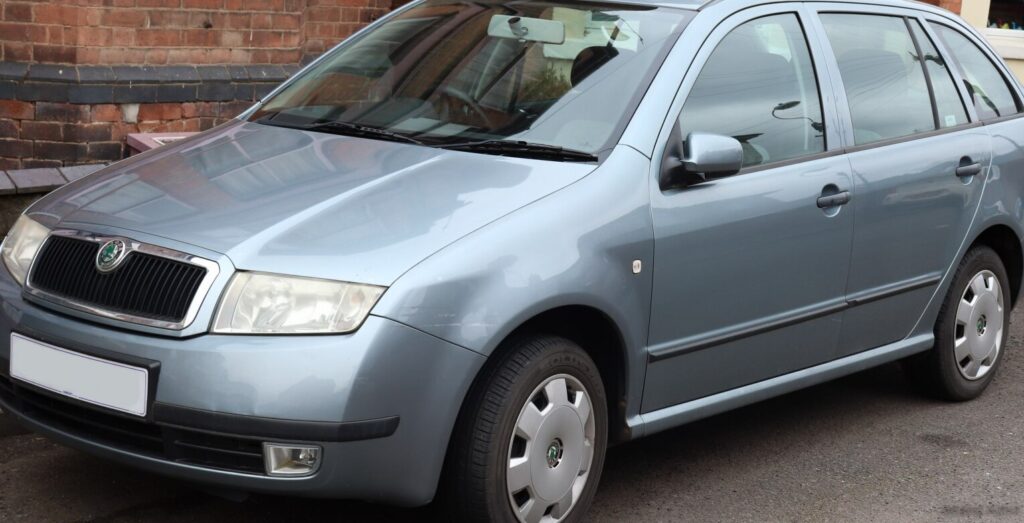
Technical Specifications
| Brand | Skoda |
| Model | Fabia |
| Generation | Fabia I Combi (6Y) |
| Type (Engine) | 1.4 TDI (75 Hp) |
| Start of production | April, 2003 |
| End of production | October, 2004 |
| Powertrain Architecture | Internal Combustion engine |
| Body type | Station wagon (estate) |
| Seats | 5 |
| Doors | 5 |
| Fuel consumption (urban) | 5.6 l/100 km (42 US mpg, 50.4 UK mpg, 17.9 km/l) |
| Fuel consumption (extra urban) | 4 l/100 km (58.8 US mpg, 70.6 UK mpg, 25 km/l) |
| Fuel Type | Diesel |
| Acceleration 0 – 100 km/h | 14.4 sec |
| Acceleration 0 – 62 mph | 14.4 sec |
| Acceleration 0 – 60 mph | 13.7 sec |
| Maximum speed | 170 km/h (105.63 mph) |
| Weight-to-power ratio | 15.5 kg/Hp, 64.4 Hp/tonne |
| Weight-to-torque ratio | 6 kg/Nm, 167.4 Nm/tonne |
| Power | 75 Hp @ 4000 rpm |
| Power per litre | 52.7 Hp/l |
| Torque | 195 Nm @ 2200 rpm (143.82 lb.-ft. @ 2200 rpm) |
| Engine layout | Front, Transverse |
| Engine Model/Code | AMF |
| Engine displacement | 1422 cm3 (86.78 cu. in.) |
| Number of cylinders | 3 |
| Engine configuration | Inline |
| Cylinder Bore | 79.5 mm (3.13 in.) |
| Piston Stroke | 95.5 mm (3.76 in.) |
| Compression ratio | 19:1 |
| Number of valves per cylinder | 2 |
| Fuel injection system | Pump-nozzle (Unit Injector) |
| Engine aspiration | Turbocharger, Intercooler |
| Valvetrain | OHC |
| Engine oil capacity | 3.8 l (4.02 US qt | 3.34 UK qt) |
| Coolant | 6.2 l (6.55 US qt | 5.46 UK qt) |
| Kerb Weight | 1165 kg (2568.39 lbs.) |
| Max. weight | 1680 kg (3703.77 lbs.) |
| Max load | 515 kg (1135.38 lbs.) |
| Trunk (boot) space – minimum | 426 l (15.04 cu. ft.) |
| Trunk (boot) space – maximum | 1225 l (43.26 cu. ft.) |
| Fuel tank capacity | 45 l (11.89 US gal | 9.9 UK gal) |
| Length | 4222 mm (166.22 in.) |
| Width | 1646 mm (64.8 in.) |
| Height | 1452 mm (57.17 in.) |
| Wheelbase | 2462 mm (96.93 in.) |
| Front track | 1419 mm (55.87 in.) |
| Rear (Back) track | 1408 mm (55.43 in.) |
| Drivetrain Architecture | The Internal combustion engine (ICE) drives the front wheels of the vehicle. |
| Drive wheel | Front wheel drive |
| Number of gears and type of gearbox | 5 gears, manual transmission |
| Front suspension | Coil spring |
| Rear suspension | Coil spring |
| Front brakes | Disc |
| Rear brakes | Drum |
| Steering type | Steering rack and pinion |
| Power steering | Hydraulic Steering |
| Tires size | 185/60 R14 |
| Wheel rims size | 6J x 14 |
The Skoda Fabia I Combi (6Y) 1.4 TDI, producing 75 horsepower, was a practical and economical station wagon offered by the Czech automaker between April 2003 and October 2004. Positioned as an entry-level variant within the first generation Fabia Combi range, it catered to buyers prioritizing fuel efficiency and affordability over outright performance. This model occupied a key space in Skoda’s lineup, offering a budget-friendly, versatile option in the European small family car segment. It was built on the Volkswagen Group’s PQ24 platform, also known as the A4 platform, shared with the Volkswagen Polo, SEAT Ibiza, and Audi A2.
Powertrain & Engine Architecture
The heart of the Fabia Combi 1.4 TDI was the AMF engine code, a 1.4-liter inline three-cylinder diesel engine. This engine utilized a pump-nozzle (unit injector) fuel injection system, a technology known for its precision and efficiency in diesel engines. The AMF engine was turbocharged and intercooled, allowing it to produce a respectable 75 horsepower at 4000 rpm and 195 Nm (144 lb-ft) of torque at 2200 rpm. The engine featured an overhead camshaft (OHC) valvetrain with two valves per cylinder. The engine’s compact size and relatively light weight contributed to the Fabia’s balanced handling. The five-speed manual transmission was the standard offering, optimized for fuel economy and smooth operation.
Driving Characteristics
The 1.4 TDI engine, paired with the five-speed manual gearbox, provided adequate, though not exhilarating, performance. Acceleration from 0 to 100 km/h (0-62 mph) took around 14.4 seconds, and the top speed was 170 km/h (106 mph). The engine’s torque peak at 2200 rpm meant that it felt reasonably responsive in everyday driving situations, particularly for overtaking maneuvers. Compared to the more powerful 1.8-liter petrol engines available in the Fabia range, the 1.4 TDI prioritized fuel economy over outright speed. The gear ratios were chosen to maximize efficiency, resulting in a slightly ‘stretched’ feel at higher speeds. The manual transmission offered precise shifts, enhancing the driving experience.
Equipment & Trim Levels
The 1.4 TDI Combi typically came with a modest level of standard equipment. This included central locking, power steering, front airbags, and an adjustable steering column. Interior upholstery was typically cloth, and the dashboard featured a functional, if somewhat basic, design. Optional extras included air conditioning, alloy wheels, and a radio/CD player. The trim level was generally considered entry-level, focusing on providing essential features at an affordable price point. The Combi body style itself added practicality with its increased cargo capacity compared to the hatchback version.
Chassis & Braking
The Fabia Combi 1.4 TDI utilized a simple yet effective chassis design. Front suspension consisted of coil springs and independent suspension, while the rear featured a torsion beam axle with coil springs. The braking system employed disc brakes on the front wheels and drum brakes on the rear. This configuration was typical for vehicles in this weight class and price range. The steering was a hydraulic power-assisted rack and pinion system, providing a reasonable level of feedback and control. Stabilizer bars were fitted to both the front and rear axles to reduce body roll during cornering.
Market Reception & Comparison
The Skoda Fabia Combi 1.4 TDI was generally well-received by automotive critics as a practical and economical family car. Its fuel efficiency was a major selling point, particularly in Europe where diesel fuel was often cheaper than petrol. Compared to other trims in the Fabia lineup, such as the 1.4 16V petrol, the TDI offered significantly better fuel economy but less outright performance. Reliability was generally good, although the pump-nozzle injection system could be prone to issues if not properly maintained. The Fabia Combi offered a compelling alternative to rivals like the Renault Clio Estate and Peugeot 206 SW.
Legacy
The Skoda Fabia I Combi 1.4 TDI has proven to be a relatively durable and reliable vehicle in the used car market. The AMF engine, while not known for its blistering performance, is generally considered robust if properly maintained. Common issues include wear and tear on the turbocharger and potential problems with the pump-nozzle injectors. However, parts availability is generally good, and the relatively simple mechanical design makes it accessible for DIY repairs. Today, these Fabia Combis represent an affordable and practical option for buyers seeking a fuel-efficient and spacious estate car.