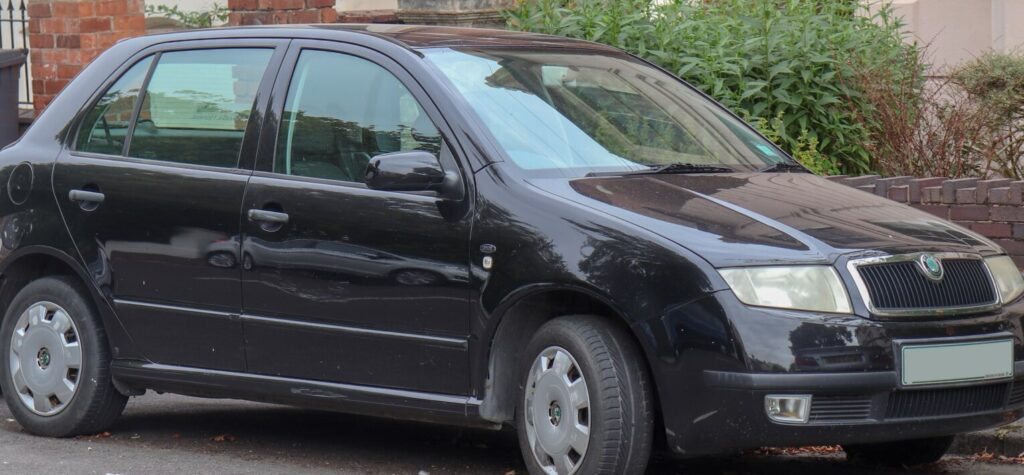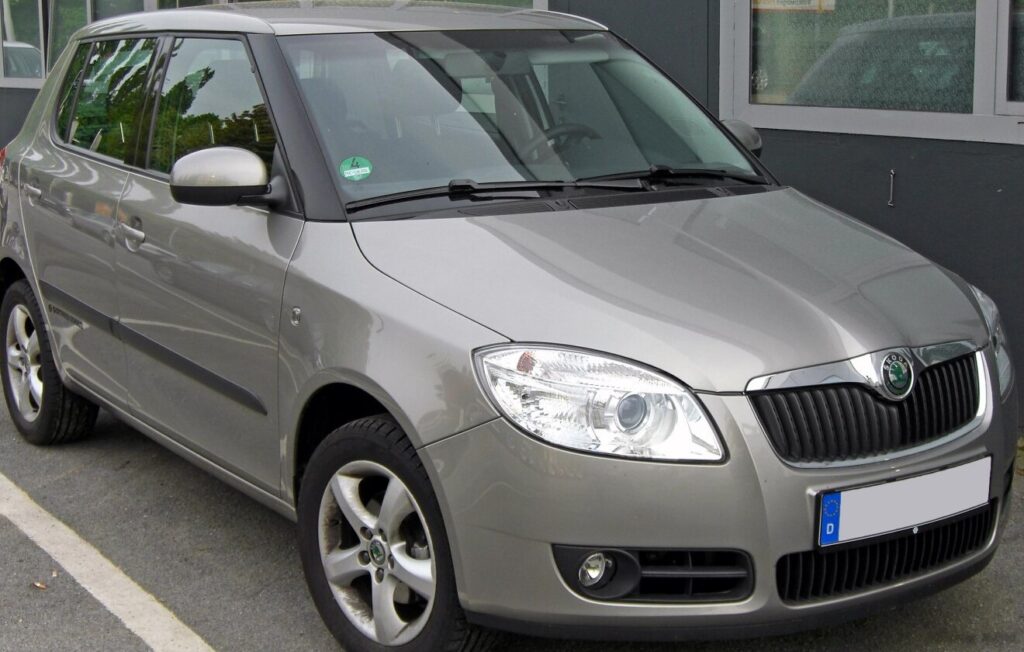
The Skoda Fabia II 1.2 i HTP (60 hp) was a subcompact hatchback produced from 2007 to 2010, representing an entry-level offering within the second generation Fabia lineup (Typ 5J). Positioned as the most economical variant, it aimed to provide affordable transportation within the European market. This model utilized a small-displacement, three-cylinder engine paired with a five-speed manual transmission, prioritizing fuel efficiency over outright performance. It was a key component in Skoda’s strategy to offer a broad range of models catering to diverse consumer needs.
Technical Specifications
| Brand | Skoda |
| Model | Fabia |
| Generation | Fabia II |
| Type (Engine) | 1.2 i HTP (60 Hp) |
| Start of production | 2007 |
| End of production | 2010 |
| Powertrain Architecture | Internal Combustion engine |
| Body type | Hatchback |
| Seats | 5 |
| Doors | 5 |
| Fuel consumption (urban) | 7.8 l/100 km (30.2 US mpg, 36.2 UK mpg, 12.8 km/l) |
| Fuel consumption (extra urban) | 4.8 l/100 km (49 US mpg, 58.9 UK mpg, 20.8 km/l) |
| Fuel consumption (combined) | 5.9 l/100 km (39.9 US mpg, 47.9 UK mpg, 16.9 km/l) |
| Fuel Type | Petrol (Gasoline) |
| Acceleration 0 – 100 km/h | 16.5 sec |
| Acceleration 0 – 62 mph | 16.5 sec |
| Acceleration 0 – 60 mph | 15.7 sec |
| Maximum speed | 155 km/h (96.31 mph) |
| Emission standard | Euro 4 |
| Weight-to-power ratio | 17.3 kg/Hp, 57.7 Hp/tonne |
| Weight-to-torque ratio | 9.6 kg/Nm, 103.8 Nm/tonne |
| Power | 60 Hp @ 5200 rpm |
| Power per litre | 50.1 Hp/l |
| Torque | 108 Nm @ 3000 rpm (79.66 lb.-ft. @ 3000 rpm) |
| Engine layout | Front, Transverse |
| Engine Model/Code | EA111 / BBM |
| Engine displacement | 1198 cm3 (73.11 cu. in.) |
| Number of cylinders | 3 |
| Engine configuration | Inline |
| Cylinder Bore | 76.5 mm (3.01 in.) |
| Piston Stroke | 86.9 mm (3.42 in.) |
| Compression ratio | 10.3:1 |
| Fuel injection system | Multi-port manifold injection |
| Engine aspiration | Naturally aspirated engine |
| Engine oil capacity | 2.8 l (2.96 US qt | 2.46 UK qt) |
| Coolant | 5.2 l (5.49 US qt | 4.58 UK qt) |
| Kerb Weight | 1040 kg (2292.81 lbs.) |
| Max. weight | 1555 kg (3428.19 lbs.) |
| Max load | 515 kg (1135.38 lbs.) |
| Trunk (boot) space – minimum | 300 l (10.59 cu. ft.) |
| Trunk (boot) space – maximum | 1163 l (41.07 cu. ft.) |
| Fuel tank capacity | 45 l (11.89 US gal | 9.9 UK gal) |
| Length | 3992 mm (157.17 in.) |
| Width | 1642 mm (64.65 in.) |
| Height | 1498 mm (58.98 in.) |
| Wheelbase | 2462 mm (96.93 in.) |
| Front track | 1436 mm (56.54 in.) |
| Rear (Back) track | 1426 mm (56.14 in.) |
| Drivetrain Architecture | The Internal combustion engine (ICE) drives the front wheels of the vehicle. |
| Drive wheel | Front wheel drive |
| Number of gears and type of gearbox | 5 gears, manual transmission |
| Front suspension | Spring Strut |
| Rear suspension | Coil spring |
| Front brakes | Ventilated discs |
| Rear brakes | Drum |
| Assisting systems | ABS (Anti-lock braking system) |
| Steering type | Steering rack and pinion |
| Tires size | 165/70 R14 |
INTRODUCTION
The Skoda Fabia II 1.2 i HTP (60 hp) was introduced in 2007 as part of the Fabia II model range (built on the Volkswagen Group’s PQ25 platform, also known as the 1HX0/A3 platform). This variant was specifically designed to appeal to budget-conscious buyers seeking a practical and economical hatchback. It occupied the base trim level, offering a no-frills transportation solution. The 1.2 i HTP engine was a key component of Skoda’s efforts to broaden the Fabia’s appeal and compete effectively in the highly competitive subcompact segment. It was primarily sold in European markets, where fuel efficiency and affordability were paramount concerns.
Powertrain & Engine Architecture
The heart of this Fabia variant is the EA111 series 1.2-liter inline three-cylinder engine, designated BBM. This engine featured multi-point fuel injection and a single overhead camshaft (SOHC) operating four valves per cylinder. The 1.2 HTP (High Torque Performance) engine was designed to offer a balance between fuel economy and acceptable performance for urban driving. Despite its small displacement, the engine utilized technologies like optimized combustion chamber design and lightweight components to maximize efficiency. The five-speed manual transmission was chosen for its simplicity and contribution to fuel savings. The transmission featured typical ratios for a small-displacement engine, prioritizing acceleration in lower gears and fuel efficiency at highway speeds. The engine’s relatively low output meant that the transmission wasn’t subjected to excessive stress.
Driving Characteristics
The 1.2 i HTP Fabia was not known for its blistering acceleration. With only 60 horsepower, the 0-60 mph time hovered around 15.7 seconds. Real-world driving involved a need for careful planning when overtaking or merging onto highways. The engine’s torque peak of 108 Nm (79.66 lb-ft) at 3000 rpm provided adequate pulling power for everyday driving, but required the engine to be revved to maintain momentum, especially when loaded with passengers or cargo. Compared to the more powerful 1.4 or 1.6-liter variants, or even the diesel options, the 1.2 HTP felt noticeably slower. However, its light weight and responsive steering made it nimble and easy to maneuver in city traffic. The gear ratios were spaced to keep the engine within its optimal operating range, but frequent downshifts were often necessary to maintain speed on inclines.
Equipment & Trim Levels
The 1.2 i HTP typically came with a basic level of equipment. Standard features generally included power steering, central locking, front airbags, and an adjustable steering column. Interior upholstery was typically cloth, and the dashboard featured a simple, functional design. Air conditioning, alloy wheels, and a radio/CD player were often offered as optional extras. The trim level was designed to be as affordable as possible, so many comfort and convenience features were omitted to keep the price down. The focus was on providing a reliable and practical vehicle rather than a luxurious one.
Chassis & Braking
The Fabia II utilized a MacPherson strut front suspension and a twist-beam rear suspension. This setup provided a reasonable balance between ride comfort and handling. The front brakes were ventilated discs, while the rear brakes were drums, a cost-saving measure common in entry-level models. ABS (Anti-lock Braking System) was standard, enhancing safety during emergency braking. The suspension was tuned for comfort, prioritizing a smooth ride over sporty handling. Stabilizer bars were present, but were relatively thin compared to those found on higher-spec models.
Market Reception & Comparison
The Skoda Fabia II 1.2 i HTP was generally well-received as an affordable and economical option. Critics praised its fuel efficiency and low running costs, but noted its lack of power. Compared to other engines in the Fabia lineup, such as the 1.4-liter or the 1.9 TDI diesel, the 1.2 HTP offered significantly lower performance but also lower fuel consumption and purchase price. The 1.9 TDI, while more expensive, provided superior torque and fuel economy, making it a popular choice for drivers covering long distances. The 1.4-liter offered a compromise between performance and economy. The 1.2 HTP was primarily targeted at first-time buyers, city dwellers, and those seeking a low-cost vehicle for short journeys.
Legacy
The 1.2 i HTP engine, while economical, gained a reputation for some reliability issues, particularly related to timing chain wear and oil consumption. These issues, while not universal, became a concern for owners as the cars aged. Despite these concerns, the Fabia II 1.2 i HTP remains a relatively affordable option on the used car market. Its simplicity and low running costs continue to appeal to budget-conscious buyers. However, potential buyers should be aware of the potential engine issues and ensure that any prospective purchase has been well-maintained and has a documented service history. The model represents a significant step in Skoda’s development, demonstrating their ability to produce a competitive and affordable vehicle for the European market.