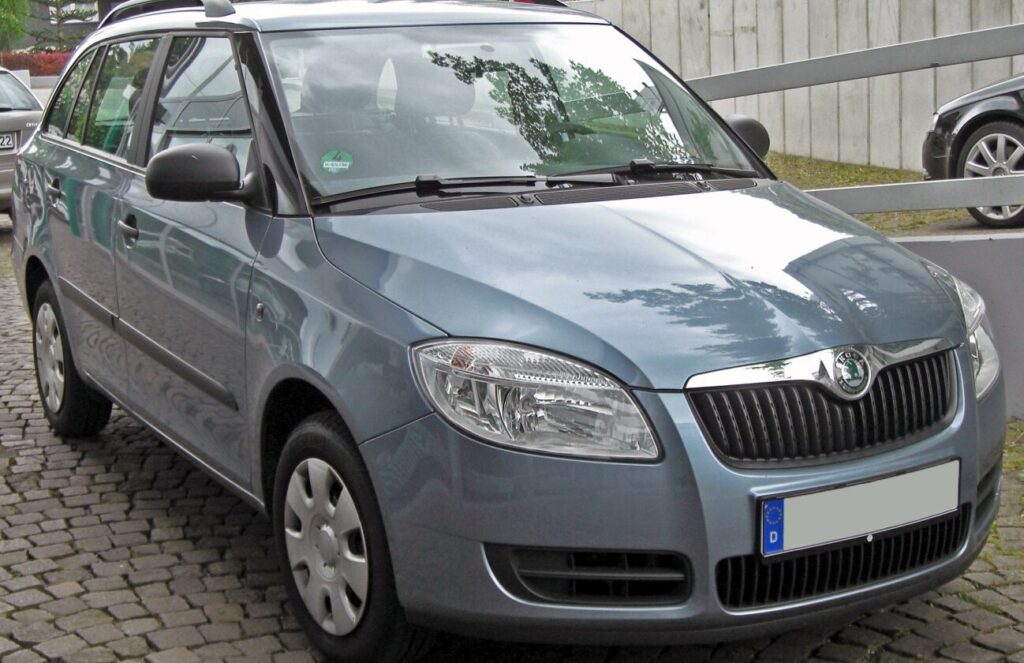
The Skoda Fabia II Combi 1.2 HTP (60 hp) was a subcompact estate car produced by the Czech manufacturer Skoda between 2007 and 2010. Positioned as the entry-level variant of the second-generation Fabia Combi (estate) range, it offered an affordable and practical option for buyers prioritizing fuel efficiency and cargo space over outright performance. This model was part of the wider Fabia II series, based on the Volkswagen Group’s PQ35 platform – also known as the A5/1HX0 platform – shared with the Volkswagen Polo Mk5 and SEAT Ibiza Mk4. The Combi body style, a station wagon, significantly expanded the Fabia’s practicality compared to the hatchback version.
Technical Specifications
| Brand | Skoda |
| Model | Fabia |
| Generation | Fabia II Combi |
| Type (Engine) | 1.2 HTP (60 Hp) |
| Start of production | 2007 |
| End of production | 2010 |
| Powertrain Architecture | Internal Combustion engine |
| Body type | Station wagon (estate) |
| Seats | 5 |
| Doors | 5 |
| Fuel consumption (urban) | 7.8 l/100 km (30.2 US mpg, 36.2 UK mpg, 12.8 km/l) |
| Fuel consumption (extra urban) | 4.8 l/100 km (49 US mpg, 58.9 UK mpg, 20.8 km/l) |
| Fuel consumption (combined) | 5.9 l/100 km (39.9 US mpg, 47.9 UK mpg, 16.9 km/l) |
| Fuel Type | Petrol (Gasoline) |
| Acceleration 0 – 100 km/h | 16.8 sec |
| Acceleration 0 – 62 mph | 16.8 sec |
| Acceleration 0 – 60 mph | 16 sec |
| Maximum speed | 156 km/h (96.93 mph) |
| Emission standard | Euro 4 |
| Weight-to-power ratio | 19 kg/Hp, 52.6 Hp/tonne |
| Weight-to-torque ratio | 10.6 kg/Nm, 94.7 Nm/tonne |
| Power | 60 Hp @ 5200 rpm |
| Power per litre | 50.1 Hp/l |
| Torque | 108 Nm @ 3000 rpm (79.66 lb.-ft. @ 3000 rpm) |
| Engine layout | Front, Transverse |
| Engine Model/Code | EA111 / BBM |
| Engine displacement | 1198 cm3 (73.11 cu. in.) |
| Number of cylinders | 3 |
| Engine configuration | Inline |
| Cylinder Bore | 76.5 mm (3.01 in.) |
| Piston Stroke | 86.9 mm (3.42 in.) |
| Compression ratio | 10.5:1 |
| Number of valves per cylinder | 2 |
| Fuel injection system | Multi-port manifold injection |
| Engine aspiration | Naturally aspirated engine |
| Valvetrain | OHC |
| Engine oil capacity | 2.8 l (2.96 US qt | 2.46 UK qt) |
| Coolant | 5.2 l (5.49 US qt | 4.58 UK qt) |
| Kerb Weight | 1140 kg (2513.27 lbs.) |
| Max. weight | 1580 kg (3483.3 lbs.) |
| Max load | 440 kg (970.03 lbs.) |
| Trunk (boot) space – minimum | 480 l (16.95 cu. ft.) |
| Trunk (boot) space – maximum | 1460 l (51.56 cu. ft.) |
| Fuel tank capacity | 45 l (11.89 US gal | 9.9 UK gal) |
| Length | 4239 mm (166.89 in.) |
| Width | 1642 mm (64.65 in.) |
| Height | 1498 mm (58.98 in.) |
| Wheelbase | 2462 mm (96.93 in.) |
| Front track | 1435 mm (56.5 in.) |
| Rear (Back) track | 1424 mm (56.06 in.) |
| Drivetrain Architecture | The Internal combustion engine (ICE) drives the front wheels of the vehicle. |
| Drive wheel | Front wheel drive |
| Number of gears and type of gearbox | 5 gears, manual transmission |
| Front suspension | Coil spring |
| Rear suspension | Coil spring |
| Front brakes | Disc |
| Rear brakes | Drum |
| Assisting systems | ABS (Anti-lock braking system) |
| Steering type | Steering rack and pinion |
| Tires size | 165/70 R14 |
Powertrain & Engine Architecture
The Fabia II Combi 1.2 HTP utilized the EA111 engine code, specifically the BBM variant. This was a three-cylinder, naturally aspirated engine, representing a downsized approach to gasoline engine design. The ‘HTP’ designation stood for ‘High Torque Pump,’ referring to the engine’s multi-point fuel injection system. While designed to offer reasonable torque at lower engine speeds, the 1.2 HTP was known for its relatively modest power output. The engine featured a single overhead camshaft (OHC) operating two valves per cylinder. The five-speed manual transmission was the standard offering, geared towards maximizing fuel economy rather than providing sporty acceleration. The engine’s small displacement and three-cylinder configuration contributed to inherent vibrations, which were mitigated by engine mounts and balancing shafts.
Driving Characteristics
The 1.2 HTP engine in the Fabia Combi delivered a driving experience focused on economy and practicality. Acceleration was slow, with 0-60 mph taking around 16 seconds. The engine required frequent downshifting to maintain momentum, particularly when overtaking or climbing hills. The five-speed gearbox was well-matched to the engine’s characteristics, with relatively long gear ratios prioritizing fuel efficiency. Compared to the more powerful 1.4 or 1.6-liter engines available in the Fabia II range, the 1.2 HTP felt significantly underpowered. However, for urban driving and shorter journeys, the engine proved adequate, offering acceptable fuel economy. The steering was light and easy, making it maneuverable in city environments.
Equipment & Trim Levels
The 1.2 HTP Combi typically came with a basic level of equipment. Standard features generally included central locking, power steering, front airbags, and an adjustable steering column. Interior upholstery was typically cloth, and the dashboard featured a simple, functional design. Optional extras included air conditioning, alloy wheels, and a radio/CD player. Trim levels varied slightly depending on the market, but the 1.2 HTP generally represented the entry point to the Fabia Combi range, with fewer standard features than higher-spec models.
Chassis & Braking
The Fabia II Combi’s chassis featured a MacPherson strut front suspension and a twist-beam rear axle. This setup provided a comfortable ride, although it wasn’t particularly sporty. The front brakes were disc brakes, while the rear brakes were drum brakes – a cost-saving measure common in entry-level models. Anti-lock Braking System (ABS) was standard, enhancing braking performance and safety. The suspension was tuned for comfort and stability, prioritizing ride quality over handling precision. Stabilizer bars were fitted to reduce body roll during cornering, but the overall handling characteristics were geared towards everyday usability rather than enthusiastic driving.
Market Reception & Comparison
The Skoda Fabia II Combi 1.2 HTP was generally well-received as an affordable and practical estate car. Critics praised its spacious interior, large cargo area, and fuel efficiency. However, the engine’s lack of power was a common criticism. Compared to other engines in the Fabia II range, such as the 1.4 or 1.6-liter petrol engines, the 1.2 HTP offered significantly lower performance. The 1.9 TDI diesel engine provided superior fuel economy and torque, but at a higher purchase price. The 1.2 HTP appealed to buyers prioritizing low running costs and practicality over performance, making it a popular choice for families and those on a budget.
Legacy
The 1.2 HTP engine, while offering good fuel economy, gained a reputation for some reliability issues, particularly concerning timing chain wear and oil consumption. These issues, while not universal, became well-known within the Skoda and Volkswagen communities. In the used car market, the Fabia II Combi 1.2 HTP remains an affordable option, but potential buyers should be aware of the engine’s potential weaknesses and ensure a thorough inspection is carried out before purchase. Despite these concerns, the Fabia II Combi’s spaciousness and practicality continue to make it a viable choice for those seeking a budget-friendly estate car.