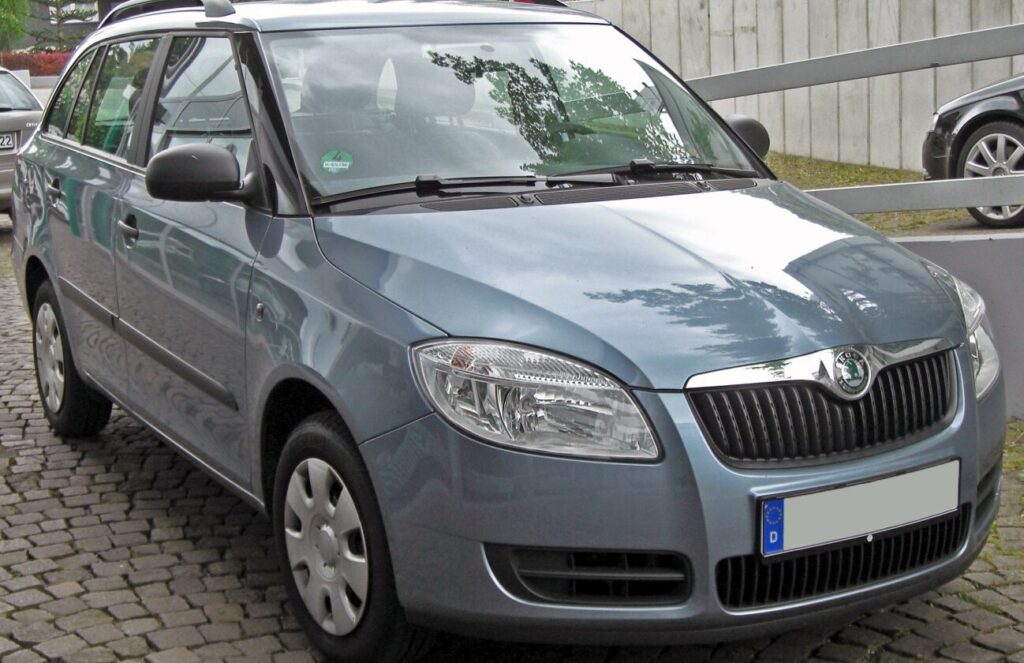
The Skoda Fabia II Combi 1.4 TDI (70 hp) was a practical and economical station wagon produced between 2007 and 2010. Positioned as an entry-level offering within the Fabia Combi range, it catered to buyers prioritizing fuel efficiency and affordability over outright performance. This variant was built on the Volkswagen Group’s A5 (1HX0/A3) platform, shared with models like the Volkswagen Polo and SEAT Ibiza, and represented Skoda’s continued expansion into Western European markets with a focus on value-for-money vehicles. The Combi body style, or estate as it’s known in some regions, offered significantly increased cargo capacity compared to the hatchback version, making it a popular choice for families and those needing versatile transportation.
Technical Specifications
| Brand | Skoda |
| Model | Fabia |
| Generation | Fabia II Combi |
| Type (Engine) | 1.4 TDI (70 Hp) |
| Start of production | 2007 |
| End of production | 2010 |
| Powertrain Architecture | Internal Combustion engine |
| Body type | Station wagon (estate) |
| Seats | 5 |
| Doors | 5 |
| Fuel consumption (urban) | 6 l/100 km (39.2 US mpg, 47.1 UK mpg, 16.7 km/l) |
| Fuel consumption (extra urban) | 4.2 l/100 km (56 US mpg, 67.3 UK mpg, 23.8 km/l) |
| Fuel consumption (combined) | 4.8 l/100 km (49 US mpg, 58.9 UK mpg, 20.8 km/l) |
| Fuel Type | Diesel |
| Acceleration 0 – 100 km/h | 15.4 sec |
| Acceleration 0 – 62 mph | 15.4 sec |
| Acceleration 0 – 60 mph | 14.6 sec |
| Maximum speed | 164 km/h (101.9 mph) |
| Emission standard | Euro 4 |
| Weight-to-power ratio | 17.4 kg/Hp, 57.4 Hp/tonne |
| Weight-to-torque ratio | 7.9 kg/Nm, 127 Nm/tonne |
| Power | 70 Hp @ 4000 rpm |
| Power per litre | 49.2 Hp/l |
| Torque | 155 Nm @ 1600-2800 rpm (114.32 lb.-ft. @ 1600-2800 rpm) |
| Engine layout | Front, Transverse |
| Engine Model/Code | EA188 / BNM |
| Engine displacement | 1422 cm3 (86.78 cu. in.) |
| Number of cylinders | 3 |
| Engine configuration | Inline |
| Cylinder Bore | 79.5 mm (3.13 in.) |
| Piston Stroke | 95.5 mm (3.76 in.) |
| Compression ratio | 19.5:1 |
| Number of valves per cylinder | 2 |
| Fuel injection system | Pump-nozzle (Unit Injector) |
| Engine aspiration | Turbocharger, Intercooler |
| Engine oil capacity | 3.8 l (4.02 US qt | 3.34 UK qt) |
| Coolant | 5.5 l (5.81 US qt | 4.84 UK qt) |
| Kerb Weight | 1220 kg (2689.64 lbs.) |
| Max. weight | 1660 kg (3659.67 lbs.) |
| Max load | 440 kg (970.03 lbs.) |
| Trunk (boot) space – minimum | 480 l (16.95 cu. ft.) |
| Trunk (boot) space – maximum | 1226 l (43.3 cu. ft.) |
| Fuel tank capacity | 45 l (11.89 US gal | 9.9 UK gal) |
| Length | 4239 mm (166.89 in.) |
| Width | 1642 mm (64.65 in.) |
| Height | 1498 mm (58.98 in.) |
| Wheelbase | 2462 mm (96.93 in.) |
| Front track | 1435 mm (56.5 in.) |
| Rear (Back) track | 1424 mm (56.06 in.) |
| Drivetrain Architecture | The Internal combustion engine (ICE) drives the front wheels of the vehicle. |
| Drive wheel | Front wheel drive |
| Number of gears and type of gearbox | 5 gears, manual transmission |
| Front suspension | Coil spring |
| Rear suspension | Coil spring |
| Front brakes | Disc |
| Rear brakes | Drum |
| Assisting systems | ABS (Anti-lock braking system) |
| Steering type | Steering rack and pinion |
| Tires size | 165/70 R14; 195/55 R15 |
Powertrain & Engine Architecture
The heart of the Fabia II Combi 1.4 TDI was the EA188 series engine, specifically the BNM code. This was a 1.4-liter, three-cylinder diesel engine featuring a turbocharger and intercooler. The BNM utilized a pump-nozzle (unit injector) fuel injection system, a technology known for its precision and efficiency, though it could be more susceptible to contamination from poor fuel quality than common-rail systems. The engine produced 70 horsepower at 4000 rpm and 155 Nm (114 lb-ft) of torque between 1600 and 2800 rpm. The five-speed manual transmission was the standard offering, chosen for its simplicity and contribution to fuel economy. The engine’s inline-three configuration, while compact, inherently produced some vibration, which was mitigated by engine mounts and balancing shafts.
Driving Characteristics
The 1.4 TDI 70 hp engine in the Fabia Combi delivered modest performance. Acceleration was leisurely, taking approximately 15.4 seconds to reach 62 mph (100 km/h). The focus was clearly on fuel economy rather than spirited driving. The turbocharger helped to provide a usable amount of torque at lower engine speeds, making it adequate for everyday driving and highway cruising, though overtaking required careful planning. The five-speed manual transmission was well-matched to the engine’s characteristics, with gear ratios optimized for efficiency. Compared to higher-output versions of the Fabia, such as those equipped with the 1.9 TDI or 2.0 TDI engines, this variant felt significantly slower, but it offered a more economical and affordable option.
Equipment & Trim Levels
The 1.4 TDI 70 hp Fabia Combi typically came with a basic level of equipment. Standard features generally included power steering, central locking, electric front windows, and an ABS anti-lock braking system. Interior upholstery was typically cloth, and the dashboard featured a functional, if somewhat basic, design. Optional extras included air conditioning, alloy wheels, a radio/CD player, and parking sensors. Trim levels varied slightly depending on the market, but the 1.4 TDI was generally positioned as the entry-level Combi, appealing to budget-conscious buyers.
Chassis & Braking
The Fabia II Combi’s chassis featured a simple yet effective suspension setup. Both the front and rear axles utilized coil springs and dampers. The front suspension employed independent MacPherson struts, while the rear used a torsion beam axle. Braking was handled by disc brakes on the front wheels and drum brakes on the rear. This configuration was typical for vehicles in this weight class and provided adequate stopping power for everyday driving. Stabilizer bars were fitted to both axles to reduce body roll during cornering.
Market Reception & Comparison
The Skoda Fabia II Combi 1.4 TDI was well-received in markets where fuel efficiency and affordability were key considerations. Critics praised its spacious interior, practical estate car body style, and low running costs. However, the engine’s lack of outright power was often noted. Compared to other trims in the Fabia lineup, the 1.4 TDI offered the lowest purchase price and the best fuel economy, but at the expense of performance. It competed with other small diesel estate cars, such as the Volkswagen Polo Estate and SEAT Ibiza ST, offering a compelling value proposition.
Legacy
The 1.4 TDI engine, while not known for being particularly exciting, proved to be relatively reliable when properly maintained. The pump-nozzle injection system required regular servicing and the use of high-quality diesel fuel to prevent issues. Today, the Fabia II Combi 1.4 TDI can be found on the used car market at very affordable prices. Its simplicity and fuel efficiency continue to appeal to buyers seeking a practical and economical vehicle. While not a collector’s item, it represents a solid and dependable choice for those needing a spacious and economical estate car.