Technical Specifications
| Brand | Skoda |
| Model | Fabia |
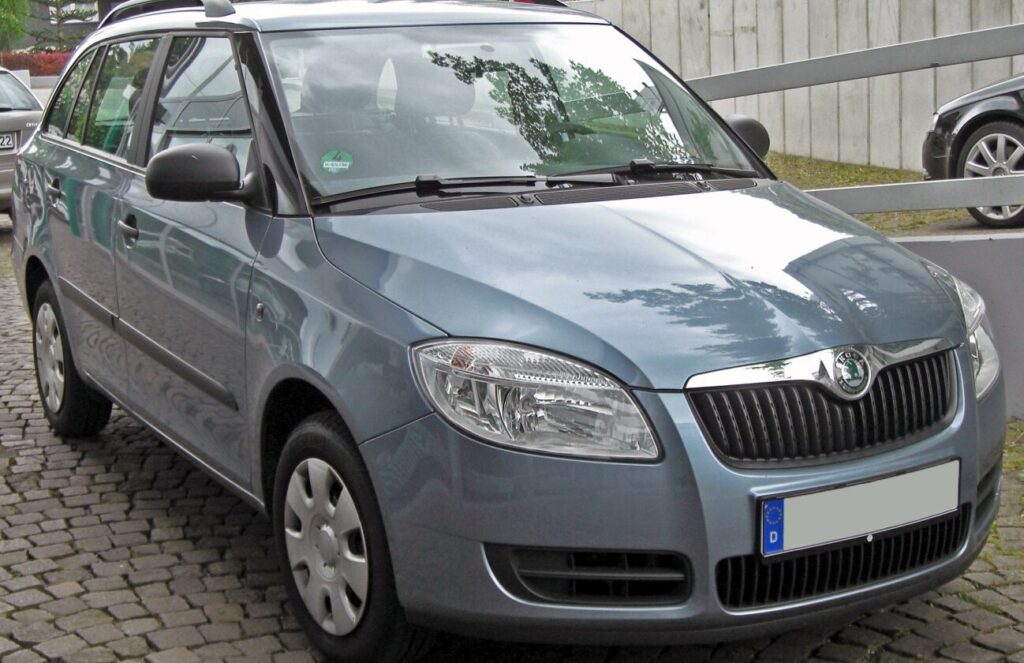
| Generation | Fabia II Combi |
| Type (Engine) | 1.4 TDI (80 Hp) |
| Start of production | January, 2007 |
| End of production | March, 2010 |
| Powertrain Architecture | Internal Combustion engine |
| Body type | Station wagon (estate) |
| Seats | 5 |
| Doors | 5 |
| Fuel consumption (urban) | 5.7 l/100 km (41.3 US mpg, 49.6 UK mpg, 17.5 km/l) |
| Fuel consumption (extra urban) | 4 l/100 km (58.8 US mpg, 70.6 UK mpg, 25 km/l) |
| Fuel consumption (combined) | 4.6 l/100 km (51.1 US mpg, 61.4 UK mpg, 21.7 km/l) |
| Fuel Type | Diesel |
| Acceleration 0 – 100 km/h | 13.7 sec |
| Acceleration 0 – 62 mph | 13.7 sec |
| Acceleration 0 – 60 mph | 13 sec |
| Maximum speed | 173 km/h (107.5 mph) |
| Emission standard | Euro 4 |
| Weight-to-power ratio | 15.3 kg/Hp, 65.3 Hp/tonne |
| Weight-to-torque ratio | 6.3 kg/Nm, 159.2 Nm/tonne |
| Power | 80 Hp @ 4000 rpm |
| Power per litre | 56.3 Hp/l |
| Torque | 195 Nm @ 2200 rpm (143.82 lb.-ft. @ 2200 rpm) |
| Engine layout | Front, Transverse |
| Engine Model/Code | EA188 / BNV |
| Engine displacement | 1422 cm3 (86.78 cu. in.) |
| Number of cylinders | 3 |
| Engine configuration | Inline |
| Cylinder Bore | 79.5 mm (3.13 in.) |
| Piston Stroke | 95.5 mm (3.76 in.) |
| Compression ratio | 19.5:1 |
| Number of valves per cylinder | 2 |
| Fuel injection system | Pump-nozzle (Unit Injector) |
| Engine aspiration | Turbocharger, Intercooler |
| Engine oil capacity | 4.2 l (4.44 US qt | 3.7 UK qt) |
| Coolant | 5.5 l (5.81 US qt | 4.84 UK qt) |
| Kerb Weight | 1225 kg (2700.66 lbs.) |
| Max. weight | 1665 kg (3670.7 lbs.) |
| Max load | 440 kg (970.03 lbs.) |
| Trunk (boot) space – minimum | 480 l (16.95 cu. ft.) |
| Trunk (boot) space – maximum | 1226 l (43.3 cu. ft.) |
| Fuel tank capacity | 45 l (11.89 US gal | 9.9 UK gal) |
| Length | 4239 mm (166.89 in.) |
| Width | 1642 mm (64.65 in.) |
| Height | 1498 mm (58.98 in.) |
| Wheelbase | 2462 mm (96.93 in.) |
| Front track | 1435 mm (56.5 in.) |
| Rear (Back) track | 1424 mm (56.06 in.) |
| Drivetrain Architecture | The Internal combustion engine (ICE) drives the front wheels of the vehicle. |
| Drive wheel | Front wheel drive |
| Number of gears and type of gearbox | 5 gears, manual transmission |
| Front suspension | Coil spring |
| Rear suspension | Coil spring |
| Front brakes | Disc |
| Rear brakes | Drum |
| Assisting systems | ABS (Anti-lock braking system) |
| Steering type | Steering rack and pinion |
| Tires size | 165/70 R14; 195/55 R15 |
The Skoda Fabia II Combi 1.4 TDI (80 hp) debuted in 2007 as part of the Fabia II series, a significant step forward for Skoda in terms of build quality and design. The Combi, or estate, version offered increased cargo capacity compared to the hatchback, making it a popular choice for families and those requiring more practical load-lugging capabilities. This particular variant, powered by the 1.4-liter three-cylinder diesel engine, represented the entry point into the Fabia Combi range, prioritizing fuel efficiency and affordability over outright performance. It was a key model in Skoda’s strategy to gain market share in Europe by offering value-for-money vehicles.
Powertrain & Engine Architecture
At the heart of the Fabia II Combi 1.4 TDI was the EA188 engine family, specifically the BNV code. This 1.4-liter, three-cylinder diesel engine utilized pump-nozzle (unit injector) technology for direct fuel injection, a system known for its precision and efficiency. The engine featured a turbocharger with an intercooler to boost power output and improve combustion. The engine produced 80 horsepower at 4000 rpm and 195 Nm (143.82 lb-ft) of torque at 2200 rpm. The engine’s inline-three configuration, while compact, resulted in inherent vibrations which were mitigated by engine mounts and balancing shafts. The engine’s 19.5:1 compression ratio was typical for a diesel engine, contributing to its thermal efficiency. A 5-speed manual transmission was the only gearbox option available with this engine, chosen for its simplicity and contribution to fuel economy.
Driving Characteristics
The 1.4 TDI 80 hp engine in the Fabia Combi delivered adequate, but not exhilarating, performance. Acceleration from 0 to 100 km/h (0-62 mph) took approximately 13.7 seconds, and top speed was around 173 km/h (107.5 mph). The engine’s torque peak at 2200 rpm provided reasonable pulling power for everyday driving, but overtaking maneuvers required careful planning. Compared to the more powerful 1.9 TDI variants, the 1.4 TDI felt noticeably slower, particularly when fully loaded. The manual transmission’s gear ratios were geared towards fuel efficiency, with taller gearing in higher gears. The driving experience was generally comfortable, but the three-cylinder engine’s inherent vibrations were noticeable, especially at idle. The Combi’s suspension provided a decent ride quality, although it could feel somewhat unsettled on rough roads.
Equipment & Trim Levels
The 1.4 TDI Combi typically came with a modest level of standard equipment. Basic features included central locking, power steering, front airbags, and an ABS anti-lock braking system. Interior upholstery was typically cloth, and the dashboard featured a functional, if somewhat basic, design. Optional extras included air conditioning, alloy wheels, a radio/CD player, and electric windows. Higher trim levels, such as the ‘Elegance’ or ‘Sport’ offered additional features like climate control, upgraded upholstery, and more sophisticated audio systems. The focus of this trim level was practicality and affordability, so luxury features were often kept to a minimum or offered as optional upgrades.
Chassis & Braking
The Fabia II Combi 1.4 TDI utilized a front-wheel-drive layout with a MacPherson strut front suspension and a twist-beam rear suspension. The front brakes were ventilated discs, while the rear brakes were drums. This configuration was typical for vehicles in this weight class and price range. The steering was a rack-and-pinion system, providing reasonably precise control. Stabilizer bars were fitted to both the front and rear axles to reduce body roll during cornering. Tire sizes typically ranged from 165/70 R14 to 195/55 R15, depending on the trim level.
Market Reception & Comparison
The Skoda Fabia II Combi 1.4 TDI was generally well-received by automotive critics as a practical and economical estate car. Its fuel efficiency was a major selling point, with combined fuel consumption figures of around 4.6 l/100 km (51.1 US mpg). Compared to the more powerful diesel variants, the 1.4 TDI offered lower running costs but sacrificed performance. It was often seen as a sensible choice for budget-conscious buyers who prioritized fuel economy and practicality over driving excitement. Compared to competitors like the Ford Focus Estate or Volkswagen Golf Estate, the Fabia Combi offered a more affordable price point, although it lacked some of the refinement and features of those models.
Legacy
The 1.4 TDI engine, while generally reliable, could be prone to issues with the turbocharger and fuel injectors if not properly maintained. The pump-nozzle injection system required regular servicing to ensure optimal performance. Today, the Fabia II Combi 1.4 TDI can be found on the used car market at very affordable prices. Its fuel efficiency and practicality continue to make it an attractive option for those seeking a budget-friendly estate car. However, potential buyers should be aware of the potential maintenance costs associated with the diesel engine and ensure that the vehicle has been well-maintained throughout its life. The model remains a testament to Skoda’s ability to deliver value-for-money vehicles that offer a compelling combination of practicality, economy, and reliability.