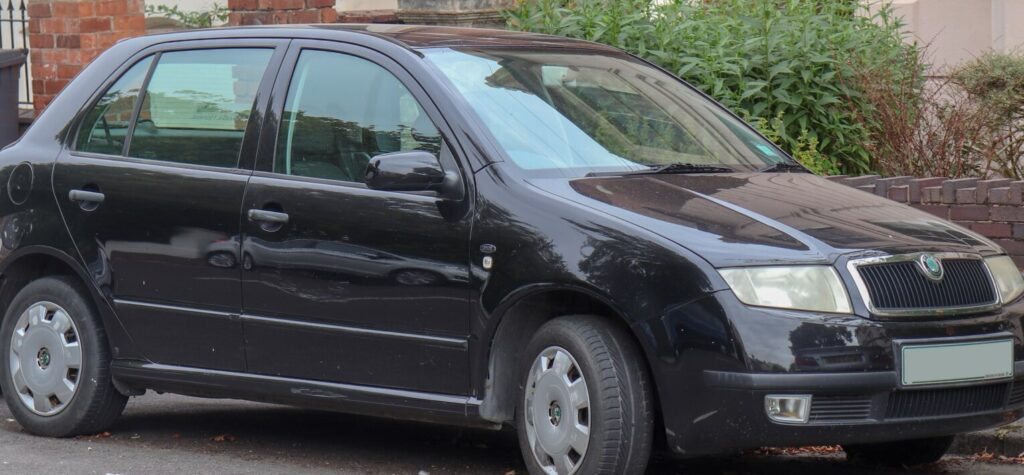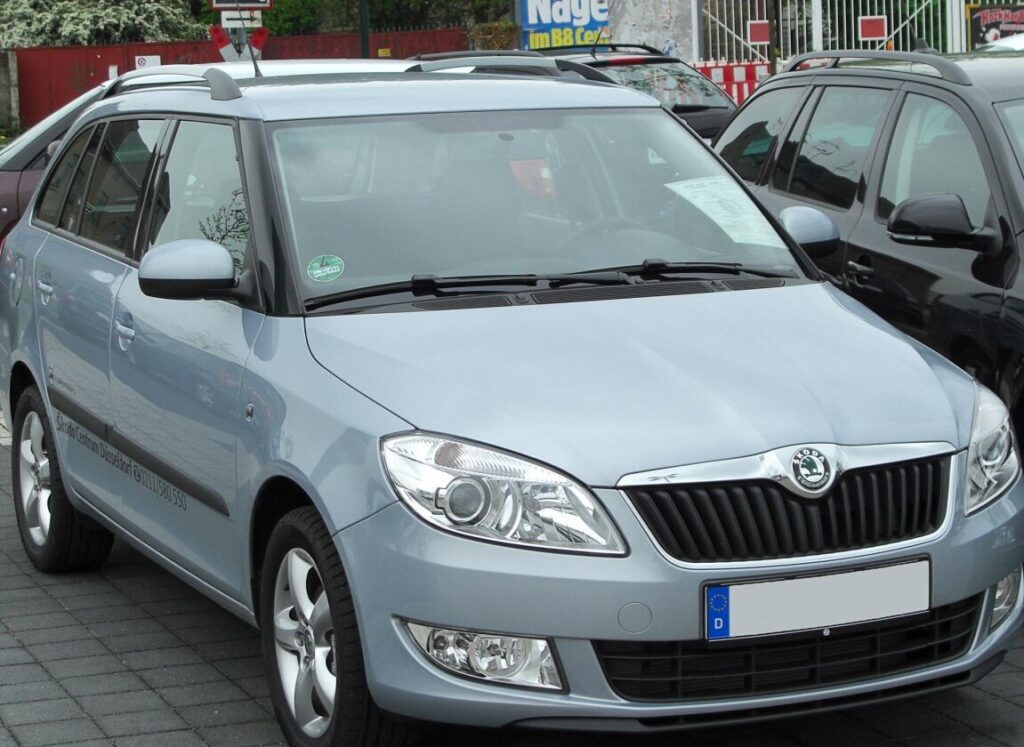
The Skoda Fabia II Combi (facelift, produced from November 2011 to 2014) 1.2 MPI 60 hp variant represents an entry-level offering within the second generation Fabia Combi (estate) lineup. Positioned as the most economical and accessible version of the practical wagon, it catered to buyers prioritizing fuel efficiency and low running costs over outright performance. This model was primarily sold in European markets, where smaller displacement engines and estate body styles are highly popular. It built upon the foundation of the Fabia II, which itself was based on the Volkswagen Group’s PQ24 platform (also known as the A4 platform), shared with models like the Volkswagen Polo and SEAT Ibiza.
Technical Specifications
| Brand | Skoda |
| Model | Fabia |
| Generation | Fabia II Combi (facelift 2010) |
| Type (Engine) | 1.2 MPI (60 Hp) |
| Start of production | November, 2011 |
| End of production | 2014 |
| Powertrain Architecture | Internal Combustion engine |
| Body type | Station wagon (estate) |
| Seats | 5 |
| Doors | 5 |
| Fuel consumption (urban) | 7.3-7.5 l/100 km (32.2 – 31.4 US mpg) |
| Fuel consumption (extra urban) | 4.5-4.7 l/100 km (52.3 – 50 US mpg) |
| Fuel consumption (combined) | 5.5-5.7 l/100 km (42.8 – 41.3 US mpg) |
| CO2 emissions | 128-132 g/km |
| Fuel Type | Petrol (Gasoline) |
| Acceleration 0 – 100 km/h | 16.7 sec |
| Acceleration 0 – 62 mph | 16.7 sec |
| Acceleration 0 – 60 mph | 15.9 sec |
| Maximum speed | 156 km/h (96.93 mph) |
| Emission standard | Euro 5 |
| Weight-to-power ratio | 17.3 kg/Hp |
| Weight-to-torque ratio | 9.6 kg/Nm |
| Power | 60 Hp @ 5200 rpm |
| Torque | 108 Nm @ 3000 rpm (79.66 lb.-ft. @ 3000 rpm) |
| Engine layout | Front, Transverse |
| Engine Model/Code | EA111 / CGPB |
| Engine displacement | 1198 cm3 (73.11 cu. in.) |
| Number of cylinders | 3 |
| Engine configuration | Inline |
| Cylinder Bore | 76.5 mm (3.01 in.) |
| Piston Stroke | 86.9 mm (3.42 in.) |
| Compression ratio | 10.5:1 |
| Number of valves per cylinder | 4 |
| Fuel injection system | Multi-port manifold injection |
| Engine aspiration | Naturally aspirated |
| Valvetrain | DOHC |
| Engine oil capacity | 2.8 l (2.96 US qt | 2.46 UK qt) |
| Coolant capacity | 5.5 l (5.81 US qt | 4.84 UK qt) |
| Kerb Weight | 1035-1040 kg (2281.78 – 2292.81 lbs.) |
| Max. weight | 1565-1570 kg (3450.23 – 3461.26 lbs.) |
| Max load | 530 kg (1168.45 lbs.) |
| Trunk (boot) space – minimum | 505 l (17.83 cu. ft.) |
| Trunk (boot) space – maximum | 1485 l (52.44 cu. ft.) |
| Fuel tank capacity | 45 l (11.89 US gal | 9.9 UK gal) |
| Max. roof load | 75 kg (165.35 lbs.) |
| Permitted trailer load (braked) | 800 kg (1763.7 lbs.) |
| Permitted trailer load (unbraked) | 450 kg (992.08 lbs.) |
| Permitted towbar download | 50 kg (110.23 lbs.) |
| Length | 4247 mm (167.2 in.) |
| Width | 1642 mm (64.65 in.) |
| Width including mirrors | 1886 mm (74.25 in.) |
| Height | 1498 mm (58.98 in.) |
| Wheelbase | 2465 mm (97.05 in.) |
| Front track | 1433 mm (56.42 in.) |
| Rear track | 1426 mm (56.14 in.) |
| Front overhang | 860 mm (33.86 in.) |
| Rear overhang | 922 mm (36.3 in.) |
| Ride height (ground clearance) | 135 mm (5.31 in.) |
| Drag coefficient (Cd) | 0.31 |
| Minimum turning circle | 10 m (32.81 ft.) |
| Front suspension | Independent, McPherson with coil spring and anti-roll bar |
| Rear suspension | Coil spring, Torsion |
| Front brakes | Ventilated discs |
| Rear brakes | Drum |
| Assisting systems | ABS (Anti-lock braking system) |
| Steering type | Steering rack and pinion |
| Power steering | Electric |
| Tires size | 165/70 R14; 185/60 R14; 195/55 R15 |
| Wheel rims size | 5J x 14; 6J x 14; 6J x 15 |
Powertrain & Engine Architecture
The 1.2 MPI engine, specifically the CGPB code, is a naturally aspirated, three-cylinder petrol engine. This engine belongs to the EA111 family, a widely used engine series within the Volkswagen Group. It features multi-point fuel injection and a double overhead camshaft (DOHC) valvetrain. The three-cylinder configuration inherently results in a slightly unbalanced engine, which is mitigated through the use of balance shafts. The engine’s relatively small displacement and modest output were designed for maximizing fuel economy rather than providing spirited performance. The engine paired with a five-speed manual transmission was the standard offering, but a six-speed automatic transmission was also available, though less common. The automatic transmission was a conventional torque converter type, prioritizing smooth shifts and ease of use over outright efficiency.
Driving Characteristics
The 60 hp 1.2 MPI engine in the Fabia Combi delivered modest performance. Acceleration was slow, with a 0-60 mph time of around 15.9 seconds. In real-world driving, this meant that overtaking required careful planning and the engine felt strained when fully loaded or climbing hills. The automatic transmission, while providing convenience, further diminished acceleration due to its less efficient power transfer compared to a manual gearbox. Gear ratios were optimized for fuel economy, resulting in a relatively high final drive ratio. The focus was on providing adequate power for everyday commuting and urban driving, rather than sporty handling or quick acceleration.
Equipment & Trim Levels
The 1.2 MPI variant typically represented the base trim level of the Fabia Combi. Standard equipment generally included power steering, ABS, front airbags, and basic audio system. Interior upholstery was typically cloth, and the dashboard featured a functional but basic design. Optional extras included air conditioning, alloy wheels, electric windows, and a more advanced audio system. Higher trim levels, such as the Elegance or Sport, offered more luxurious features and styling enhancements, but at a higher price point.
Chassis & Braking
The Fabia Combi’s chassis featured independent McPherson strut suspension at the front and a torsion beam rear suspension. This setup provided a reasonable balance between ride comfort and handling. The front brakes were ventilated discs, while the rear brakes were drums, a cost-saving measure common in entry-level models. Stabilizer bars were typically fitted to both the front and rear axles to reduce body roll during cornering. The suspension tuning was geared towards comfort, prioritizing a smooth ride over sporty handling.
Market Reception & Comparison
The 1.2 MPI Fabia Combi was generally well-received by critics as a practical and economical family car. However, its performance was often criticized as being underpowered, particularly when compared to higher-output versions of the Fabia, such as the 1.4 TSI or 1.6 TDI. The 1.4 TSI offered significantly more power and torque, resulting in much brisker acceleration and improved drivability. The 1.6 TDI, while also offering more performance, was praised for its even better fuel economy. The 1.2 MPI’s main advantage was its lower purchase price and running costs, making it an attractive option for budget-conscious buyers.
Legacy
The 1.2 MPI engine, while not known for its performance, proved to be relatively reliable. Common issues included occasional problems with the fuel injectors and the ignition system. The automatic transmission, if properly maintained, also proved to be durable. Today, the 1.2 MPI Fabia Combi can be found on the used car market at very affordable prices. It remains a practical and economical option for those seeking a no-frills estate car for everyday use. However, potential buyers should be aware of its limited performance and ensure that the vehicle has been well-maintained.