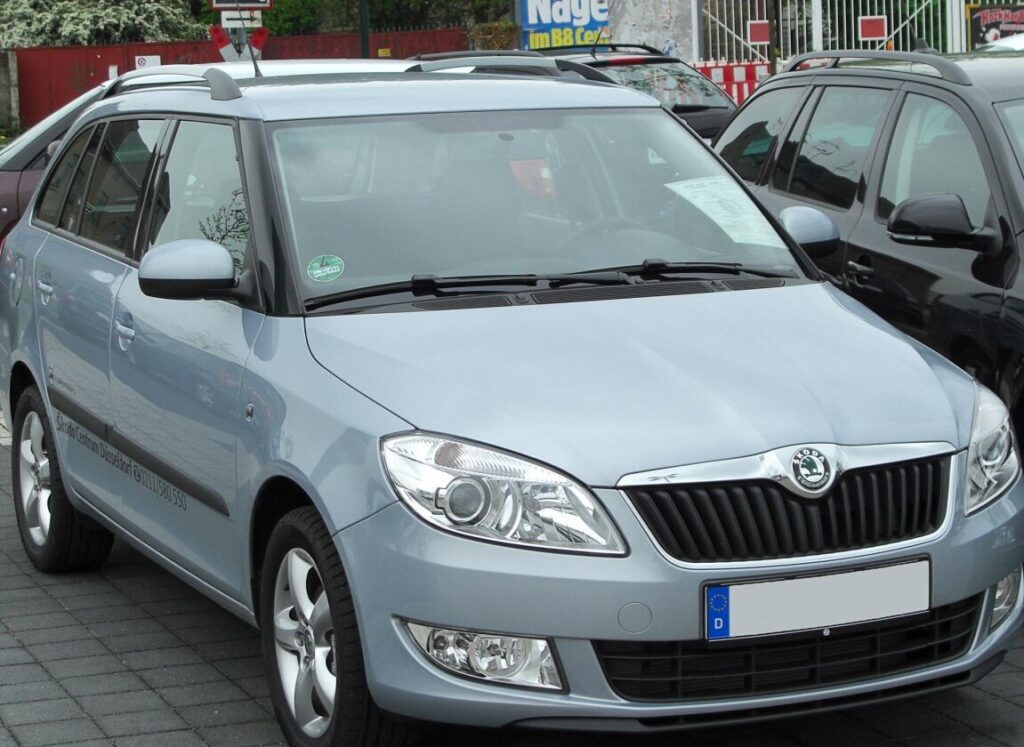
The Skoda Fabia II Combi (facelift, produced from September 2010 to August 2013) 1.2 TDI 75 hp represents an entry-level offering within the second generation Fabia Combi (estate) range. Positioned as a fuel-efficient and practical option, this variant catered to buyers prioritizing economy and space over outright performance. It was a key model for Skoda in the European market, where compact estates were – and continue to be – highly popular. The facelift brought styling updates and refinements to the Fabia II, enhancing its appeal and competitiveness.
Technical Specifications
| Brand | Skoda |
| Model | Fabia |
| Generation | Fabia II Combi (facelift 2010) |
| Type (Engine) | 1.2 TDI (75 Hp) |
| Start of production | September, 2010 |
| End of production | August, 2013 |
| Powertrain Architecture | Internal Combustion engine |
| Body type | Station wagon (estate) |
| Seats | 5 |
| Doors | 5 |
| Fuel consumption (urban) | 4.8 l/100 km (49 US mpg, 58.9 UK mpg, 20.8 km/l) |
| Fuel consumption (extra urban) | 3.3 l/100 km (71.3 US mpg, 85.6 UK mpg, 30.3 km/l) |
| Fuel consumption (combined) | 3.8 l/100 km (61.9 US mpg, 74.3 UK mpg, 26.3 km/l) |
| CO2 emissions | 99 g/km |
| Fuel Type | Diesel |
| Acceleration 0 – 100 km/h | 14.3 sec |
| Acceleration 0 – 62 mph | 14.3 sec |
| Acceleration 0 – 60 mph | 13.6 sec |
| Maximum speed | 167 km/h (103.77 mph) |
| Emission standard | Euro 5 |
| Weight-to-power ratio | 16.1 kg/Hp |
| Weight-to-torque ratio | 6.7 kg/Nm |
| Power | 75 Hp @ 4200 rpm |
| Torque | 180 Nm @ 2000 rpm (132.76 lb.-ft. @ 2000 rpm) |
| Engine layout | Front, Transverse |
| Engine Model/Code | EA189 / CFWA |
| Engine displacement | 1199 cm3 (73.17 cu. in.) |
| Number of cylinders | 3 |
| Engine configuration | Inline |
| Cylinder Bore | 79.5 mm (3.13 in.) |
| Piston Stroke | 80.5 mm (3.17 in.) |
| Compression ratio | 16.5:1 |
| Number of valves per cylinder | 4 |
| Fuel injection system | Diesel Commonrail |
| Engine aspiration | Turbocharger, Intercooler |
| Valvetrain | DOHC |
| Engine oil capacity | 4.3 l (4.54 US qt | 3.78 UK qt) |
| Coolant capacity | 6.6 l (6.97 US qt | 5.81 UK qt) |
| Kerb Weight | 1209 kg (2665.39 lbs.) |
| Max. weight | 1664 kg (3668.49 lbs.) |
| Max load | 455 kg (1003.1 lbs.) |
| Trunk (boot) space – minimum | 505 l (17.83 cu. ft.) |
| Trunk (boot) space – maximum | 1485 l (52.44 cu. ft.) |
| Fuel tank capacity | 45 l (11.89 US gal | 9.9 UK gal) |
| Max. roof load | 75 kg (165.35 lbs.) |
| Permitted trailer load (braked) | 1000 kg (2204.62 lbs.) |
| Permitted trailer load (unbraked) | 450 kg (992.08 lbs.) |
| Permitted towbar download | 50 kg (110.23 lbs.) |
| Length | 4247 mm (167.2 in.) |
| Width | 1642 mm (64.65 in.) |
| Width including mirrors | 1886 mm (74.25 in.) |
| Height | 1498 mm (58.98 in.) |
| Wheelbase | 2465 mm (97.05 in.) |
| Front track | 1433 mm (56.42 in.) |
| Rear track | 1426 mm (56.14 in.) |
| Ride height (ground clearance) | 135 mm (5.31 in.) |
| Drag coefficient (Cd) | 0.31 |
| Minimum turning circle | 10 m (32.81 ft.) |
| Front suspension | Independent, McPherson with coil spring and anti-roll bar |
| Rear suspension | Coil spring, Torsion |
| Front brakes | Ventilated discs |
| Rear brakes | Disc |
| Steering type | Steering rack and pinion |
| Power steering | Electric |
| Tires size | 165/70 R14; 185/60 R14; 195/55 R15 |
| Wheel rims size | 5J x 14; 6J x 14; 6J x 15 |
INTRODUCTION
The Skoda Fabia II Combi 1.2 TDI 75 hp, introduced with the 2010 facelift, was a practical and economical estate car designed for the European market. Built on the Volkswagen Group’s PQ35 platform (also known as the 1HX0/A3 platform), it offered a larger cargo capacity than the hatchback version while maintaining a relatively compact footprint. This variant aimed to provide a cost-effective entry point into the Fabia Combi range, appealing to families and individuals needing versatile transportation without a high purchase price or running costs.
Powertrain & Engine Architecture
At the heart of this Fabia Combi variant lies the EA189 series 1.2-liter three-cylinder turbocharged diesel engine, specifically the CFWA code. This engine utilizes a common rail direct injection system, delivering fuel at high pressure directly into the combustion chamber for improved efficiency and reduced emissions. The engine features a single overhead camshaft (SOHC) operating four valves per cylinder (DOHC). The turbocharger, coupled with an intercooler, helps to boost power output and improve torque across a wider rev range. The engine’s 16.5:1 compression ratio is typical for a diesel engine, contributing to its thermal efficiency. The engine is transversely mounted at the front of the vehicle. The 5-speed manual transmission was standard, designed to maximize fuel economy and provide adequate performance for everyday driving.
Driving Characteristics
The 75 hp output and 180 Nm (132.76 lb-ft) of torque, while not exhilarating, provided sufficient power for typical commuting and highway driving, especially considering the relatively light weight of the vehicle. Acceleration from 0-60 mph took around 13.6 seconds, and top speed was approximately 103.77 mph. The 5-speed gearbox was geared for economy, meaning higher gears were engaged at lower speeds. This resulted in a relaxed cruising experience but required more frequent downshifts when overtaking or climbing hills. Compared to higher-output versions of the Fabia II Combi, such as those with the 1.6 TDI or petrol engines, this 1.2 TDI felt noticeably slower. However, its strength lay in its fuel efficiency and low running costs.
Equipment & Trim Levels
The 1.2 TDI 75 hp Fabia Combi typically came with a modest level of standard equipment. This included central locking, electric front windows, a basic audio system, and ABS brakes. Interior upholstery was typically cloth, and the dashboard featured a functional, if somewhat basic, design. Optional extras included air conditioning, alloy wheels, parking sensors, and an upgraded audio system. Trim levels varied slightly depending on the market, but generally, this variant represented the entry-level option, with more luxurious trims offering additional features and cosmetic enhancements.
Chassis & Braking
The Fabia II Combi’s chassis featured independent McPherson strut suspension at the front and a torsion beam setup at the rear. This configuration provided a reasonable balance between ride comfort and handling. The front brakes were ventilated discs, while the rear brakes were solid discs. ABS (Anti-lock Braking System) was standard, enhancing safety during emergency braking. The suspension was tuned for comfort, prioritizing a smooth ride over sporty handling. Stabilizer bars were fitted to both the front and rear axles to reduce body roll during cornering.
Market Reception & Comparison
The Skoda Fabia II Combi 1.2 TDI 75 hp was generally well-received by critics for its fuel efficiency and practicality. It was praised for its spacious interior and large cargo area, making it a suitable choice for families. However, some reviewers noted its lack of outright performance and somewhat basic interior. Compared to other trims in the Fabia Combi lineup, such as the 1.6 TDI, this variant offered significantly better fuel economy but at the expense of performance. It also represented a more affordable option, making it attractive to budget-conscious buyers. Against competitors like the Ford Focus Estate and Vauxhall Astra Estate, the Fabia Combi offered a compelling combination of value, space, and economy.
Legacy
The 1.2 TDI engine, while generally reliable, has been known to exhibit issues with diesel particulate filter (DPF) clogging, particularly on vehicles used primarily for short journeys. Regular servicing and the use of quality diesel fuel are crucial for maintaining the longevity of this powertrain. Today, the Skoda Fabia II Combi 1.2 TDI 75 hp remains a relatively affordable and practical used car option. Its fuel efficiency and spaciousness continue to appeal to buyers seeking an economical and versatile estate car. However, potential buyers should be aware of the potential DPF issues and ensure the vehicle has been well-maintained.