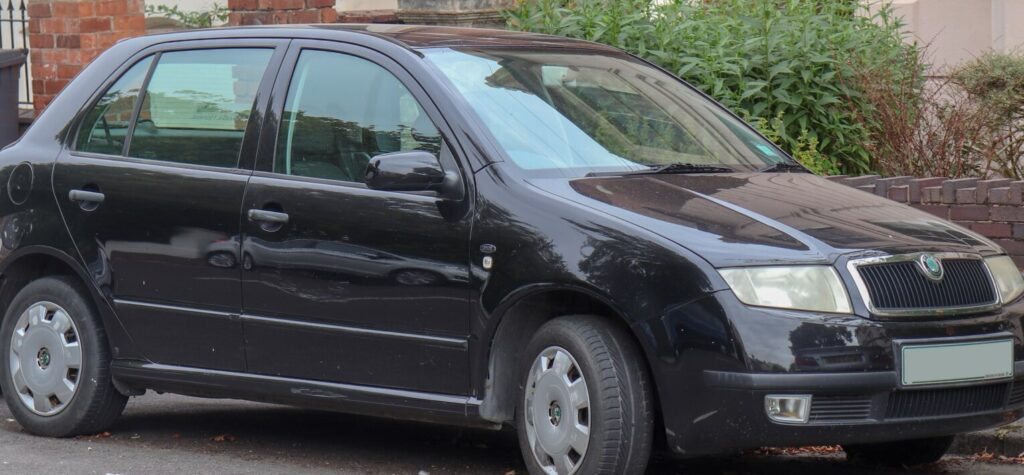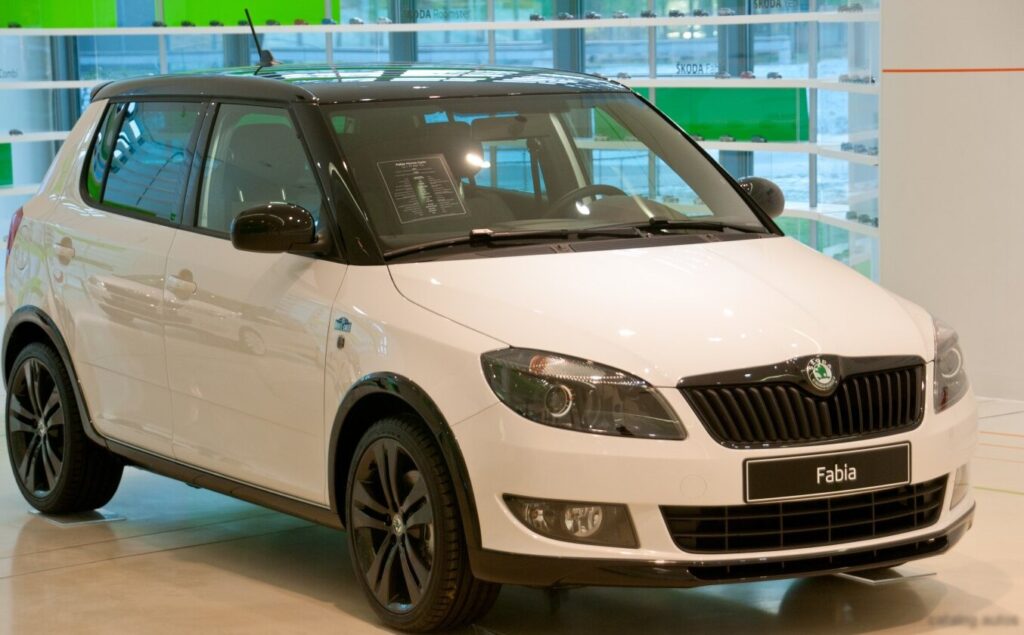
The Skoda Fabia II (facelift, introduced in March 2010) 1.6 TDI 105 hp represents a significant iteration within the second generation of Skoda’s popular supermini. Produced through 2014, this variant occupied a crucial position in the Fabia lineup, offering a balance between fuel efficiency, reasonable performance, and affordability. It was primarily aimed at the European market, where demand for economical diesel hatchbacks was high. The facelift brought styling updates and revised engine options, solidifying the Fabia’s appeal as a practical and value-oriented choice.
Technical Specifications
| Brand | Skoda |
| Model | Fabia |
| Generation | Fabia II (facelift 2010) |
| Type (Engine) | 1.6 TDI (105 Hp) |
| Start of production | March, 2010 |
| End of production | 2014 |
| Powertrain Architecture | Internal Combustion engine |
| Body type | Hatchback |
| Seats | 5 |
| Doors | 5 |
| Fuel consumption (urban) | 5.1 l/100 km (46.1 US mpg, 55.4 UK mpg, 19.6 km/l) |
| Fuel consumption (extra urban) | 3.6 l/100 km (65.3 US mpg, 78.5 UK mpg, 27.8 km/l) |
| Fuel consumption (combined) | 4.2 l/100 km (56 US mpg, 67.3 UK mpg, 23.8 km/l) |
| CO2 emissions | 109 g/km |
| Fuel Type | Diesel |
| Acceleration 0 – 100 km/h | 10.9 sec |
| Acceleration 0 – 62 mph | 10.9 sec |
| Acceleration 0 – 60 mph | 10.4 sec |
| Maximum speed | 188 km/h (116.82 mph) |
| Emission standard | Euro 5 |
| Weight-to-power ratio | 10.9 kg/Hp, 91.8 Hp/tonne |
| Weight-to-torque ratio | 4.6 kg/Nm, 218.5 Nm/tonne |
| Power | 105 Hp @ 4400 rpm |
| Power per litre | 65.7 Hp/l |
| Torque | 250 Nm @ 1500-2500 rpm (184.39 lb.-ft. @ 1500-2500 rpm) |
| Engine layout | Front, Transverse |
| Engine Model/Code | EA189 / CAYC |
| Engine displacement | 1598 cm3 (97.52 cu. in.) |
| Number of cylinders | 4 |
| Engine configuration | Inline |
| Cylinder Bore | 79.5 mm (3.13 in.) |
| Piston Stroke | 80.5 mm (3.17 in.) |
| Compression ratio | 16.5:1 |
| Number of valves per cylinder | 4 |
| Fuel injection system | Diesel Commonrail |
| Engine aspiration | Turbocharger, Intercooler |
| Valvetrain | DOHC |
| Engine oil capacity | 4.3 l (4.54 US qt | 3.78 UK qt) |
| Coolant | 8.4 l (8.88 US qt | 7.39 UK qt) |
| Kerb Weight | 1144 kg (2522.09 lbs.) |
| Max. weight | 1674 kg (3690.54 lbs.) |
| Max load | 530 kg (1168.45 lbs.) |
| Trunk (boot) space – minimum | 315 l (11.12 cu. ft.) |
| Trunk (boot) space – maximum | 1180 l (41.67 cu. ft.) |
| Fuel tank capacity | 45 l (11.89 US gal | 9.9 UK gal) |
| Max. roof load | 75 kg (165.35 lbs.) |
| Permitted trailer load with brakes (12%) | 1200 kg (2645.55 lbs.) |
| Permitted trailer load without brakes | 500 kg (1102.31 lbs.) |
| Permitted towbar download | 50 kg (110.23 lbs.) |
| Length | 4000 mm (157.48 in.) |
| Width | 1642 mm (64.65 in.) |
| Width including mirrors | 1886 mm (74.25 in.) |
| Height | 1498 mm (58.98 in.) |
| Wheelbase | 2465 mm (97.05 in.) |
| Front track | 1433 mm (56.42 in.) |
| Rear track | 1426 mm (56.14 in.) |
| Front overhang | 860 mm (33.86 in.) |
| Rear overhang | 675 mm (26.57 in.) |
| Ride height (ground clearance) | 134 mm (5.28 in.) |
| Drag coefficient (Cd) | 0.33 |
| Minimum turning circle | 10 m (32.81 ft.) |
| Approach angle | 14° |
| Departure angle | 16.2° |
| Drivetrain Architecture | The Internal combustion engine (ICE) drives the front wheels of the vehicle. |
| Drive wheel | Front wheel drive |
| Number of gears and type of gearbox | 5 gears, manual transmission |
| Front suspension | Independent, type McPherson with coil spring and anti-roll bar |
| Rear suspension | Coil spring, Torsion |
| Front brakes | Ventilated discs |
| Rear brakes | Disc |
| Assisting systems | ABS (Anti-lock braking system) |
| Steering type | Steering rack and pinion |
| Power steering | Electric Steering |
| Tires size | 195/55 R15 |
| Wheel rims size | 6J x 15 |
Powertrain & Engine Architecture
The heart of this Fabia variant is the 1.6-liter, four-cylinder diesel engine, identified by the engine code CAYC. This engine belongs to the Volkswagen Group’s EA189 family, a widely used and relatively robust engine series. It features a turbocharger with an intercooler to boost power and efficiency. The engine utilizes a common rail direct injection system, delivering fuel directly into the combustion chamber at extremely high pressure for optimized combustion. The DOHC (Double Overhead Camshaft) valvetrain, with four valves per cylinder, further enhances breathing and performance. The engine produces 105 horsepower at 4400 rpm and 250 Nm (184 lb-ft) of torque between 1500 and 2500 rpm. This torque curve provides good low-end grunt, making it suitable for everyday driving. The engine is transversely mounted, driving the front wheels.
Driving Characteristics
The 1.6 TDI 105 hp Fabia offers a practical and economical driving experience. Acceleration from 0 to 62 mph takes around 10.9 seconds, which is adequate for most situations but doesn’t offer particularly sporty performance. The strength of this engine lies in its mid-range torque, making overtaking and merging onto highways relatively effortless. The five-speed manual transmission is well-matched to the engine’s characteristics, providing smooth gear changes. Compared to the more powerful 1.4 TSI petrol engine or the higher-output TDI variants, this 1.6 TDI feels less refined and has a more noticeable diesel engine sound. However, it excels in fuel economy, consistently achieving combined figures around 56 mpg.
Equipment & Trim Levels
The 1.6 TDI 105 hp Fabia typically came equipped with a reasonable level of standard features. These included central locking, electric front windows, a basic audio system, and ABS brakes. Higher trim levels, such as Elegance, added features like alloy wheels, air conditioning, a multi-function steering wheel, and upgraded interior trim. Optional extras included parking sensors, a trip computer, and a more advanced audio system. Interior upholstery was typically cloth, with a functional and durable design. The dashboard layout was straightforward and easy to use.
Chassis & Braking
The Fabia II utilizes a McPherson strut front suspension and a torsion beam rear suspension. This setup provides a comfortable ride quality, although it’s not particularly sporty. The front brakes are ventilated discs, while the rear brakes are solid discs. ABS (Anti-lock Braking System) is standard, providing enhanced braking performance and stability. The steering is electrically assisted, offering light and precise control. The suspension is tuned for comfort and practicality, prioritizing ride quality over handling precision.
Market Reception & Comparison
The Skoda Fabia 1.6 TDI 105 hp was well-received in the European market as a sensible and economical choice. Critics praised its fuel efficiency and practicality, but some noted its lack of refinement compared to more expensive rivals. Compared to the petrol-powered Fabia variants, the 1.6 TDI offered significantly better fuel economy, making it a popular choice for high-mileage drivers. Against other diesel-powered superminis, such as the Ford Fiesta TDCi and the Volkswagen Polo TDI, the Fabia offered a competitive price point and a spacious interior.
Legacy
The 1.6 TDI engine, while generally reliable, has been subject to some scrutiny regarding diesel emissions. However, the CAYC engine code is considered less problematic than some other EA189 variants. Today, used examples of the Fabia 1.6 TDI 105 hp are readily available and represent a good value proposition for buyers seeking an economical and practical hatchback. Regular maintenance, including oil changes and filter replacements, is crucial for ensuring long-term reliability. The engine’s robust construction and relatively simple design contribute to its longevity, making it a dependable choice for everyday transportation.