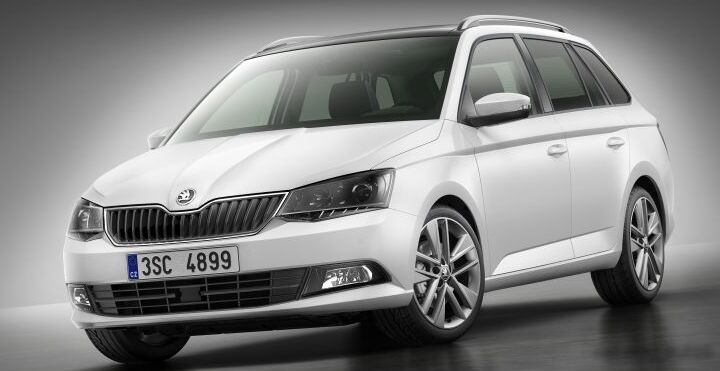
The Skoda Fabia III Combi 1.4 TDI (105 hp) was a popular variant of Skoda’s third-generation Fabia, a subcompact car produced from 2014 to 2018. Positioned as an efficient and practical option within the Fabia Combi (estate/wagon) lineup, it catered to buyers seeking low running costs and a spacious interior. This model played a significant role in Skoda’s continued expansion in European markets, offering a compelling alternative to rivals like the Volkswagen Golf Estate and Opel/Vauxhall Astra Sports Tourer. It was built on the Volkswagen Group’s PQ25 platform, also known as the A05 platform, shared with models like the Volkswagen Polo and SEAT Ibiza.
Technical Specifications
| Brand | Skoda |
| Model | Fabia |
| Generation | Fabia III Combi |
| Type (Engine) | 1.4 TDI (105 Hp) |
| Start of production | 2014 |
| End of production | July, 2018 |
| Powertrain Architecture | Internal Combustion engine |
| Body type | Station wagon (estate) |
| Seats | 5 |
| Doors | 5 |
| Fuel consumption (urban) | 4 l/100 km (58.8 US mpg, 70.6 UK mpg, 25 km/l) |
| Fuel consumption (extra urban) | 3.3 l/100 km (71.3 US mpg, 85.6 UK mpg, 30.3 km/l) |
| Fuel consumption (combined) | 3.5 l/100 km (67.2 US mpg, 80.7 UK mpg, 28.6 km/l) |
| CO2 emissions | 92 g/km |
| Fuel Type | Diesel |
| Acceleration 0 – 100 km/h | 10.2 sec |
| Acceleration 0 – 62 mph | 10.2 sec |
| Acceleration 0 – 60 mph | 9.7 sec |
| Maximum speed | 196 km/h (121.79 mph) |
| Emission standard | Euro 6 |
| Weight-to-power ratio | 11.3 kg/Hp, 88.3 Hp/tonne |
| Weight-to-torque ratio | 4.8 kg/Nm, 210.3 Nm/tonne |
| Power | 105 Hp @ 3500-3750 rpm |
| Power per litre | 73.8 Hp/l |
| Torque | 250 Nm @ 1750-2500 rpm (184.39 lb.-ft. @ 1750-2500 rpm) |
| Engine layout | Front, Transverse |
| Engine Model/Code | EA288 / CUTA |
| Engine displacement | 1422 cm3 (86.78 cu. in.) |
| Number of cylinders | 3 |
| Engine configuration | Inline |
| Cylinder Bore | 79.5 mm (3.13 in.) |
| Piston Stroke | 95.5 mm (3.76 in.) |
| Compression ratio | 16.2:1 |
| Fuel injection system | Diesel Commonrail |
| Engine aspiration | Turbocharger, Intercooler |
| Valvetrain | DOHC |
| Engine oil capacity | 4.1 l (4.33 US qt | 3.61 UK qt) |
| Kerb Weight | 1189 kg (2621.3 lbs.) |
| Max. weight | 1644 kg (3624.4 lbs.) |
| Max load | 455 kg (1003.1 lbs.) |
| Trunk (boot) space – minimum | 530 l (18.72 cu. ft.) |
| Trunk (boot) space – maximum | 1395 l (49.26 cu. ft.) |
| Fuel tank capacity | 45 l (11.89 US gal | 9.9 UK gal) |
| Length | 4257 mm (167.6 in.) |
| Width | 1732 mm (68.19 in.) |
| Height | 1467 mm (57.76 in.) |
| Wheelbase | 2470 mm (97.24 in.) |
| Front track | 1457 mm (57.36 in.) |
| Rear (Back) track | 1451 mm (57.13 in.) |
| Minimum turning circle | 10.4 m (34.12 ft.) |
| Drivetrain Architecture | Front wheel drive |
| Number of gears | 5 |
| Gearbox type | Manual transmission |
| Front suspension | Independent, type McPherson with coil spring and anti-roll bar |
| Rear suspension | Semi-independent, coil spring |
| Front brakes | Ventilated discs |
| Rear brakes | Drum |
| Assisting systems | ABS (Anti-lock braking system) |
| Steering type | Steering rack and pinion |
| Power steering | Electric Steering |
| Tires size | 185/60 R15 |
| Wheel rims size | 6J x 15 |
INTRODUCTION
The Skoda Fabia III Combi 1.4 TDI (105 hp) represented a key offering in Skoda’s strategy to provide practical, affordable, and fuel-efficient vehicles. Introduced in 2014 as part of the Fabia III generation, the Combi body style (estate/wagon) significantly increased cargo capacity compared to the hatchback, making it a popular choice for families and those requiring more versatile space. The 1.4 TDI engine, designated with the CUTA engine code, was a three-cylinder diesel known for its economy and relatively refined operation. This particular variant occupied a mid-range position in the Fabia Combi lineup, offering a balance between performance, fuel efficiency, and price.
Powertrain & Engine Architecture
The heart of the Fabia III Combi 1.4 TDI was the EA288 series three-cylinder diesel engine. This engine, specifically the CUTA code, featured a common rail direct injection system, delivering fuel at extremely high pressure for optimized combustion. The engine utilized a turbocharger with an intercooler to boost power output and improve efficiency. The double overhead camshaft (DOHC) valvetrain controlled four valves per cylinder, contributing to improved breathing and performance. The 1.4 TDI produced 105 horsepower at 3500-3750 rpm and 250 Nm (184 lb-ft) of torque between 1750-2500 rpm. This engine was paired with a five-speed manual transmission, chosen for its simplicity and contribution to fuel economy. The engine also incorporated a diesel particulate filter (DPF) to meet stringent Euro 6 emission standards.
Driving Characteristics
The 1.4 TDI 105 hp engine in the Fabia Combi provided adequate, though not exhilarating, performance. Acceleration from 0-60 mph took around 9.7 seconds, and top speed was approximately 122 mph. The engine’s torque delivery was its strong suit, providing good pulling power for everyday driving and overtaking maneuvers. Compared to the more powerful 1.2 TSI petrol engine, the 1.4 TDI offered superior fuel economy but lacked the same level of responsiveness. The five-speed manual transmission was well-matched to the engine’s characteristics, with gear ratios optimized for fuel efficiency and relaxed cruising. The Combi’s increased weight compared to the hatchback was noticeable, slightly impacting acceleration and handling, but the suspension provided a comfortable ride.
Equipment & Trim Levels
The Fabia III Combi 1.4 TDI typically came with a reasonable level of standard equipment. Base models included features like air conditioning, electric front windows, a basic audio system, and ABS brakes. Higher trim levels, such as SE and Elegance, added features like alloy wheels, parking sensors, a touchscreen infotainment system, and cruise control. Interior upholstery was typically cloth, with options for upgraded materials on higher trims. Optional extras included a panoramic sunroof, heated seats, and a navigation system. The dashboard layout was functional and straightforward, prioritizing usability over stylistic flair.
Chassis & Braking
The Fabia III Combi utilized a McPherson strut front suspension and a semi-independent torsion beam rear suspension. This setup provided a good balance between ride comfort and handling. The front brakes were ventilated discs, offering good stopping power, while the rear brakes were drums, a cost-saving measure common in this segment. Electric power steering provided light and precise steering feel. The chassis was designed to maximize interior space and minimize weight, contributing to the car’s overall efficiency. Stabilizer bars were fitted to both the front and rear axles to reduce body roll during cornering.
Market Reception & Comparison
The Skoda Fabia III Combi 1.4 TDI was generally well-received by automotive critics. It was praised for its fuel efficiency, spacious interior, and practical estate car body style. However, some reviewers noted that the engine could feel strained when fully loaded or driving uphill. Compared to the petrol-powered Fabia variants, the 1.4 TDI offered significantly better fuel economy, making it a popular choice for high-mileage drivers. Against competitors like the Volkswagen Golf Estate and Opel/Vauxhall Astra Sports Tourer, the Fabia Combi offered a more affordable price point, though it lacked some of the refinement and features of those models. Reliability reports generally indicated good dependability, with the EA288 engine proving to be a robust unit.
Legacy
The Skoda Fabia III Combi 1.4 TDI has proven to be a reliable and economical used car. The EA288 engine, while requiring regular maintenance (including DPF regeneration), is generally considered durable. The availability of spare parts is good, and maintenance costs are relatively low. Today, these Fabia Combis represent a practical and affordable option for buyers seeking a fuel-efficient and spacious estate car. The combination of a diesel engine, estate body style, and Skoda’s reputation for value has ensured a continued demand in the used car market.