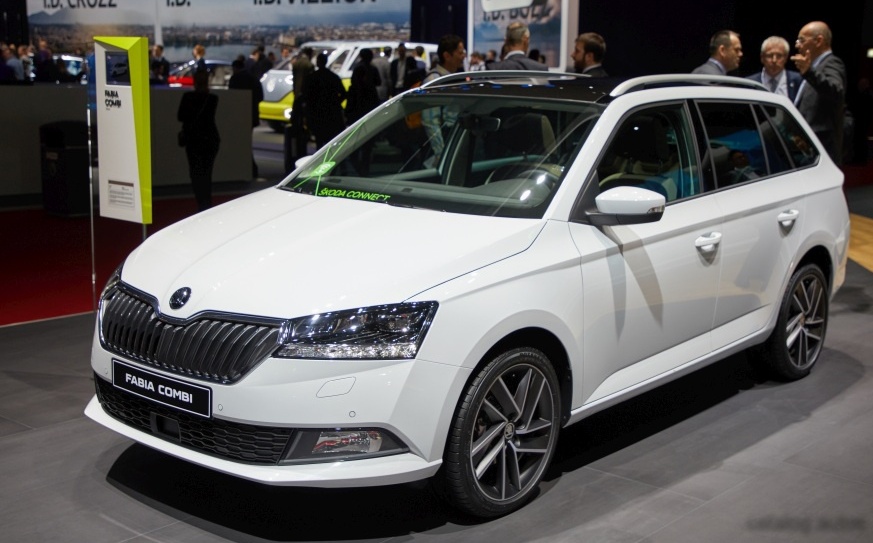
The Skoda Fabia III Combi (facelift, produced from July 2018 to November 2020) 1.0 TSI 110 horsepower variant represents a significant offering within the third generation of Skoda’s popular hatchback and wagon lineup. Positioned as a mid-range option, this model aimed to balance fuel efficiency with adequate performance for everyday driving. It was a key component of Skoda’s strategy to provide practical, affordable, and well-equipped vehicles to the European market, leveraging the Volkswagen Group’s modular MQB platform (specifically the A05 version). The facelift brought updated styling, improved technology, and refined engine options, making it a competitive choice in the compact estate segment.
| Brand | Skoda |
| Model | Fabia |
| Generation | Fabia III Combi (facelift 2018) |
| Type (Engine) | 1.0 TSI (110 Hp) |
| Start of production | July, 2018 |
| End of production | November, 2020 |
| Powertrain Architecture | Internal Combustion engine |
| Body type | Station wagon (estate) |
| Seats | 5 |
| Doors | 5 |
| Fuel consumption (urban) | 5.6-5.7 l/100 km (42 – 41.3 US mpg) |
| Fuel consumption (extra urban) | 3.9-4.0 l/100 km (60.3 – 58.8 US mpg) |
| Fuel consumption (combined) | 4.5-4.7 l/100 km (52.3 – 50 US mpg) |
| CO2 emissions | 104-106 g/km |
| Fuel Type | Petrol (Gasoline) |
| Acceleration 0 – 100 km/h | 9.7 sec |
| Acceleration 0 – 62 mph | 9.7 sec |
| Acceleration 0 – 60 mph | 9.2 sec |
| Maximum speed | 198 km/h (123.03 mph) |
| Emission standard | Euro 6d-TEMP-EVAP-ISC |
| Weight-to-power ratio | 9.7 kg/Hp, 102.6 Hp/tonne |
| Weight-to-torque ratio | 5.4 kg/Nm, 186.6 Nm/tonne |
| Power | 110 Hp @ 5000-5500 rpm |
| Torque | 200 Nm @ 2000-3500 rpm (147.51 lb.-ft. @ 2000-3500 rpm) |
| Engine layout | Front, Transverse |
| Engine Model/Code | EA211 / DKRC |
| Engine displacement | 999 cm3 (60.96 cu. in.) |
| Number of cylinders | 3 |
| Engine configuration | Inline |
| Cylinder Bore | 74.5 mm (2.93 in.) |
| Piston Stroke | 76.4 mm (3.01 in.) |
| Compression ratio | 10.5:1 |
| Number of valves per cylinder | 4 |
| Fuel injection system | Direct injection |
| Engine aspiration | Turbocharger, Intercooler |
| Valvetrain | DOHC |
| Engine oil capacity | 4 l (4.23 US qt | 3.52 UK qt) |
| Kerb Weight | 1072 kg (2363.36 lbs.) |
| Max. weight | 1602 kg (3531.81 lbs.) |
| Max load | 530 kg (1168.45 lbs.) |
| Trunk (boot) space – minimum | 530 l (18.72 cu. ft.) |
| Trunk (boot) space – maximum | 1395 l (49.26 cu. ft.) |
| Fuel tank capacity | 45 l (11.89 US gal | 9.9 UK gal) |
| Max. roof load | 75 kg (165.35 lbs.) |
| Permitted trailer load with brakes (12%) | 1100 kg (2425.08 lbs.) |
| Permitted trailer load without brakes | 570 kg (1256.63 lbs.) |
| Permitted towbar download | 50 kg (110.23 lbs.) |
| Length | 4262 mm (167.8 in.) |
| Width | 1732 mm (68.19 in.) |
| Height | 1467 mm (57.76 in.) |
| Wheelbase | 2470 mm (97.24 in.) |
| Front track | 1457 mm (57.36 in.) |
| Rear (Back) track | 1451 mm (57.13 in.) |
| Ride height (ground clearance) | 135 mm (5.31 in.) |
| Drag coefficient (Cd) | 0.324 |
| Minimum turning circle (turning diameter) | 9.8 m (32.15 ft.) |
| Drivetrain Architecture | The Internal combustion engine (ICE) drives the front wheels of the vehicle. |
| Drive wheel | Front wheel drive |
| Number of gears and type of gearbox | 6 gears, manual transmission |
| Front suspension | Independent type McPherson |
| Front brakes | Ventilated discs |
| Rear brakes | Disc |
| Assisting systems | ABS (Anti-lock braking system) |
| Steering type | Steering rack and pinion |
| Power steering | Electric Steering |
| Tires size | 215/45 R16 |
| Wheel rims size | 7; 0J x 16 |
Powertrain & Engine Architecture
The heart of this Fabia variant is the EA211 series 1.0 TSI three-cylinder engine, specifically the DKRC code. This engine is a turbocharged, direct-injection unit known for its efficiency and surprisingly punchy performance for its size. The direct injection system, coupled with a single turbocharger and intercooler, allows for precise fuel delivery and improved combustion efficiency. The engine utilizes a DOHC (Dual Overhead Camshaft) valvetrain with four valves per cylinder, optimizing gas flow and contributing to its power output. The 1.0 TSI engine benefits from technologies like variable valve timing, further enhancing its responsiveness and fuel economy. The engine is transversely mounted at the front of the vehicle, driving the front wheels. The six-speed manual transmission was the standard offering, providing a good balance between fuel efficiency and driver engagement. The gear ratios were tuned to maximize the engine’s torque band, offering reasonable acceleration in everyday driving situations.
Driving Characteristics
The 110 horsepower 1.0 TSI engine, paired with the six-speed manual transmission, delivers a respectable driving experience. While not a performance-oriented setup, it provides sufficient power for typical commuting and highway driving. Acceleration from 0-60 mph takes around 9.2 seconds, and the car reaches a top speed of 198 km/h (123 mph). The turbocharger provides a noticeable boost in power, particularly in the mid-range, making overtaking maneuvers relatively easy. However, the three-cylinder engine can feel a bit rough at higher RPMs. The manual transmission is well-matched to the engine, with smooth gear changes and a reasonably precise shift feel. Compared to the more powerful 1.5 TSI variants, this engine offers a more economical driving experience, but at the expense of outright performance. Compared to diesel options, it provides a quieter and smoother ride, but typically with slightly higher fuel costs.
Equipment & Trim Levels
The 1.0 TSI 110 horsepower Fabia Combi typically came equipped with a solid range of standard features. These included air conditioning, electric front windows, a touchscreen infotainment system with Bluetooth connectivity, and alloy wheels. Safety features such as ABS, ESC (Electronic Stability Control), and multiple airbags were also standard. Higher trim levels offered additional features like automatic climate control, parking sensors, a rear-view camera, and more advanced infotainment options. Interior upholstery was typically cloth, with options for upgraded materials on higher trims. The dashboard layout was functional and well-designed, with a focus on ergonomics and ease of use.
Chassis & Braking
The Fabia Combi utilizes a McPherson strut front suspension and a torsion beam rear suspension. This setup provides a comfortable ride quality, while also offering decent handling characteristics. The front brakes are ventilated discs, providing ample stopping power, while the rear brakes are discs. The steering is electric power-assisted, offering a light and responsive feel. The chassis was tuned to prioritize comfort and stability, making it a pleasant vehicle to drive on a variety of road surfaces. Stabilizer bars were fitted to both the front and rear axles to reduce body roll during cornering.
Market Reception & Comparison
The Skoda Fabia III Combi 1.0 TSI 110 horsepower variant was generally well-received by automotive critics. It was praised for its fuel efficiency, practicality, and value for money. Critics noted that the engine provided adequate performance for most drivers, and the spacious interior and large cargo area made it a practical choice for families. Compared to other compact estates in its class, the Fabia Combi offered a compelling combination of features and affordability. Fuel economy figures of 4.5-4.7 l/100 km (52.3-50 US mpg) were competitive, and the car’s reliability was generally considered to be good. However, some critics noted that the engine could feel a bit underpowered when fully loaded or driving uphill.
Legacy
The 1.0 TSI engine has proven to be a reliable and durable powertrain, and the Fabia Combi 1.0 TSI 110 horsepower variant remains a popular choice in the used car market. Its fuel efficiency and practicality make it an attractive option for buyers looking for an affordable and economical estate car. While some maintenance may be required as the car ages, the engine is generally considered to be relatively trouble-free. The availability of spare parts is good, and the car’s simple design makes it relatively easy to repair. The Fabia Combi continues to be recognized as a well-rounded and practical vehicle, offering a good balance of comfort, efficiency, and affordability.