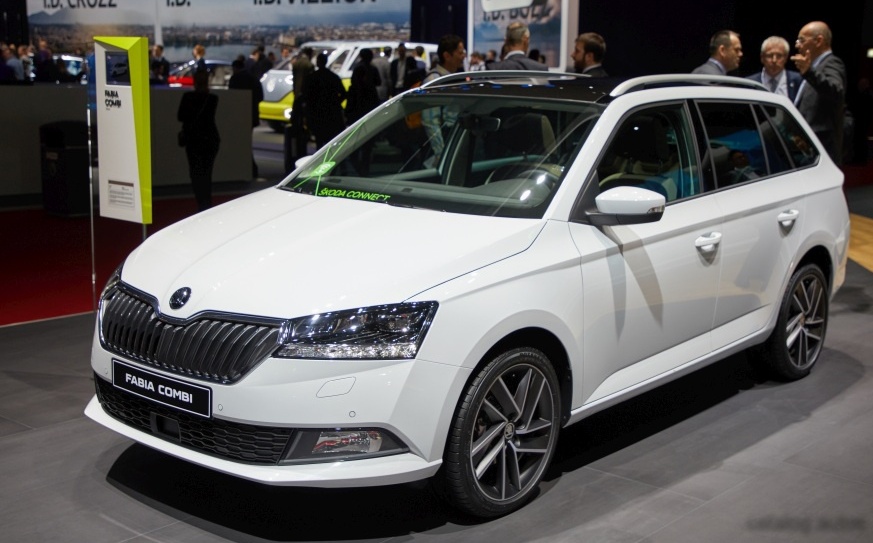
The Skoda Fabia III Combi (facelift, produced from July 2018 to September 2020) 1.0 TSI 95 horsepower variant represents an entry-level offering within the third generation Fabia Combi range. Positioned as a fuel-efficient and practical option, this model aimed to provide affordable family transportation within the European market. It builds upon the foundation of the Fabia III, which itself utilizes the Volkswagen Group’s A05 (PQ25) platform, commonly known as the 1HX0/A3 platform. The facelift brought styling updates and revised engine options, with the 1.0 TSI becoming a key part of the lineup.
Technical Specifications
| Brand | Skoda |
| Model | Fabia |
| Generation | Fabia III Combi (facelift 2018) |
| Type (Engine) | 1.0 TSI (95 Hp) |
| Start of production | July, 2018 |
| End of production | September, 2020 |
| Powertrain Architecture | Internal Combustion engine |
| Body type | Station wagon (estate) |
| Seats | 5 |
| Doors | 5 |
| Fuel consumption (urban) | 5.4 l/100 km (43.6 US mpg, 52.3 UK mpg, 18.5 km/l) |
| Fuel consumption (extra urban) | 4.1 l/100 km (57.4 US mpg, 68.9 UK mpg, 24.4 km/l) |
| Fuel consumption (combined) | 4.6 l/100 km (51.1 US mpg, 61.4 UK mpg, 21.7 km/l) |
| CO2 emissions | 105 g/km |
| Fuel Type | Petrol (Gasoline) |
| Acceleration 0 – 100 km/h | 10.8 sec |
| Acceleration 0 – 62 mph | 10.8 sec |
| Acceleration 0 – 60 mph | 10.3 sec |
| Maximum speed | 185 km/h (114.95 mph) |
| Emission standard | Euro 6 |
| Weight-to-power ratio | 11.2 kg/Hp, 89.1 Hp/tonne |
| Weight-to-torque ratio | 6.7 kg/Nm, 150.1 Nm/tonne |
| Power | 95 Hp |
| Power per litre | 95.1 Hp/l |
| Torque | 160 Nm @ 1800-3500 rpm (118.01 lb.-ft. @ 1800-3500 rpm) |
| Engine layout | Front, Transverse |
| Engine Model/Code | EA211 / DKLD |
| Engine displacement | 999 cm3 (60.96 cu. in.) |
| Number of cylinders | 3 |
| Engine configuration | Inline |
| Cylinder Bore | 74.5 mm (2.93 in.) |
| Piston Stroke | 76.4 mm (3.01 in.) |
| Compression ratio | 10.3:1 |
| Number of valves per cylinder | 4 |
| Fuel injection system | Direct injection |
| Engine aspiration | Turbocharger, Intercooler |
| Engine oil capacity | 4 l (4.23 US qt | 3.52 UK qt) |
| Kerb Weight | 1066 kg (2350.13 lbs.) |
| Max. weight | 1596 kg (3518.58 lbs.) |
| Max load | 530 kg (1168.45 lbs.) |
| Trunk (boot) space – minimum | 530 l (18.72 cu. ft.) |
| Trunk (boot) space – maximum | 1395 l (49.26 cu. ft.) |
| Fuel tank capacity | 45 l (11.89 US gal | 9.9 UK gal) |
| Max. roof load | 75 kg (165.35 lbs.) |
| Permitted trailer load with brakes (12%) | 1000 kg (2204.62 lbs.) |
| Permitted trailer load without brakes | 570 kg (1256.63 lbs.) |
| Permitted towbar download | 50 kg (110.23 lbs.) |
| Length | 4262 mm (167.8 in.) |
| Width | 1732 mm (68.19 in.) |
| Height | 1467 mm (57.76 in.) |
| Wheelbase | 2470 mm (97.24 in.) |
| Front track | 1463 mm (57.6 in.) |
| Rear (Back) track | 1457 mm (57.36 in.) |
| Minimum turning circle | 10.4 m (34.12 ft.) |
| Drivetrain Architecture | Front wheel drive |
| Number of gears and type of gearbox | 5 gears, manual transmission |
| Front brakes | Ventilated discs |
| Assisting systems | ABS (Anti-lock braking system) |
| Steering type | Steering rack and pinion |
| Power steering | Electric Steering |
Powertrain & Engine Architecture
The heart of this Fabia Combi is the EA211 series 1.0 TSI three-cylinder engine, specifically the DKLD code. This engine represents a shift towards smaller displacement, turbocharged units for improved fuel economy. It features direct fuel injection, delivering fuel directly into the combustion chamber for precise control and increased efficiency. The engine utilizes a single scroll turbocharger with an intercooler to mitigate turbo lag and enhance power delivery. The valvetrain employs four valves per cylinder, contributing to improved breathing and overall performance. The 1.0 TSI engine is known for its relatively quiet operation, a characteristic often praised in reviews. The engine is paired with a five-speed manual transmission, which was the standard offering for this variant. While an automatic transmission was available on other Fabia models, it wasn’t offered with the 95 hp 1.0 TSI engine.
Driving Characteristics
The 95 horsepower 1.0 TSI engine, coupled with the five-speed manual gearbox, provides adequate performance for everyday driving. Acceleration from 0-60 mph takes around 10.3 seconds, and top speed is rated at 185 km/h (114.95 mph). However, it’s not a particularly sporty setup. The engine’s torque peak of 160 Nm (118 lb-ft) is available from 1800-3500 rpm, providing reasonable pulling power for overtaking and climbing hills. Compared to the more powerful 1.0 TSI 110 hp version, or the older 1.2 TSI engines, this variant feels noticeably less responsive. The gear ratios are tuned for fuel efficiency rather than outright performance. The manual transmission is generally light and precise, making it easy to navigate through the gears. The relatively low weight of the Fabia Combi helps to mitigate the effects of the modest power output.
Equipment & Trim Levels
The 1.0 TSI 95 hp Fabia Combi typically came equipped as a base or mid-range trim level, depending on the specific market and optional packages selected. Standard features generally included air conditioning, electric front windows, a basic audio system with Bluetooth connectivity, and steel wheels with wheel covers. Safety features such as ABS, ESC (Electronic Stability Control), and multiple airbags were standard. Optional extras included alloy wheels, parking sensors, a touchscreen infotainment system with navigation, and climate control. Interior upholstery was typically cloth, with a functional and durable design. The dashboard layout was straightforward and user-friendly, prioritizing practicality over luxury.
Chassis & Braking
The Fabia Combi’s chassis is a typical front-wheel-drive configuration with MacPherson strut suspension at the front and a torsion beam axle at the rear. This setup provides a comfortable ride quality, although it’s not particularly engaging for enthusiastic drivers. The front brakes are ventilated discs, while the rear brakes are typically drum brakes, a cost-saving measure for the entry-level models. The steering is electrically assisted, providing light and easy steering feel. Stabilizer bars are fitted to both the front and rear axles to reduce body roll during cornering.
Market Reception & Comparison
The Skoda Fabia III Combi 1.0 TSI 95 hp was generally well-received as a practical and economical family car. Critics praised its fuel efficiency, spacious interior, and comfortable ride. However, some reviewers noted that the engine could feel underpowered, especially when fully loaded or driving uphill. Compared to the 1.0 TSI 110 hp version, the 95 hp model offered lower running costs but sacrificed some performance. Against competitors like the Volkswagen Polo, SEAT Ibiza, and Renault Clio, the Fabia Combi offered a compelling combination of value, space, and practicality.
Legacy
The EA211 1.0 TSI engine has proven to be a relatively reliable unit, although some early versions experienced issues with timing chain wear. Regular maintenance, including oil changes and timing chain inspections, is crucial for long-term reliability. In the used car market, the Fabia Combi 1.0 TSI 95 hp represents an affordable and practical option for buyers seeking a fuel-efficient and spacious estate car. Its simplicity and relatively low running costs make it an attractive choice for those prioritizing practicality over performance. The availability of spare parts and a strong dealer network further contribute to its appeal in the used car market.