Technical Specifications
| Brand | Skoda |
| Model | Fabia |
| Generation | Fabia III (facelift 2018) |
| Type (Engine) | 1.0 MPI (60 Hp) |
| Start of production | March, 2019 |
| End of production | November, 2020 |
| Powertrain Architecture | Internal Combustion engine |
| Body type | Hatchback |
| Seats | 5 |
| Doors | 5 |
| Fuel consumption (urban) | 5.8 l/100 km (40.6 US mpg, 48.7 UK mpg, 17.2 km/l) |
| Fuel consumption (extra urban) | 4.2 l/100 km (56 US mpg, 67.3 UK mpg, 23.8 km/l) |
| Fuel consumption (combined) | 4.8 l/100 km (49 US mpg, 58.9 UK mpg, 20.8 km/l) |
| CO2 emissions | 109 g/km |
| Fuel Type | Petrol (Gasoline) |
| Acceleration 0 – 100 km/h | 16.6 sec |
| Acceleration 0 – 62 mph | 16.6 sec |
| Acceleration 0 – 60 mph | 15.8 sec |
| Maximum speed | 157 km/h (97.56 mph) |
| Emission standard | Euro 6 |
| Weight-to-power ratio | 18.1 kg/Hp, 55.2 Hp/tonne |
| Weight-to-torque ratio | 11.4 kg/Nm, 87.5 Nm/tonne |
| Power | 60 Hp @ 5000-6000 rpm |
| Power per litre | 60.1 Hp/l |
| Torque | 95 Nm @ 3000-4300 rpm (70.07 lb.-ft. @ 3000-4300 rpm) |
| Engine layout | Front, Transverse |
| Engine Model/Code | EA211 / CHYE |
| Engine displacement | 999 cm3 (60.96 cu. in.) |
| Number of cylinders | 3 |
| Engine configuration | Inline |
| Cylinder Bore | 74.5 mm (2.93 in.) |
| Piston Stroke | 76.4 mm (3.01 in.) |
| Compression ratio | 10.5:1 |
| Number of valves per cylinder | 4 |
| Fuel injection system | Multi-port manifold injection |
| Engine aspiration | Naturally aspirated engine |
| Valvetrain | DOHC |
| Engine oil capacity | 3.4 l (3.59 US qt | 2.99 UK qt) |
| Kerb Weight | 1086 kg (2394.22 lbs.) |
| Max. weight | 1541 kg (3397.32 lbs.) |
| Max load | 455 kg (1003.1 lbs.) |
| Trunk (boot) space – minimum | 330 l (11.65 cu. ft.) |
| Trunk (boot) space – maximum | 1150 l (40.61 cu. ft.) |
| Fuel tank capacity | 45 l (11.89 US gal | 9.9 UK gal) |
| Permitted trailer load with brakes (8%) | 1000 kg (2204.62 lbs.) |
| Permitted trailer load with brakes (12%) | 800 kg (1763.7 lbs.) |
| Permitted trailer load without brakes | 540 kg (1190.5 lbs.) |
| Permitted towbar download | 50 kg (110.23 lbs.) |
| Length | 3997 mm (157.36 in.) |
| Width | 1732 mm (68.19 in.) |
| Width including mirrors | 1958 mm (77.09 in.) |
| Height | 1467 mm (57.76 in.) |
| Wheelbase | 2470 mm (97.24 in.) |
| Front track | 1463 mm (57.6 in.) |
| Rear (Back) track | 1457 mm (57.36 in.) |
| Ride height (ground clearance) | 133 mm (5.24 in.) |
| Drag coefficient (Cd) | 0.33 |
| Minimum turning circle (turning diameter) | 10.4 m (34.12 ft.) |
| Drivetrain Architecture | The Internal combustion engine (ICE) drives the front wheels of the vehicle. |
| Drive wheel | Front wheel drive |
| Number of gears and type of gearbox | 5 gears, manual transmission |
| Front suspension | Independent, type McPherson with coil spring and anti-roll bar |
| Rear suspension | Semi-dependent beam with stabilizer lateral stability |
| Front brakes | Disc |
| Rear brakes | Drum |
| Assisting systems | ABS (Anti-lock braking system) |
| Steering type | Steering rack and pinion |
| Power steering | Electric Steering |
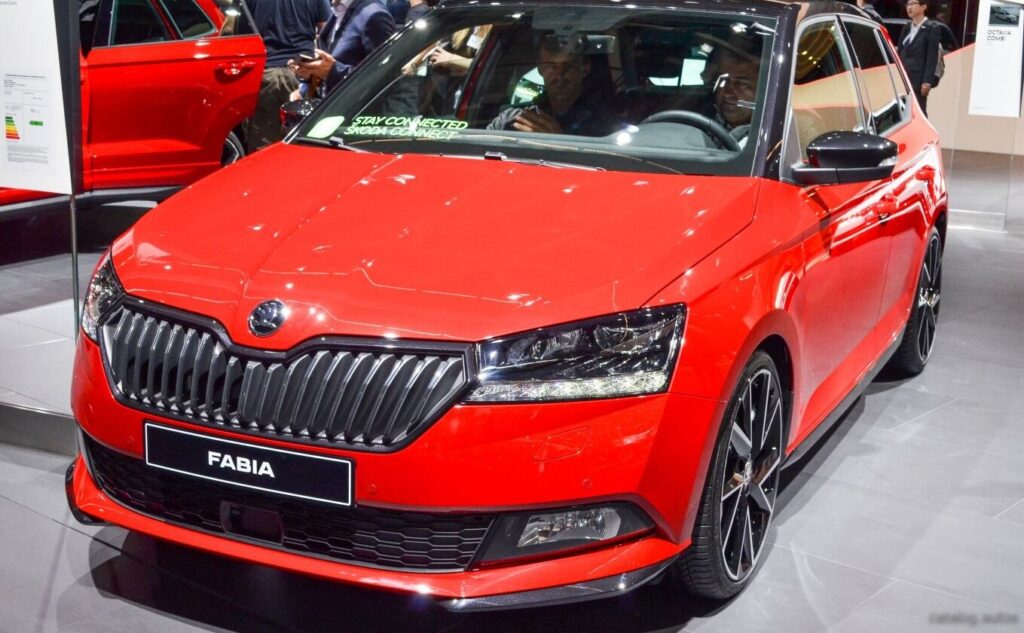
The Skoda Fabia III, post-facelift in 2018, saw the introduction of a 1.0 MPI 60 horsepower variant as its entry-level offering. Production of this specific configuration ran from March 2019 to November 2020. This model was positioned as the most affordable option within the Fabia III range, aiming to provide economical transportation for budget-conscious buyers. Built on the Volkswagen Group’s PQ25 platform (also known as A05), shared with vehicles like the Volkswagen Polo and SEAT Ibiza, the Fabia III was primarily sold in European markets where smaller, fuel-efficient cars are highly valued. It represented Skoda’s commitment to offering practical and affordable vehicles to a broad customer base.
Powertrain & Engine Architecture
The 1.0 MPI 60 hp Fabia is powered by the EA211 series 1.0-liter three-cylinder petrol engine, designated with the engine code CHYE. This engine is naturally aspirated, meaning it doesn’t utilize a turbocharger to force air into the cylinders. It employs multi-point fuel injection, delivering fuel directly into the intake ports before the intake valves. The engine features a double overhead camshaft (DOHC) valvetrain with four valves per cylinder, enhancing volumetric efficiency. This configuration contributes to improved breathing and overall engine efficiency. The engine’s compact size and three-cylinder layout are key factors in its fuel economy, though they also contribute to a distinctive engine sound. The engine is paired exclusively with a five-speed manual transmission in this configuration, prioritizing simplicity and cost-effectiveness over the availability of an automatic option found in higher trims.
Driving Characteristics
The 1.0 MPI 60 hp Fabia is not designed for performance driving. Acceleration is modest, requiring approximately 16.6 seconds to reach 62 mph (100 km/h). Peak torque of 95 Nm (70 lb-ft) is available between 3000 and 4300 rpm, necessitating drivers to utilize the engine’s rev range to access its limited power. The five-speed manual transmission is geared for fuel efficiency, rather than rapid acceleration. In everyday driving, the car is best suited for urban environments and shorter journeys. Highway overtaking requires careful planning and anticipation. Compared to Fabia variants equipped with the 1.0 TSI turbocharged engine or the older 1.2 TSI, this 60 hp version feels significantly less responsive and powerful. The gear ratios are optimized for maintaining momentum rather than providing quick bursts of speed.
Equipment & Trim Levels
The 60 hp Fabia typically came with a basic, yet functional, level of standard equipment. Features generally included power steering, Anti-lock Braking System (ABS), front airbags, electric front windows, and a basic audio system. Air conditioning was frequently offered as an optional extra, adding to the vehicle’s cost. Interior upholstery was typically cloth, and the dashboard featured a straightforward, practical design. Higher trim levels of the Fabia III offered upgrades such as alloy wheels, a touchscreen infotainment system, rear parking sensors, and climate control, but these were generally not included in the base 60 hp model. The focus was on providing an affordable and reliable vehicle, with optional extras available for buyers seeking additional comfort and convenience.
Chassis & Braking
The Fabia III utilizes a McPherson strut front suspension and a semi-independent torsion beam rear suspension. This suspension setup provides a reasonable compromise between ride comfort and handling characteristics. The front brakes are disc brakes, offering better stopping power than drum brakes, while the rear brakes are drum brakes – a cost-saving measure common in entry-level models. A stabilizer bar is fitted to both the front and rear axles to minimize body roll during cornering maneuvers. The steering system is electrically assisted, providing light and easy steering feel, particularly useful for navigating urban streets. The chassis is tuned for comfort and efficiency, prioritizing a smooth ride over sporty handling dynamics.
Market Reception & Comparison
The 1.0 MPI 60 hp Fabia was generally well-received as an affordable and economical city car. Automotive critics praised its fuel efficiency and low running costs, but consistently noted its lack of outright performance. Compared to other trims within the Fabia lineup, this version represented the lowest price point but also offered the least amount of power and standard equipment. It directly competed with other entry-level superminis, such as the Hyundai i10 and Kia Picanto, offering a similar level of affordability and practicality. Fuel economy figures averaging around 4.8 l/100 km (49 US mpg) were competitive within its segment. The car’s simplicity and low maintenance costs were also seen as positive attributes.
Legacy
The EA211 1.0 MPI engine has proven to be a relatively reliable powertrain, although the inherent characteristics of a three-cylinder engine can sometimes result in a slightly rougher idle compared to four-cylinder alternatives. Consistent maintenance, including regular oil changes and adherence to the manufacturer’s recommended timing belt replacement intervals, is crucial for ensuring long-term reliability. In the used car market, the 60 hp Fabia represents a very affordable option for buyers seeking a basic and economical vehicle. While it may not offer the performance or features of higher-specification models, its low running costs and proven reliability make it a sensible choice for those on a limited budget. The simplicity of the powertrain also translates to potentially lower repair costs compared to more complex, turbocharged engines.