Technical Specifications
| Brand | Skoda |
| Model | Fabia |
| Generation | Fabia III (facelift 2018) |
| Type (Engine) | 1.0 TSI (110 Hp) |
| Start of production | July, 2018 |
| End of production | November, 2020 |
| Powertrain Architecture | Internal Combustion engine |
| Body type | Hatchback |
| Seats | 5 |
| Doors | 5 |
| Fuel consumption (urban) | 5.6 l/100 km (42 US mpg, 50.4 UK mpg, 17.9 km/l) |
| Fuel consumption (extra urban) | 4.2 l/100 km (56 US mpg, 67.3 UK mpg, 23.8 km/l) |
| Fuel consumption (combined) | 4.7 l/100 km (50 US mpg, 60.1 UK mpg, 21.3 km/l) |
| CO2 emissions | 107 g/km |
| Fuel Type | Petrol (Gasoline) |
| Acceleration 0 – 100 km/h | 10.1 sec |
| Acceleration 0 – 62 mph | 10.1 sec |
| Acceleration 0 – 60 mph | 9.6 sec |
| Maximum speed | 195 km/h (121.17 mph) |
| Emission standard | Euro 6 |
| Weight-to-power ratio | 9.6 kg/Hp, 104.1 Hp/tonne |
| Weight-to-torque ratio | 5.3 kg/Nm, 189.2 Nm/tonne |
| Power | 110 Hp |
| Power per litre | 110.1 Hp/l |
| Torque | 200 Nm @ 2000-3500 rpm (147.51 lb.-ft. @ 2000-3500 rpm) |
| Engine layout | Front, Transverse |
| Engine Model/Code | EA211 / DKRC |
| Engine displacement | 999 cm3 (60.96 cu. in.) |
| Number of cylinders | 3 |
| Engine configuration | Inline |
| Cylinder Bore | 74.5 mm (2.93 in.) |
| Piston Stroke | 76.4 mm (3.01 in.) |
| Compression ratio | 10.3:1 |
| Number of valves per cylinder | 4 |
| Fuel injection system | Direct injection |
| Engine aspiration | Turbocharger, Intercooler |
| Engine oil capacity | 4 l (4.23 US qt | 3.52 UK qt) |
| Kerb Weight | 1057 kg (2330.29 lbs.) |
| Max. weight | 1587 kg (3498.74 lbs.) |
| Max load | 530 kg (1168.45 lbs.) |
| Trunk (boot) space – minimum | 330 l (11.65 cu. ft.) |
| Trunk (boot) space – maximum | 1150 l (40.61 cu. ft.) |
| Fuel tank capacity | 45 l (11.89 US gal | 9.9 UK gal) |
| Max. roof load | 75 kg (165.35 lbs.) |
| Permitted trailer load with brakes (12%) | 1100 kg (2425.08 lbs.) |
| Permitted trailer load without brakes | 560 kg (1234.59 lbs.) |
| Permitted towbar download | 50 kg (110.23 lbs.) |
| Length | 3997 mm (157.36 in.) |
| Width | 1732 mm (68.19 in.) |
| Height | 1467 mm (57.76 in.) |
| Wheelbase | 2470 mm (97.24 in.) |
| Front track | 1457 mm (57.36 in.) |
| Rear (Back) track | 1451 mm (57.13 in.) |
| Minimum turning circle | 10.4 m (34.12 ft.) |
| Drivetrain Architecture | ICE drives front wheels |
| Drive wheel | Front wheel drive |
| Number of gears and type of gearbox | 6 gears, manual transmission |
| Front suspension | Independent, McPherson with coil spring and anti-roll bar |
| Rear suspension | Semi-dependent beam with stabilizer |
| Front brakes | Ventilated discs |
| Assisting systems | ABS |
| Steering type | Steering rack and pinion |
| Power steering | Electric |
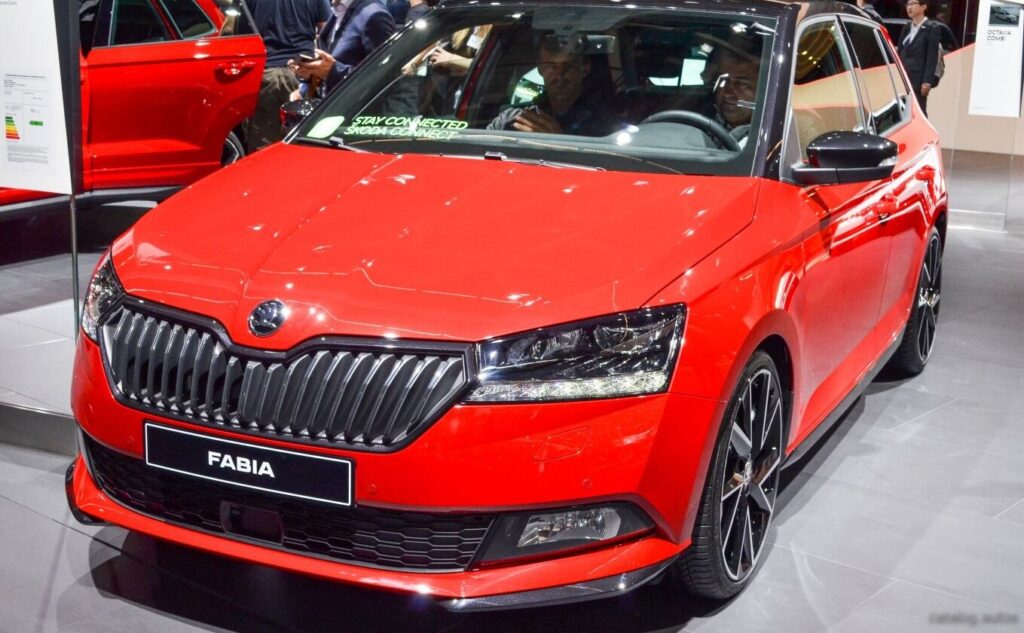
The Skoda Fabia III facelift, launched in 2018, represented a significant refresh of the already popular third-generation Fabia. The 1.0 TSI 110 horsepower variant was a crucial part of this update, offering a compelling blend of efficiency and performance. This engine, part of the Volkswagen Group’s EA211 family, was designed to meet increasingly stringent emissions standards while still providing a usable driving experience. Within the Fabia III range, this trim level sat comfortably in the middle, appealing to buyers who wanted more than the base engine but didn’t require the higher costs and performance of the more powerful options.
Powertrain & Engine Architecture
At the heart of the Fabia 1.0 TSI 110 is the EA211 engine code DKRC, a three-cylinder, 1.0-liter turbocharged gasoline engine. This engine utilizes direct fuel injection, a technology that improves fuel efficiency and reduces emissions by injecting fuel directly into the combustion chamber. The engine also features an intercooler to cool the intake air, further enhancing performance. The turbocharger, a key component, provides a boost in power and torque, compensating for the relatively small displacement. The 110 horsepower is achieved at 5,500 rpm, while the peak torque of 200 Nm (147.51 lb-ft) is available from 2,000 to 3,500 rpm. The engine is paired with a six-speed manual transmission, which was the most common configuration. While a seven-speed DSG dual-clutch transmission was available as an option, the manual gearbox was favored by many for its lower cost and engaging driving feel.
Driving Characteristics
The 1.0 TSI 110 horsepower engine in the Fabia delivers a surprisingly lively driving experience. While not a sports car, it provides sufficient power for everyday driving, including highway overtaking and navigating urban traffic. Acceleration from 0 to 100 km/h (0-62 mph) takes around 10.1 seconds. The turbocharger provides a noticeable boost in power, but there is some turbo lag at lower engine speeds. The six-speed manual transmission is well-matched to the engine, offering precise shifts and allowing the driver to keep the engine in its optimal power band. Compared to the lower-powered 1.0 MPI engine, the TSI version offers a significant improvement in performance. However, it doesn’t quite match the responsiveness of the more expensive 1.5 TSI engine. The gear ratios are tuned for a balance of fuel efficiency and performance, with a relatively long sixth gear for comfortable cruising on the highway.
Equipment & Trim Levels
The Fabia 1.0 TSI 110 typically came equipped with a reasonable level of standard features. These included air conditioning, electric front windows, a touchscreen infotainment system with Bluetooth connectivity, and alloy wheels. Higher trim levels added features such as automatic climate control, parking sensors, a rearview camera, and a more advanced infotainment system with navigation. Interior upholstery was typically cloth, with options for upgraded materials and designs. Safety features included ABS, electronic stability control, and multiple airbags. Optional extras included a panoramic sunroof, heated seats, and adaptive cruise control.
Chassis & Braking
The Fabia III utilizes a McPherson strut front suspension and a semi-independent torsion beam rear suspension. This setup provides a good balance of ride comfort and handling. The front suspension incorporates a stabilizer bar to reduce body roll during cornering. Braking duties are handled by ventilated disc brakes at the front and drum brakes at the rear. ABS (Anti-lock Braking System) is standard, providing enhanced braking performance in emergency situations. The steering is electric power-assisted, offering light and precise steering feel.
Market Reception & Comparison
The Skoda Fabia 1.0 TSI 110 received generally positive reviews from automotive critics. It was praised for its fuel efficiency, comfortable ride, and surprisingly peppy engine. Critics noted that the engine could feel a little strained when fully loaded or climbing steep hills. Compared to other engines in the Fabia lineup, the 1.0 TSI offered a good compromise between performance and economy. The 1.0 MPI engine was cheaper but lacked the TSI’s power, while the 1.5 TSI offered more performance but came at a higher price. In terms of reliability, the EA211 engine family has proven to be generally robust, although some owners have reported issues with the timing chain.
Legacy
The Skoda Fabia III 1.0 TSI 110 has proven to be a reliable and economical used car. The EA211 engine, while not without its potential issues, has generally demonstrated good long-term durability. The availability of spare parts is excellent, and maintenance costs are relatively low. Today, these Fabias represent a good value proposition for buyers looking for a practical and affordable compact hatchback. The combination of fuel efficiency, reasonable performance, and Skoda’s reputation for build quality has ensured that the Fabia 1.0 TSI 110 remains a popular choice in the used car market.