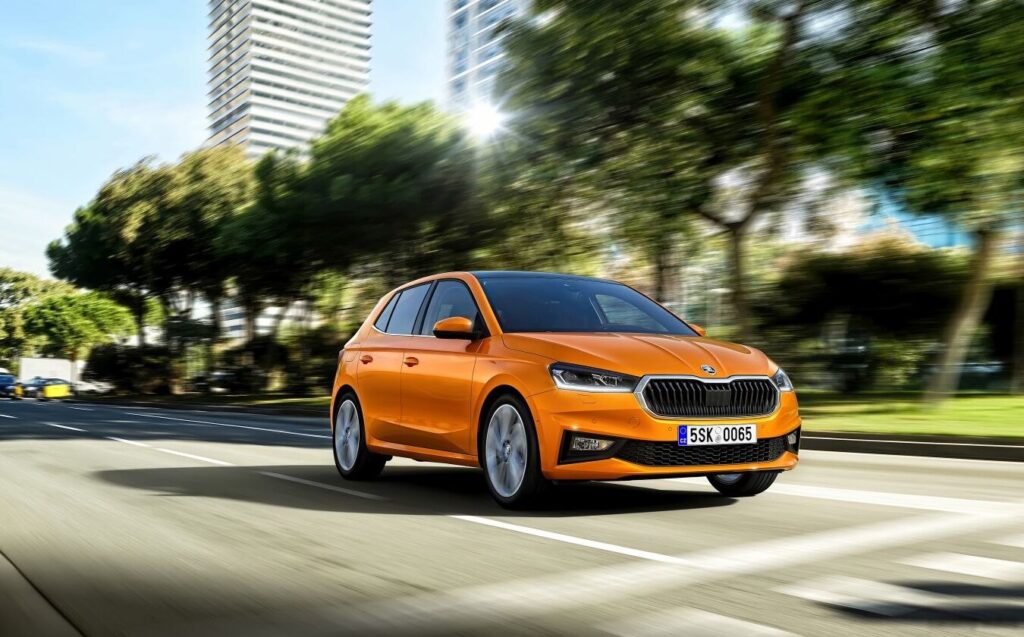
The Skoda Fabia IV 1.0 TSI (95 horsepower) represents an entry point into the fourth generation of Skoda’s popular supermini, launched in June 2021. Positioned within the broader Fabia IV range (based on the MQB-A0 platform shared with the Volkswagen Polo and SEAT Ibiza), this variant aimed to deliver a balance of affordability, fuel efficiency, and practicality for the European market. It served as the base engine option, appealing to buyers prioritizing economy over outright performance. This generation marked a significant increase in size compared to its predecessor, offering improved interior space and a more refined driving experience.
Technical Specifications
| Brand | Skoda |
| Model | Fabia |
| Generation | Fabia IV |
| Type (Engine) | 1.0 TSI (95 Hp) |
| Start of production | June, 2021 |
| Powertrain Architecture | Internal Combustion engine |
| Body type | Hatchback |
| Seats | 5 |
| Doors | 5 |
| Combined fuel consumption (WLTP) | 5 l/100 km (47 US mpg, 56.5 UK mpg, 20 km/l) |
| CO2 emissions (WLTP) | 114 g/km |
| Fuel Type | Petrol (Gasoline) |
| Acceleration 0 – 100 km/h | 10.6 sec |
| Acceleration 0 – 62 mph | 10.6 sec |
| Acceleration 0 – 60 mph | 10.1 sec |
| Maximum speed | 195 km/h (121.17 mph) |
| Emission standard | Euro 6 AP |
| Power | 95 Hp |
| Power per litre | 95.1 Hp/l |
| Torque | 175 Nm @ 1600-3500 rpm (129.07 lb.-ft. @ 1600-3500 rpm) |
| Engine layout | Front, Transverse |
| Engine Model/Code | EA211 evo / DLAC |
| Engine displacement | 999 cm3 (60.96 cu. in.) |
| Number of cylinders | 3 |
| Engine configuration | Inline |
| Number of valves per cylinder | 4 |
| Fuel injection system | Direct injection |
| Engine aspiration | Turbocharger, Intercooler |
| Engine oil capacity | 4 l (4.23 US qt | 3.52 UK qt) |
| Trunk (boot) space – minimum | 380 l (13.42 cu. ft.) |
| Trunk (boot) space – maximum | 1190 l (42.02 cu. ft.) |
| Fuel tank capacity | 40 l (10.57 US gal | 8.8 UK gal) |
| Permitted trailer load with brakes (12%) | 1000 kg (2204.62 lbs.) |
| Permitted trailer load without brakes | 570 kg (1256.63 lbs.) |
| Length | 4108 mm (161.73 in.) |
| Width | 1780 mm (70.08 in.) |
| Width including mirrors | 1954 mm (76.93 in.) |
| Height | 1459 mm (57.44 in.) |
| Wheelbase | 2564 mm (100.94 in.) |
| Front track | 1525 mm (60.04 in.) |
| Rear (Back) track | 1509 mm (59.41 in.) |
| Front overhang | 809 mm (31.85 in.) |
| Rear overhang | 735 mm (28.94 in.) |
| Ride height (ground clearance) | 138 mm (5.43 in.) |
| Drag coefficient (Cd) | 0.278-0.315 |
| Minimum turning circle (turning diameter) | 10.4 m (34.12 ft.) |
| Approach angle | 14.1° |
| Departure angle | 17.5° |
| Drivetrain Architecture | The Internal combustion engine (ICE) drives the front wheels of the vehicle. |
| Drive wheel | Front wheel drive |
| Number of gears and type of gearbox | 5 gears, manual transmission |
| Front suspension | Independent type McPherson |
| Rear suspension | Threaded twist beam |
| Front brakes | Ventilated discs |
| Assisting systems | ABS (Anti-lock braking system) |
| Steering type | Steering rack and pinion |
| Power steering | Electric Steering |
| Tires size | 185/65 R15; 195/55 R16 |
| Wheel rims size | 5.5J x 15; 6J x 16 |
Powertrain & Engine Architecture
The heart of this Fabia variant is the EA211 evo series 1.0-liter turbocharged three-cylinder engine, specifically the DLAC code. This engine is a member of Volkswagen Group’s modular engine family, known for its compact size and efficiency. It utilizes direct fuel injection, delivering fuel directly into the combustion chamber for improved combustion control and power output. The engine also features an exhaust gas recirculation (EGR) system and a particulate filter to meet stringent Euro 6 AP emission standards. The turbocharger, coupled with an intercooler, provides a boost in power and torque, mitigating the inherent limitations of a small-displacement engine. The engine is paired with a five-speed manual transmission, chosen for its simplicity and cost-effectiveness in the base model. While an automatic transmission (typically a seven-speed DSG) was available on higher trim levels, the 95 hp version was primarily offered with the manual.
Driving Characteristics
The 1.0 TSI 95 hp Fabia delivers adequate performance for everyday driving, particularly in urban and suburban environments. Acceleration from 0-60 mph takes around 10.1 seconds, which is not particularly brisk, but sufficient for most commuting needs. The engine’s 175 Nm (129 lb-ft) of torque, available from 1600-3500 rpm, provides reasonable responsiveness for overtaking and merging onto highways. Compared to the more powerful 1.5 TSI variants, the 1.0 TSI feels noticeably less energetic, requiring more downshifting to maintain speed on inclines or during quicker maneuvers. The five-speed manual transmission is well-matched to the engine’s characteristics, offering a relatively smooth and precise shift action. The gear ratios are geared towards fuel efficiency rather than outright performance.
Equipment & Trim Levels
The 1.0 TSI 95 hp Fabia typically came equipped as a base trim level, often designated as ‘Active’ or a similar entry-level moniker. Standard features generally included air conditioning, a basic infotainment system with a touchscreen display (usually around 6.5 inches), Bluetooth connectivity, steel wheels with wheel covers, and basic safety equipment such as ABS, ESC (Electronic Stability Control), and multiple airbags. Interior upholstery was typically cloth, and the dashboard featured a functional but relatively simple design. Optional extras included alloy wheels, upgraded infotainment systems with larger screens and navigation, parking sensors, and a driver assistance package with features like automatic emergency braking.
Chassis & Braking
The Fabia IV utilizes a McPherson strut front suspension and a threaded twist beam rear suspension. This setup provides a good balance of ride comfort and handling for a supermini. The chassis is relatively lightweight, contributing to the car’s agility. Front brakes are ventilated discs, providing adequate stopping power, while rear brakes are typically drum brakes on the base model to reduce costs. The steering is electrically assisted, offering a light and precise feel. Stabilizer bars are present on both axles, helping to reduce body roll during cornering.
Market Reception & Comparison
The Skoda Fabia IV 1.0 TSI 95 hp was generally well-received by automotive critics as a sensible and economical choice in the supermini segment. It was praised for its spacious interior, comfortable ride, and fuel efficiency. However, some reviewers noted that the engine could feel underpowered, particularly when fully loaded or on hilly roads. Compared to the 1.5 TSI variants, the 1.0 TSI offered significantly lower running costs but at the expense of performance. Against competitors like the Volkswagen Polo, SEAT Ibiza, and Renault Clio, the Fabia offered a compelling value proposition, often undercutting them on price while providing similar levels of equipment and practicality.
Legacy
The EA211 engine family, including the 1.0 TSI, has proven to be relatively reliable, although some owners have reported issues with the timing chain and particulate filter. Regular maintenance, including oil changes and filter replacements, is crucial for ensuring long-term reliability. On the used car market, the Fabia IV 1.0 TSI 95 hp represents an affordable and practical option for buyers seeking a fuel-efficient and reliable supermini. Its simplicity and relatively low running costs make it an attractive choice for first-time car owners or those on a budget. The fourth-generation Fabia has solidified Skoda’s reputation for producing well-built, value-for-money vehicles.