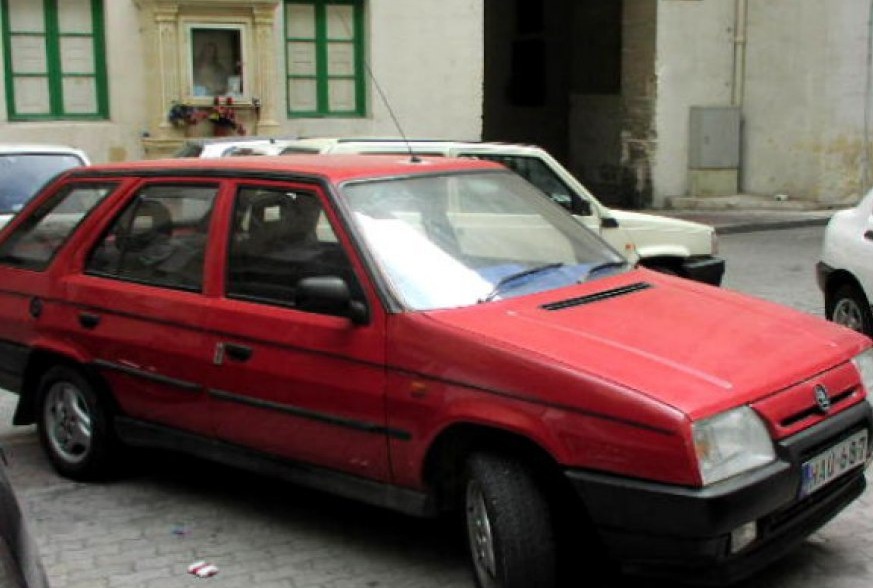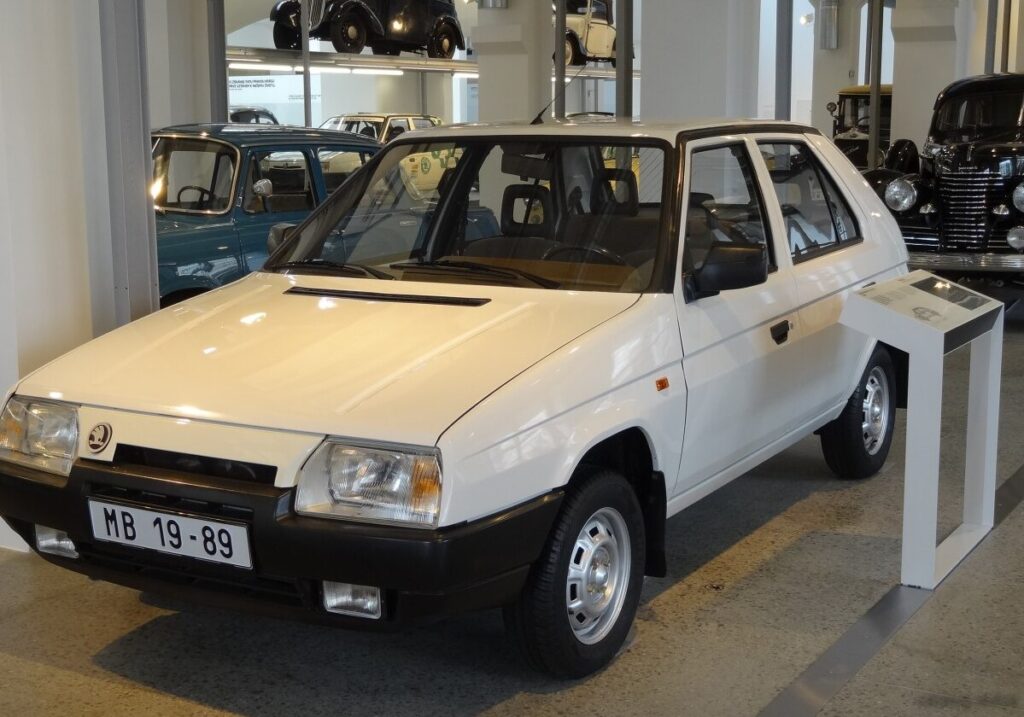
The Skoda Favorit 1.3, specifically the 781 series with the 135 engine code, was a pivotal model for the Czech automaker during a period of significant transition. Produced from 1990 to 1994, it represented a modern leap forward for Skoda, moving away from older designs and embracing a more contemporary hatchback format. This 54 horsepower variant, typically found in the X, LX, and GLX trim levels, served as the entry point into the Favorit range, offering affordable transportation for a broad segment of the European market. It was a key component of Skoda’s strategy to re-establish itself as a competitive player before its acquisition by the Volkswagen Group.
Technical Specifications
| Brand | Skoda |
| Model | Favorit |
| Generation | Favorit (781) |
| Type (Engine) | 1.3 135 X,LX,GLX (781) (54 Hp) |
| Start of production | 1990 |
| End of production | 1994 |
| Powertrain Architecture | Internal Combustion engine |
| Body type | Hatchback |
| Seats | 5 |
| Doors | 5 |
| Fuel consumption (combined) | 7.1 l/100 km (33.1 US mpg, 39.8 UK mpg, 14.1 km/l) |
| Fuel Type | Petrol (Gasoline) |
| Acceleration 0 – 100 km/h | 17 sec |
| Acceleration 0 – 62 mph | 17 sec |
| Acceleration 0 – 60 mph | 16.2 sec |
| Maximum speed | 140 km/h (86.99 mph) |
| Weight-to-power ratio | 16.2 kg/Hp, 61.7 Hp/tonne |
| Weight-to-torque ratio | 8.8 kg/Nm, 113.1 Nm/tonne |
| Power | 54 Hp @ 4500 rpm |
| Power per litre | 41.9 Hp/l |
| Torque | 99 Nm @ 3000 rpm (73.02 lb.-ft. @ 3000 rpm) |
| Engine layout | Front, Transverse |
| Engine Model/Code | 781.135 |
| Engine displacement | 1289 cm3 (78.66 cu. in.) |
| Number of cylinders | 4 |
| Engine configuration | Inline |
| Cylinder Bore | 75.5 mm (2.97 in.) |
| Piston Stroke | 72 mm (2.83 in.) |
| Compression ratio | 8.8:1 |
| Number of valves per cylinder | 2 |
| Fuel injection system | Single-point injection |
| Engine aspiration | Naturally aspirated engine |
| Engine oil capacity | 4.5 l (4.76 US qt | 3.96 UK qt) |
| Coolant | 6 l (6.34 US qt | 5.28 UK qt) |
| Kerb Weight | 875 kg (1929.04 lbs.) |
| Max. weight | 1325 kg (2921.12 lbs.) |
| Max load | 450 kg (992.08 lbs.) |
| Trunk (boot) space – minimum | 251 l (8.86 cu. ft.) |
| Trunk (boot) space – maximum | 1038 l (36.66 cu. ft.) |
| Fuel tank capacity | 42 l (11.1 US gal | 9.24 UK gal) |
| Length | 3815 mm (150.2 in.) |
| Width | 1620 mm (63.78 in.) |
| Height | 1415 mm (55.71 in.) |
| Wheelbase | 2450 mm (96.46 in.) |
| Front track | 1420 mm (55.91 in.) |
| Rear (Back) track | 1380 mm (54.33 in.) |
| Drivetrain Architecture | The Internal combustion engine (ICE) drives the front wheels of the vehicle. |
| Drive wheel | Front wheel drive |
| Number of gears and type of gearbox | 5 gears, manual transmission |
| Front suspension | Spring Strut |
| Rear suspension | Coil spring |
| Front brakes | Disc |
| Rear brakes | Drum |
| Assisting systems | ABS (Anti-lock braking system) |
| Steering type | Steering rack and pinion |
| Tires size | 165/70 R13 S |
INTRODUCTION
The Skoda Favorit 1.3 135, produced between 1990 and 1994, was a significant departure from Skoda’s traditionally conservative designs. It was built on the 781 platform, a completely new design for the company, and represented a move towards modern, front-wheel-drive hatchback construction. Positioned as the base model within the Favorit lineup, the 1.3-liter engine and five-speed manual transmission combination offered an economical and practical option for buyers. The Favorit aimed to compete with other small hatchbacks in the European market, such as the Fiat Uno, Peugeot 205, and Volkswagen Polo, offering a compelling value proposition.
Powertrain & Engine Architecture
At the heart of the Favorit 1.3 was the 781.135 engine, a 1.3-liter inline-four cylinder gasoline engine. This engine featured a single overhead camshaft (SOHC) operating two valves per cylinder. Fuel delivery was handled by a single-point fuel injection system, a relatively basic setup for the time, but contributing to the car’s affordability. The engine produced 54 horsepower at 4500 rpm and 99 Nm (73 lb-ft) of torque at 3000 rpm. The engine’s relatively low compression ratio of 8.8:1 was a factor in its ability to run on lower octane fuel, common in many European markets. The engine was transversely mounted, driving the front wheels through a standard five-speed manual transmission. This transmission was chosen for its efficiency and cost-effectiveness, although it wasn’t known for particularly sporty gear changes.
Driving Characteristics
The Favorit 1.3’s driving experience was characterized by its practicality rather than performance. With only 54 horsepower propelling approximately 875 kg (1929 lbs), acceleration was leisurely. 0-60 mph took around 16.2 seconds, and top speed was limited to 140 km/h (87 mph). The five-speed gearbox helped to keep the engine in its optimal power band, but overtaking required careful planning. Compared to the more powerful 1.6-liter versions of the Favorit, the 1.3 felt noticeably slower. However, the 1.3 offered better fuel economy, making it a more attractive option for drivers prioritizing cost savings. The steering was light and easy, making it maneuverable in urban environments, but lacked significant feedback. The suspension, while adequate, was tuned for comfort rather than sporty handling.
Equipment & Trim Levels
The Favorit 1.3 X served as the base trim level, offering a fairly spartan level of equipment. Standard features typically included cloth upholstery, basic instrumentation, and a steering wheel. The LX trim added features like a more comfortable interior trim, a better stereo, and sometimes power windows. The GLX trim, the highest level available with the 1.3 engine, included features like central locking, upgraded upholstery, and alloy wheels. Optional extras included a sunroof, metallic paint, and a more advanced radio. The interior design was functional and durable, prioritizing practicality over luxury.
Chassis & Braking
The Favorit 1.3 utilized a relatively simple chassis design. The front suspension consisted of MacPherson strut springs, while the rear suspension employed a coil spring setup. The front brakes were disc brakes, providing adequate stopping power, while the rear brakes were drums, a cost-saving measure. ABS (Anti-lock Braking System) was available as an option, enhancing safety. The car’s relatively light weight helped to compensate for the modest braking performance. The steering system was a rack and pinion setup, providing reasonable precision.
Market Reception & Comparison
The Skoda Favorit 1.3 was generally well-received as an affordable and practical hatchback. Critics praised its spacious interior, good fuel economy (around 33.1 US mpg), and competitive price. However, the engine’s lack of power and the somewhat basic interior were common criticisms. Compared to the higher-spec Favorit models, such as the 1.6, the 1.3 offered a significantly lower price point, making it accessible to a wider range of buyers. The 1.6-liter models provided a more engaging driving experience, but at the expense of fuel economy. The 1.3’s simplicity also translated to lower maintenance costs, making it a popular choice for budget-conscious drivers.
Legacy
The Skoda Favorit 1.3 played a crucial role in Skoda’s modernization and eventual acquisition by Volkswagen. It demonstrated the company’s ability to design and build a modern, competitive vehicle. While the 1.3 engine isn’t known for its longevity or high performance, it proved to be reasonably reliable with proper maintenance. Today, the Favorit 1.3 is a relatively rare sight on the roads, but it has gained a following among classic car enthusiasts who appreciate its simplicity, affordability, and historical significance. Parts availability can be challenging, but the car’s straightforward mechanical design makes it relatively easy to repair for those with mechanical skills. The Favorit 1.3 remains a testament to Skoda’s resilience and its journey towards becoming a respected automotive brand.