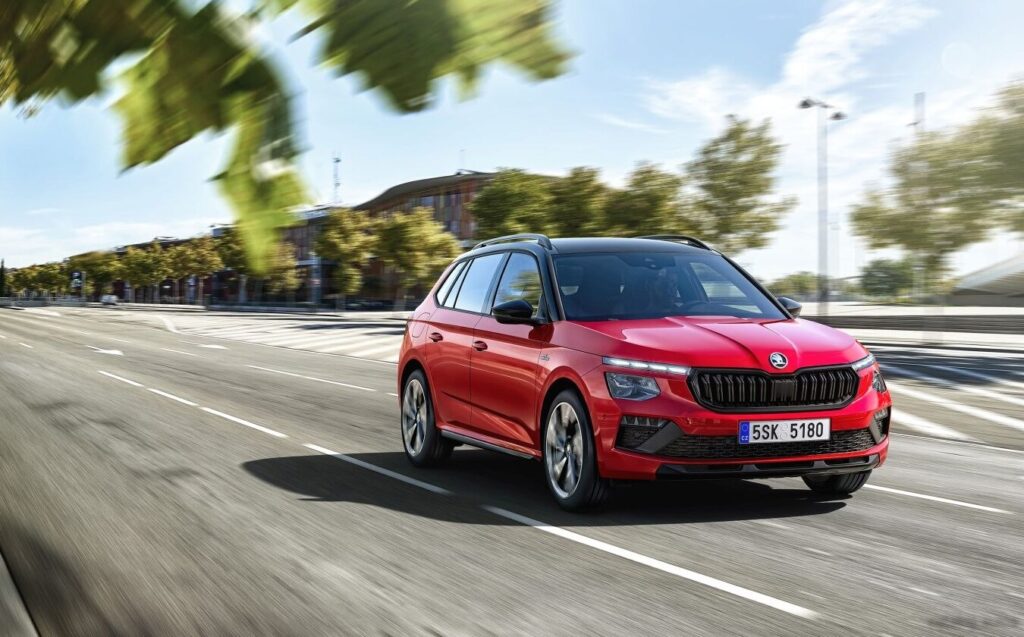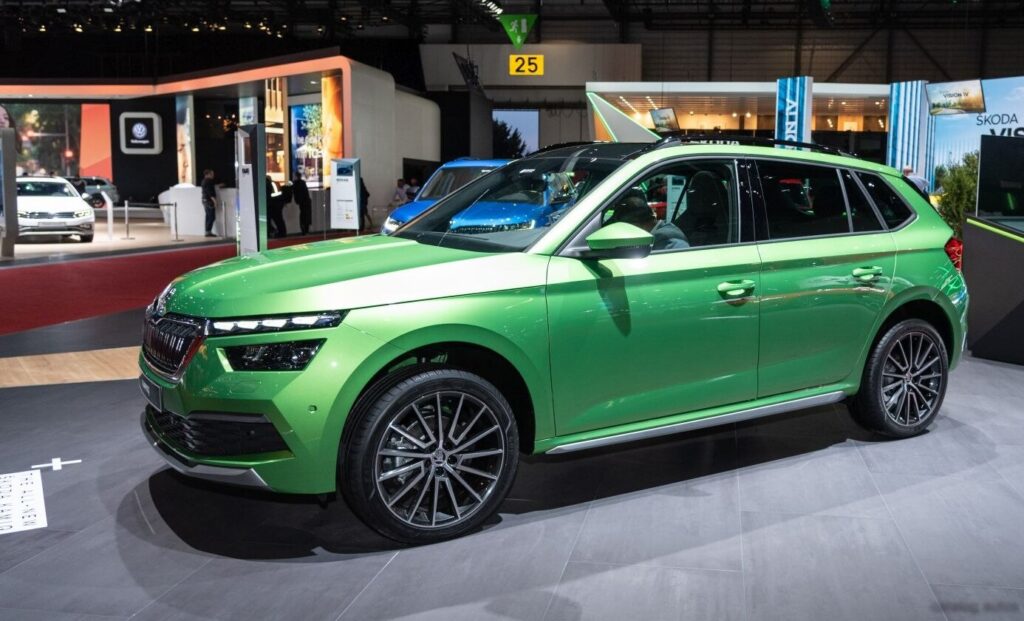
The Skoda Kamiq 1.0 TSI (115 hp) represents an entry point into the Kamiq range, Skoda’s compact SUV introduced in June 2019 and produced through October 2020. Positioned as a practical and affordable option, this variant utilized a downsized turbocharged engine paired with a six-speed manual transmission. It was a key model for Skoda in the European market, appealing to buyers seeking a fuel-efficient and versatile vehicle for urban and family use. The Kamiq itself is built on the Volkswagen Group’s MQB A0 platform, shared with models like the Volkswagen T-Cross and SEAT Arona.
Technical Specifications
| Brand | Skoda |
| Model | Kamiq |
| Generation | Kamiq |
| Type (Engine) | 1.0 TSI (115 Hp) |
| Start of production | June, 2019 |
| End of production | October, 2020 |
| Powertrain Architecture | Internal Combustion engine |
| Body type | SUV |
| Seats | 5 |
| Doors | 5 |
| Fuel consumption (urban) | 6.3-6.4 l/100 km (37.3 – 36.8 US mpg, 44.8 – 44.1 UK mpg, 15.9 – 15.6 km/l) |
| Fuel consumption (extra urban) | 4.2-4.3 l/100 km (56 – 54.7 US mpg, 67.3 – 65.7 UK mpg, 23.8 – 23.3 km/l) |
| Fuel consumption (combined) | 5.0-5.1 l/100 km (47 – 46.1 US mpg, 56.5 – 55.4 UK mpg, 20 – 19.6 km/l) |
| CO2 emissions | 113-116 g/km |
| Fuel Type | Petrol (Gasoline) |
| Acceleration 0 – 100 km/h | 9.9 sec |
| Acceleration 0 – 62 mph | 9.9 sec |
| Acceleration 0 – 60 mph | 9.4 sec |
| Maximum speed | 194 km/h (120.55 mph) |
| Emission standard | Euro 6d – TEMP |
| Weight-to-power ratio | 10.1 kg/Hp, 99.5 Hp/tonne |
| Weight-to-torque ratio | 5.8 kg/Nm, 173 Nm/tonne |
| Power | 115 Hp @ 5000-5500 rpm |
| Power per litre | 115.1 Hp/l |
| Torque | 200 Nm @ 2000-3500 rpm (147.51 lb.-ft. @ 2000-3500 rpm) |
| Engine layout | Front, Transverse |
| Engine Model/Code | EA211 / DKRF |
| Engine displacement | 999 cm3 (60.96 cu. in.) |
| Number of cylinders | 3 |
| Engine configuration | Inline |
| Number of valves per cylinder | 4 |
| Fuel injection system | Direct injection |
| Engine aspiration | Turbocharger, Intercooler |
| Valvetrain | DOHC |
| Engine oil capacity | 4 l (4.23 US qt | 3.52 UK qt) |
| Kerb Weight | 1156-1315 kg (2548.54 – 2899.08 lbs.) |
| Max. weight | 1710-1746 kg (3769.9 – 3849.27 lbs.) |
| Max load | 431-554 kg (950.19 – 1221.36 lbs.) |
| Trunk (boot) space – minimum | 400 l (14.13 cu. ft.) |
| Trunk (boot) space – maximum | 1395 l (49.26 cu. ft.) |
| Fuel tank capacity | 50 l (13.21 US gal | 11 UK gal) |
| Max. roof load | 75 kg (165.35 lbs.) |
| Permitted trailer load with brakes (12%) | 1200 kg (2645.55 lbs.) |
| Permitted trailer load without brakes | 610 kg (1344.82 lbs.) |
| Permitted towbar download | 75 kg (165.35 lbs.) |
| Length | 4241 mm (166.97 in.) |
| Width | 1793 mm (70.59 in.) |
| Width including mirrors | 1988 mm (78.27 in.) |
| Height | 1553 mm (61.14 in.) |
| Wheelbase | 2651 mm (104.37 in.) |
| Front track | 1531 mm (60.28 in.) |
| Rear (Back) track | 1516 mm (59.69 in.) |
| Front overhang | 837 mm (32.95 in.) |
| Rear overhang | 753 mm (29.65 in.) |
| Ride height (ground clearance) | 182 mm (7.17 in.) |
| Drag coefficient (Cd) | 0.330 |
| Minimum turning circle (turning diameter) | 10.8 m (35.43 ft.) |
| Approach angle | 17.4° |
| Departure angle | 20° |
| Drivetrain Architecture | The Internal combustion engine (ICE) drives the front wheels of the vehicle. |
| Drive wheel | Front wheel drive |
| Number of gears and type of gearbox | 6 gears, manual transmission |
| Front suspension | Independent type McPherson |
| Rear suspension | Torsion |
| Front brakes | Ventilated discs |
| Rear brakes | Disc |
| Assisting systems | ABS (Anti-lock braking system) |
| Steering type | Steering rack and pinion |
| Power steering | Electric Steering |
| Tires size | 205/60 R16; 205/55 R17 |
| Wheel rims size | 6J x 16; 6J x 17 |
Powertrain & Engine Architecture
The heart of the Kamiq 1.0 TSI is the EA211 series 1.0-liter turbocharged three-cylinder engine, specifically the DKRF code. This engine is a key component of Volkswagen Group’s strategy to offer fuel-efficient, downsized powertrains. It features direct fuel injection, a single turbocharger with an intercooler, and a double overhead camshaft (DOHC) valvetrain with four valves per cylinder. The engine produces 115 horsepower at 5000-5500 rpm and 200 Nm (147.51 lb-ft) of torque between 2000 and 3500 rpm. The six-speed manual transmission was standard, offering a balance between fuel economy and driver engagement. The engine’s relatively small displacement and turbocharging contribute to its responsiveness, although it’s not designed for outright performance.
Driving Characteristics
The Kamiq 1.0 TSI delivers adequate performance for everyday driving. Acceleration from 0 to 100 km/h (0-62 mph) takes approximately 9.9 seconds. While not particularly quick, the engine provides sufficient power for merging onto highways and overtaking slower traffic. The six-speed manual transmission allows drivers to maintain optimal engine speed for efficiency or power. Compared to higher-output versions of the Kamiq, such as those with the 1.5 TSI engine, the 1.0 TSI feels less powerful, especially when fully loaded. However, its lighter weight and efficient engine contribute to better fuel economy. The gear ratios are tuned for a balance of acceleration and fuel efficiency, with a relatively long sixth gear for highway cruising.
Equipment & Trim Levels
The 1.0 TSI variant typically came with a respectable level of standard equipment. This included air conditioning, a touchscreen infotainment system with Apple CarPlay and Android Auto compatibility, alloy wheels, and a suite of safety features such as ABS, ESC (Electronic Stability Control), and multiple airbags. Higher trim levels offered additional features like automatic climate control, parking sensors, a rear-view camera, and more advanced infotainment options. Interior upholstery was typically cloth, with options for upgraded materials on higher trims. The dashboard layout was functional and modern, with a focus on ease of use.
Chassis & Braking
The Kamiq 1.0 TSI utilizes a McPherson strut front suspension and a torsion beam rear suspension. This setup provides a comfortable ride quality, suitable for everyday driving conditions. The front brakes are ventilated discs, while the rear brakes are solid discs. ABS (Anti-lock Braking System) is standard, enhancing braking performance and safety. The steering is electric power-assisted, providing light and precise control. The suspension is tuned for comfort rather than sporty handling, prioritizing ride quality over sharp cornering. Stabilizer bars are included to reduce body roll during cornering.
Market Reception & Comparison
The Skoda Kamiq 1.0 TSI was generally well-received by automotive critics as a practical and affordable compact SUV. It was praised for its fuel efficiency, comfortable ride, and spacious interior. However, some reviewers noted that the 1.0-liter engine could feel underpowered, especially when carrying passengers or cargo. Compared to other trims in the Kamiq lineup, the 1.0 TSI offered the most affordable entry point, making it attractive to budget-conscious buyers. Its fuel economy was superior to that of the more powerful 1.5 TSI variants, while its reliability was generally considered good, typical of Skoda’s reputation for build quality.
Legacy
The Skoda Kamiq 1.0 TSI has proven to be a reliable and durable vehicle in the used car market. The EA211 engine, while not known for being exceptionally powerful, is generally considered robust and relatively trouble-free. Regular maintenance, including oil changes and timing belt replacements, is crucial for ensuring long-term reliability. The Kamiq’s spacious interior and practical features continue to make it an appealing option for families and individuals seeking a versatile and affordable compact SUV. As of today, well-maintained examples of the 1.0 TSI Kamiq can be found at reasonable prices, offering a good value proposition for buyers seeking a dependable and fuel-efficient vehicle.