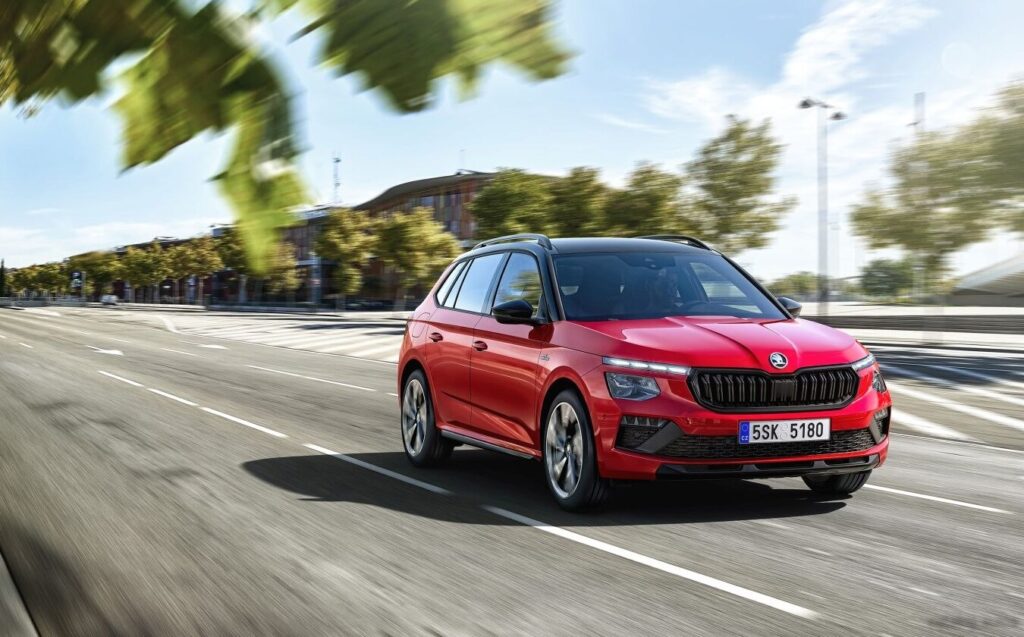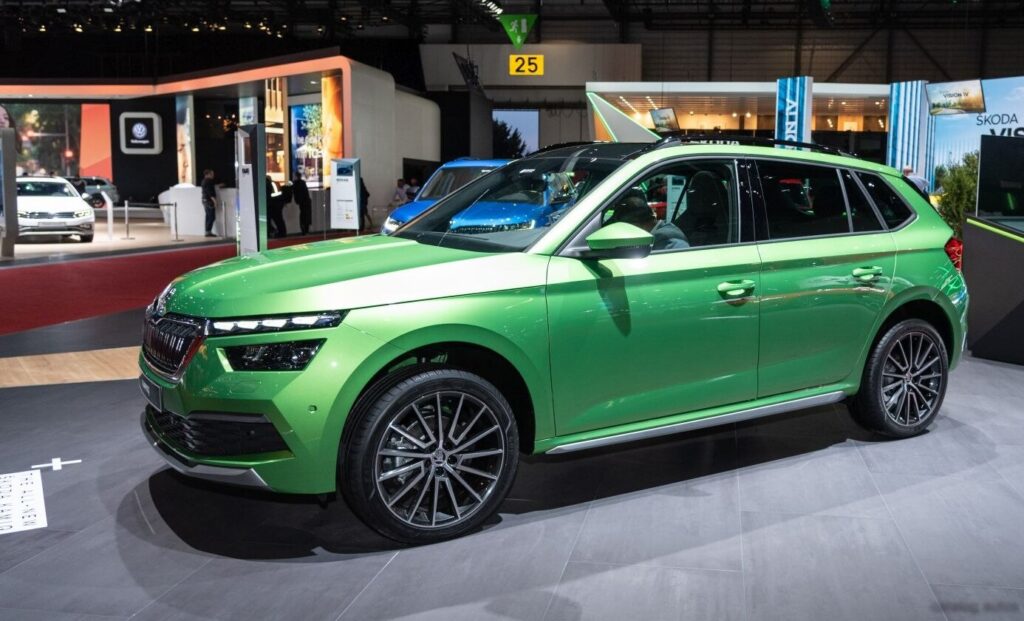
The Skoda Kamiq 1.0 TSI (95 hp) was a front-wheel-drive subcompact SUV produced from June 2019 through December 2023. Positioned as the entry-level engine option within the Kamiq range, it served as an accessible and fuel-efficient variant aimed at buyers prioritizing economy and practicality. The Kamiq itself, launched as Skoda’s smallest SUV, was built on the Volkswagen Group’s MQB A0 platform – also underpinning the Volkswagen T-Cross and SEAT Arona – and represented Skoda’s expansion into the rapidly growing compact crossover segment, primarily targeting the European market. This particular 1.0 TSI variant offered a balance between affordability and modern features, making it a popular choice for urban commuters and small families.
Technical Specifications
| Brand | Skoda |
| Model | Kamiq |
| Generation | Kamiq |
| Type (Engine) | 1.0 TSI (95 Hp) |
| Start of production | June, 2019 |
| End of production | December, 2023 |
| Powertrain Architecture | Internal Combustion engine |
| Body type | SUV |
| Seats | 5 |
| Doors | 5 |
| Fuel consumption (urban) | 6.5 l/100 km (36.2 US mpg, 43.5 UK mpg, 15.4 km/l) |
| Fuel consumption (extra urban) | 4.3 l/100 km (54.7 US mpg, 65.7 UK mpg, 23.3 km/l) |
| Fuel consumption (combined) | 5.1 l/100 km (46.1 US mpg, 55.4 UK mpg, 19.6 km/l) |
| CO2 emissions | 116 g/km |
| Fuel Type | Petrol (Gasoline) |
| Acceleration 0 – 100 km/h | 11.1 sec |
| Acceleration 0 – 62 mph | 11.1 sec |
| Acceleration 0 – 60 mph | 10.5 sec |
| Maximum speed | 181 km/h (112.47 mph) |
| Emission standard | Euro 6d – TEMP |
| Weight-to-power ratio | 12 kg/Hp, 83.4 Hp/tonne |
| Weight-to-torque ratio | 6.5 kg/Nm, 153.6 Nm/tonne |
| Power | 95 Hp @ 5000-5500 rpm |
| Power per litre | 95.1 Hp/l |
| Torque | 175 Nm @ 2000-3500 rpm (129.07 lb.-ft. @ 2000-3500 rpm) |
| Engine layout | Front, Transverse |
| Engine Model/Code | EA211 / DKLA |
| Engine displacement | 999 cm3 (60.96 cu. in.) |
| Number of cylinders | 3 |
| Engine configuration | Inline |
| Number of valves per cylinder | 4 |
| Fuel injection system | Direct injection |
| Engine aspiration | Turbocharger, Intercooler |
| Valvetrain | DOHC |
| Engine oil capacity | 4 l (4.23 US qt | 3.52 UK qt) |
| Coolant | 10 l (10.57 US qt | 8.8 UK qt) |
| Kerb Weight | 1139-1298 kg (2511.07 – 2861.6 lbs.) |
| Max. weight | 1702-1730 kg (3752.27 – 3814 lbs.) |
| Max load | 432-563 kg (952.4 – 1241.2 lbs.) |
| Trunk (boot) space – minimum | 400 l (14.13 cu. ft.) |
| Trunk (boot) space – maximum | 1395 l (49.26 cu. ft.) |
| Fuel tank capacity | 50 l (13.21 US gal | 11 UK gal) |
| Max. roof load | 75 kg (165.35 lbs.) |
| Permitted trailer load with brakes (12%) | 1150 kg (2535.32 lbs.) |
| Permitted trailer load without brakes | 600 kg (1322.77 lbs.) |
| Permitted towbar download | 75 kg (165.35 lbs.) |
| Length | 4241 mm (166.97 in.) |
| Width | 1793 mm (70.59 in.) |
| Width including mirrors | 1988 mm (78.27 in.) |
| Height | 1553 mm (61.14 in.) |
| Wheelbase | 2651 mm (104.37 in.) |
| Front track | 1531 mm (60.28 in.) |
| Rear (Back) track | 1516 mm (59.69 in.) |
| Front overhang | 837 mm (32.95 in.) |
| Rear overhang | 753 mm (29.65 in.) |
| Ride height (ground clearance) | 182 mm (7.17 in.) |
| Drag coefficient (Cd) | 0.328 |
| Minimum turning circle (turning diameter) | 10.8 m (35.43 ft.) |
| Approach angle | 17.4° |
| Departure angle | 20° |
| Drivetrain Architecture | The Internal combustion engine (ICE) drives the front wheels of the vehicle. |
| Drive wheel | Front wheel drive |
| Number of gears and type of gearbox | 5 gears, manual transmission |
| Front suspension | Independent type McPherson |
| Rear suspension | Torsion |
| Front brakes | Ventilated discs |
| Rear brakes | Disc |
| Assisting systems | ABS (Anti-lock braking system) |
| Steering type | Steering rack and pinion |
| Power steering | Electric Steering |
| Tires size | 205/60 R16; 205/55 R17 |
| Wheel rims size | 6J x 16; 6J x 17 |
Powertrain & Engine Architecture
The heart of the Kamiq 1.0 TSI is the EA211 series 1.0-liter turbocharged three-cylinder gasoline engine, specifically the DKLA code. This engine is a key component of the Volkswagen Group’s modular engine family, designed for fuel efficiency and compact packaging. It utilizes direct fuel injection, delivering fuel directly into the combustion chamber for improved combustion control and efficiency. The engine also features an intercooler to cool the intake air, increasing its density and further enhancing performance. The DOHC (Double Overhead Camshaft) valvetrain, with four valves per cylinder, optimizes gas flow for improved power output. The engine is transversely mounted at the front of the vehicle, driving the front wheels. The 95 horsepower output is achieved between 5000 and 5500 rpm, with a peak torque of 175 Nm (129 lb-ft) available from 2000 to 3500 rpm. The engine is typically paired with a five-speed manual transmission, although a seven-speed dual-clutch transmission (DSG) was also available as an option.
Driving Characteristics
The 1.0 TSI 95 hp Kamiq offers adequate performance for everyday driving, particularly in urban environments. Acceleration from 0-100 km/h (0-62 mph) takes around 11.1 seconds, which is not particularly brisk but sufficient for most commuting needs. The turbocharger provides a noticeable boost in power during acceleration, but the engine can feel somewhat strained when fully loaded or during overtaking maneuvers. The five-speed manual transmission is well-matched to the engine’s characteristics, offering smooth gear changes and a reasonable spread of ratios. Compared to higher-output versions of the Kamiq, such as the 1.5 TSI, the 1.0 TSI feels less responsive and requires more driver input to maintain speed. However, its lighter weight and lower power output contribute to improved fuel economy.
Equipment & Trim Levels
The Kamiq 1.0 TSI typically came equipped with a respectable level of standard features. These included air conditioning, a touchscreen infotainment system with Apple CarPlay and Android Auto compatibility, Bluetooth connectivity, and a suite of safety features such as ABS, ESC (Electronic Stability Control), and multiple airbags. Interior upholstery was typically cloth, with a functional and durable design. Optional extras included alloy wheels, parking sensors, a rear-view camera, and more advanced infotainment systems with navigation. Trim levels varied by market, but generally offered progressively more features and cosmetic enhancements as you moved up the range.
Chassis & Braking
The Kamiq 1.0 TSI utilizes a McPherson strut front suspension and a torsion beam rear suspension. This setup provides a comfortable ride quality, absorbing bumps and imperfections in the road surface effectively. The torsion beam rear suspension is a cost-effective solution that minimizes weight and complexity. The braking system consists of ventilated discs at the front and solid discs at the rear, providing adequate stopping power for the vehicle’s weight and performance. ABS (Anti-lock Braking System) is standard, enhancing braking performance and stability in emergency situations.
Market Reception & Comparison
The Skoda Kamiq 1.0 TSI was generally well-received by automotive critics as a practical and affordable subcompact SUV. Its fuel efficiency was a major selling point, with combined fuel consumption figures around 5.1 l/100 km (46.1 US mpg). Compared to other trims in the Kamiq lineup, the 1.0 TSI offered the most affordable entry point, making it attractive to budget-conscious buyers. However, some critics noted that the engine could feel underpowered in certain situations. Compared to competitors like the Volkswagen T-Cross and SEAT Arona, the Kamiq offered a similar level of practicality and fuel efficiency, but often at a slightly lower price point.
Legacy
The 1.0 TSI engine, particularly the DKLA code, has proven to be a relatively reliable powertrain when properly maintained. Common issues, if any, often relate to the turbocharger or the timing chain, but these are not widespread. On the used car market, the Kamiq 1.0 TSI represents a good value proposition, offering a practical and fuel-efficient SUV at an affordable price. Its compact size and easy maneuverability make it well-suited for urban driving, and its spacious interior provides ample room for passengers and luggage. The Kamiq’s reputation for build quality and reliability further enhances its appeal in the used car market.