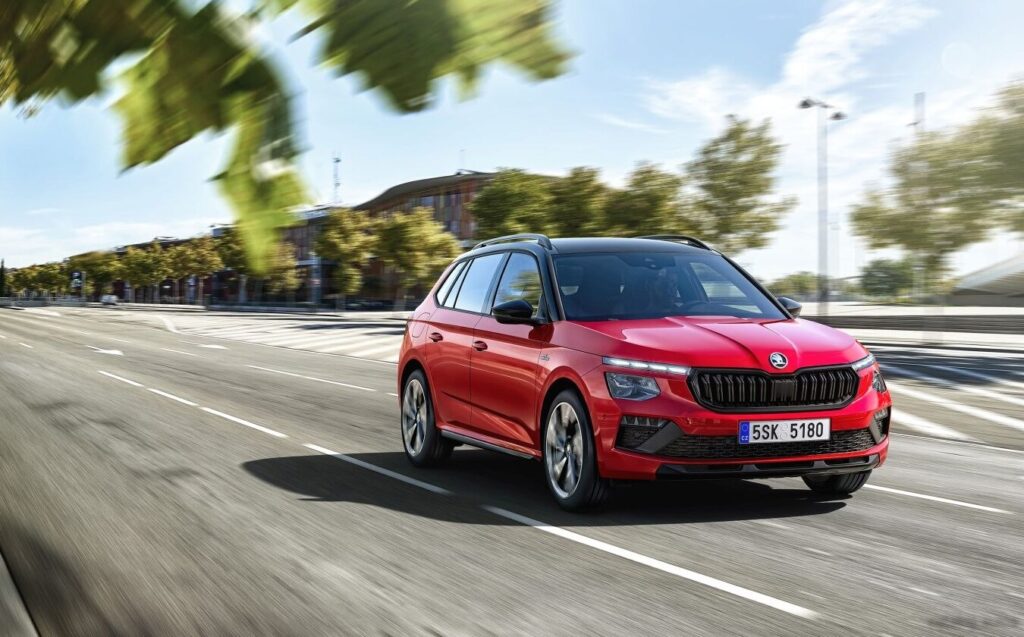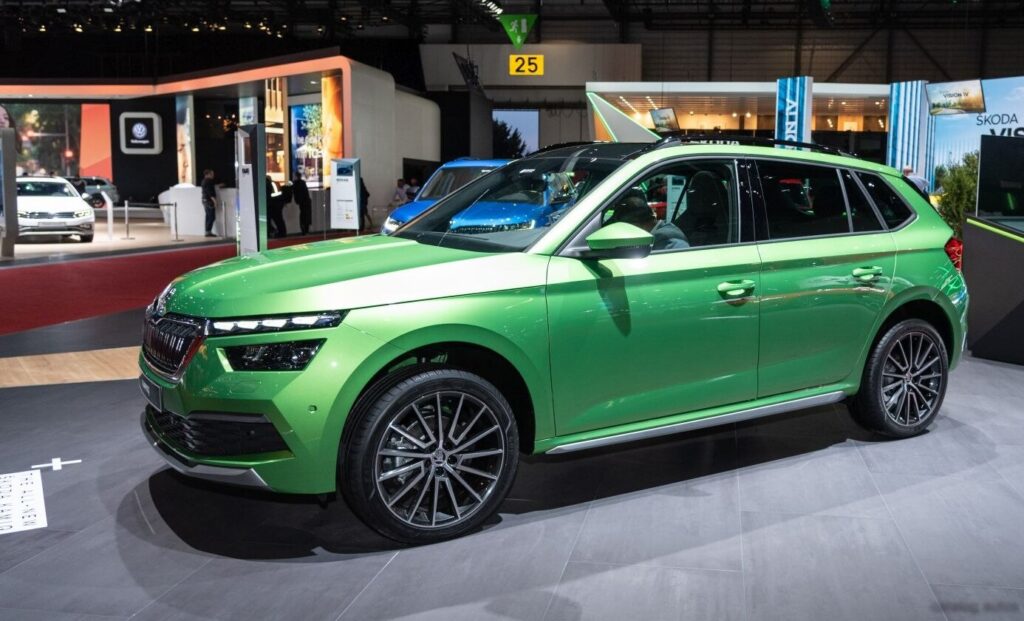
The Skoda Kamiq 1.5i, producing 110 horsepower, was a key variant in Skoda’s compact SUV lineup from its introduction in 2018 through 2023. Positioned as an entry-level to mid-range option, it offered a balance of affordability, practicality, and fuel efficiency within the broader Kamiq range, which also included more powerful engine options. The Kamiq itself represented Skoda’s entry into the rapidly growing subcompact SUV segment, designed to appeal to families and individuals seeking a versatile and modern vehicle. It’s built on the Volkswagen Group’s MQB A0 platform, shared with models like the Volkswagen T-Cross and SEAT Arona.
Technical Specifications
| Brand | Skoda |
| Model | Kamiq |
| Generation | Kamiq |
| Type (Engine) | 1.5i (110 Hp) |
| Start of production | 2018 year |
| End of production | 2023 year |
| Powertrain Architecture | Internal Combustion engine |
| Body type | SUV |
| Seats | 5 |
| Doors | 5 |
| Fuel consumption (economy) – combined | 6.3 l/100 km |
| Fuel consumption (economy) – combined | 37.3 US mpg |
| Fuel consumption (economy) – combined | 44.8 UK mpg |
| Fuel consumption (economy) – combined | 15.9 km/l |
| Fuel Type | Petrol (Gasoline) |
| Acceleration 0 – 100 km/h | 12.8 sec |
| Acceleration 0 – 62 mph | 12.8 sec |
| Acceleration 0 – 60 mph | 12.2 sec |
| Maximum speed | 178 km/h |
| Maximum speed | 110.6 mph |
| Weight-to-power ratio | 11.5 kg/Hp |
| Weight-to-power ratio | 87.3 Hp/tonne |
| Weight-to-torque ratio | 8.4 kg/Nm |
| Weight-to-torque ratio | 119 Nm/tonne |
| Power | 110 Hp @ 6000 rpm |
| Power per litre | 73.4 Hp/l |
| Torque | 150 Nm @ 3800 rpm |
| Torque | 110.63 lb.-ft. @ 3800 rpm |
| Engine layout | Front, Transverse |
| Engine displacement | 1498 cm3 |
| Engine displacement | 91.41 cu. in. |
| Number of cylinders | 4 |
| Engine configuration | Inline |
| Number of valves per cylinder | 4 |
| Fuel injection system | Multi-port manifold injection |
| Engine aspiration | Naturally aspirated engine |
| Kerb Weight | 1260 kg |
| Kerb Weight | 2777.82 lbs |
| Trunk (boot) space – minimum | 463 l |
| Trunk (boot) space – minimum | 16.35 cu. ft. |
| Trunk (boot) space – maximum | 1510 l |
| Trunk (boot) space – maximum | 53.33 cu. ft. |
| Fuel tank capacity | 55 l |
| Fuel tank capacity | 14.53 US gal |
| Fuel tank capacity | 12.1 UK gal |
| Length | 4390 mm |
| Length | 172.83 in. |
| Width | 1781 mm |
| Width | 70.12 in. |
| Height | 1593 mm |
| Height | 62.72 in. |
| Wheelbase | 2610 mm |
| Wheelbase | 102.76 in. |
| Drivetrain Architecture | The Internal combustion engine (ICE) drives the front wheels of the vehicle. |
| Drive wheel | Front wheel drive |
| Number of gears and type of gearbox | 5 gears, manual transmission |
| Front suspension | Independent type McPherson |
| Rear suspension | Semi-independent suspension, longitudinal arms with transverse torsion shafts |
| Front brakes | Ventilated discs |
| Rear brakes | Disc |
| Assisting systems | ABS (Anti-lock braking system) |
Powertrain & Engine Architecture
The Skoda Kamiq 1.5i utilizes a 1.5-liter, naturally aspirated inline-four cylinder engine, designated as the EA211 family. This engine, often found in various Volkswagen Group vehicles, is known for its relatively simple design and focus on fuel efficiency. The 1.5i engine produces 110 horsepower at 6,000 rpm and 150 Nm (110.63 lb-ft) of torque at 3,800 rpm. It employs multi-point fuel injection, delivering fuel directly into the intake ports. The engine features four valves per cylinder, contributing to improved breathing and efficiency. The 5-speed manual transmission was the standard offering for this variant, providing a straightforward driving experience. While a 7-speed DSG dual-clutch transmission was available on higher trims, it wasn’t typically paired with this specific engine output.
Driving Characteristics
The Kamiq 1.5i, with its 110 hp and manual transmission, offered a practical and economical driving experience. Acceleration was adequate for everyday driving, with a 0-60 mph time of around 12.2 seconds. However, it wasn’t designed for spirited performance. The engine felt responsive enough in the lower and mid-range, making it suitable for urban commutes and highway cruising. The 5-speed gearbox provided a decent spread of ratios, but higher gears could feel somewhat strained when climbing hills or overtaking. Compared to the more powerful 1.6-liter TDI diesel or the 1.5 TSI turbocharged petrol variants, the 1.5i felt less potent, but it offered a smoother and quieter driving experience, particularly at lower speeds. The relatively light weight of the Kamiq helped mitigate the lower power output.
Equipment & Trim Levels
The 1.5i Kamiq typically served as the entry point to the Kamiq range. Standard equipment generally included air conditioning, a touchscreen infotainment system with Apple CarPlay and Android Auto compatibility, alloy wheels, and a suite of safety features such as ABS, ESC (Electronic Stability Control), and multiple airbags. Higher trim levels, such as SE and SEL, added features like automatic climate control, parking sensors, a larger touchscreen display, and more advanced driver-assistance systems. Interior upholstery was typically cloth, with options for partial leather trim on higher trims. Optional extras included a panoramic sunroof, navigation system, and adaptive cruise control.
Chassis & Braking
The Kamiq 1.5i utilized a McPherson strut front suspension and a semi-independent torsion beam rear suspension. This setup provided a comfortable ride quality, well-suited for everyday driving conditions. The front brakes were ventilated discs, offering good stopping power, while the rear brakes were solid discs. The steering was light and precise, making it easy to maneuver in urban environments. The Kamiq’s chassis was tuned for comfort rather than outright sportiness, prioritizing ride quality and stability over sharp handling. Stabilizer bars were fitted to both the front and rear axles to reduce body roll during cornering.
Market Reception & Comparison
The Skoda Kamiq 1.5i was generally well-received by automotive critics as a practical and affordable SUV. It was praised for its spacious interior, comfortable ride, and good fuel economy. However, some reviewers noted that the engine could feel underpowered, particularly when fully loaded or driving uphill. Compared to the diesel variants, the 1.5i offered lower running costs in terms of fuel price, but the diesel engines provided superior fuel economy and torque. Against the turbocharged petrol models, the 1.5i offered a simpler and more reliable powertrain, but at the expense of performance. The Kamiq 1.5i competed with other subcompact SUVs such as the SEAT Arona, Volkswagen T-Cross, and Hyundai Kona.
Legacy
The 1.5-liter EA211 engine used in the Kamiq 1.5i has proven to be a relatively reliable powertrain. While not without its minor issues, such as occasional oil consumption, it’s generally considered a durable and long-lasting engine. On the used car market, the Kamiq 1.5i represents a good value proposition, offering a practical and affordable SUV with reasonable running costs. Its simplicity and lack of complex technology make it a potentially attractive option for buyers seeking a reliable and easy-to-maintain vehicle. The Kamiq, in general, helped solidify Skoda’s reputation for producing well-built and value-for-money vehicles in the competitive European SUV market.