
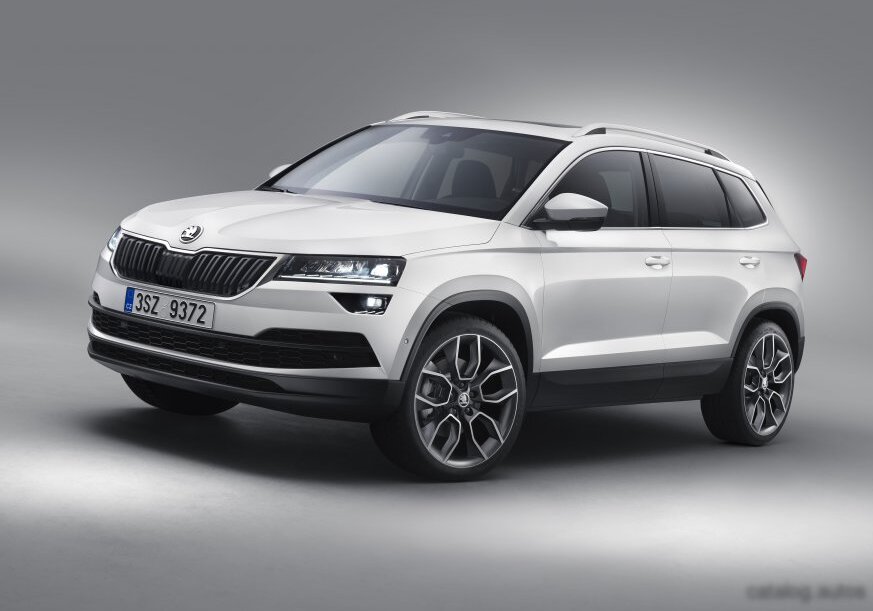
The Skoda Karoq 1.0 TSI (110 hp) was a front-wheel-drive compact SUV produced by the Czech automaker Skoda between October 2020 and November 2021. Positioned as an entry-level offering within the second-generation Karoq range (launched in 2017, internally designated as the A11 platform), it aimed to provide an accessible and fuel-efficient option for families and individuals seeking a practical and versatile vehicle. This variant utilized a three-cylinder turbocharged gasoline engine paired with a six-speed manual transmission, representing a key part of Skoda’s strategy to offer a diverse powertrain lineup catering to varying customer preferences and budgets. The Karoq itself filled a crucial gap in Skoda’s portfolio, slotting between the smaller Fabia and the larger Kodiaq, and quickly became a popular choice in the European market.
Technical Specifications
| Brand | Skoda |
| Model | Karoq |
| Generation | Karoq |
| Type (Engine) | 1.0 TSI (110 Hp) |
| Start of production | October, 2020 |
| End of production | November, 2021 |
| Powertrain Architecture | Internal Combustion engine |
| Body type | SUV |
| Seats | 5 |
| Doors | 5 |
| Fuel consumption at Low speed (WLTP) | 7.2 l/100 km (32.7 US mpg, 39.2 UK mpg, 13.9 km/l) |
| Fuel consumption at Medium speed (WLTP) | 5.7 l/100 km (41.3 US mpg, 49.6 UK mpg, 17.5 km/l) |
| Fuel consumption at high speed (WLTP) | 5.1 l/100 km (46.1 US mpg, 55.4 UK mpg, 19.6 km/l) |
| Fuel consumption at very high speed (WLTP) | 6.2 l/100 km (37.9 US mpg, 45.6 UK mpg, 16.1 km/l) |
| Combined fuel consumption (WLTP) | 5.9 l/100 km (39.9 US mpg, 47.9 UK mpg, 16.9 km/l) |
| CO2 emissions (WLTP) | 134 g/km |
| Fuel consumption (economy) – urban (NEDC) | 6.5-6.7 l/100 km (36.2 – 35.1 US mpg, 43.5 – 42.2 UK mpg, 15.4 – 14.9 km/l) |
| Fuel consumption (economy) – extra urban (NEDC) | 4.4-4.7 l/100 km (53.5 – 50 US mpg, 64.2 – 60.1 UK mpg, 22.7 – 21.3 km/l) |
| Fuel consumption (economy) – combined (NEDC) | 5.2-5.5 l/100 km (45.2 – 42.8 US mpg, 54.3 – 51.4 UK mpg, 19.2 – 18.2 km/l) |
| CO2 emissions (NEDC) | 119-125 g/km |
| Fuel Type | Petrol (Gasoline) |
| Acceleration 0 – 100 km/h | 11.1 sec |
| Acceleration 0 – 62 mph | 11.1 sec |
| Acceleration 0 – 60 mph | 10.5 sec |
| Maximum speed | 186 km/h (115.58 mph) |
| Emission standard | Euro 6d-ISC-FCM |
| Weight-to-power ratio | 11.5 kg/Hp, 86.7 Hp/tonne |
| Weight-to-torque ratio | 6.3 kg/Nm, 157.6 Nm/tonne |
| Power | 110 Hp @ 5500 rpm |
| Power per litre | 110.1 Hp/l |
| Torque | 200 Nm @ 2000-3000 rpm (147.51 lb.-ft. @ 2000-3000 rpm) |
| Engine layout | Front, Transverse |
| Engine Model/Code | EA211 / DLAA |
| Engine displacement | 999 cm3 (60.96 cu. in.) |
| Number of cylinders | 3 |
| Engine configuration | Inline |
| Cylinder Bore | 74.5 mm (2.93 in.) |
| Piston Stroke | 76.4 mm (3.01 in.) |
| Compression ratio | 10.5:1 |
| Number of valves per cylinder | 4 |
| Fuel injection system | Direct injection |
| Engine aspiration | Turbocharger, Intercooler |
| Valvetrain | DOHC |
| Engine oil capacity | 4 l (4.23 US qt | 3.52 UK qt) |
| Kerb Weight | 1269 kg (2797.67 lbs.) |
| Max. weight | 1872 kg (4127.05 lbs.) |
| Max load | 603 kg (1329.39 lbs.) |
| Trunk (boot) space – minimum | 521 l (18.4 cu. ft.) |
| Trunk (boot) space – maximum | 1630 l (57.56 cu. ft.) |
| Fuel tank capacity | 50 l (13.21 US gal | 11 UK gal) |
| Max. roof load | 75 kg (165.35 lbs.) |
| Permitted trailer load with brakes (8%) | 1400 kg (3086.47 lbs.) |
| Permitted trailer load with brakes (12%) | 1200 kg (2645.55 lbs.) |
| Permitted trailer load without brakes | 670 kg (1477.1 lbs.) |
| Permitted towbar download | 90 kg (198.42 lbs.) |
| Length | 4382 mm (172.52 in.) |
| Width | 1841 mm (72.48 in.) |
| Width including mirrors | 2025 mm (79.72 in.) |
| Height | 1603 mm (63.11 in.) |
| Wheelbase | 2638 mm (103.86 in.) |
| Front track | 1576 mm (62.05 in.) |
| Rear (Back) track | 1541 mm (60.67 in.) |
| Front overhang | 877 mm (34.53 in.) |
| Rear overhang | 866 mm (34.09 in.) |
| Ride height (ground clearance) | 163 mm (6.42 in.) |
| Drag coefficient (Cd) | 0.318 |
| Minimum turning circle (turning diameter) | 10.9 m (35.76 ft.) |
| Approach angle | 18.4° |
| Departure angle | 18.7° |
| Drivetrain Architecture | The Internal combustion engine (ICE) drives the front wheels of the vehicle. |
| Drive wheel | Front wheel drive |
| Number of gears and type of gearbox | 6 gears, manual transmission |
| Front suspension | Independent type McPherson, Transverse stabilizer |
| Rear suspension | Torsion |
| Front brakes | Ventilated discs |
| Rear brakes | Disc |
| Assisting systems | ABS (Anti-lock braking system) |
| Steering type | Steering rack and pinion |
| Power steering | Electric Steering |
| Tires size | 215/55 R17; 215/50 R18 |
| Wheel rims size | 7J x 17; 7J x 18 |
Powertrain & Engine Architecture
The Karoq 1.0 TSI utilized the EA211 engine family, specifically the DLAA code. This is a 999cc, three-cylinder, turbocharged gasoline engine. The engine features direct fuel injection, a single overhead camshaft (DOHC) with four valves per cylinder, and an intercooled turbocharger. This configuration was designed to balance fuel efficiency with adequate performance for everyday driving. The turbocharger helps to mitigate the power deficit typically associated with small displacement engines by forcing more air into the cylinders. The six-speed manual transmission was chosen to maximize fuel economy and provide a more engaging driving experience compared to an automatic option, which wasn’t widely available with this engine initially. The engine’s relatively small displacement and turbocharging contribute to its responsiveness at lower RPMs, but power does taper off at higher engine speeds.
Driving Characteristics
The 110 hp output and 200 Nm of torque delivered by the 1.0 TSI engine in the Karoq resulted in a 0-60 mph time of around 10.5 seconds. While not particularly quick, it was sufficient for comfortable highway cruising and city driving. The six-speed manual transmission allowed drivers to keep the engine in its optimal power band, but required more driver involvement than an automatic. Compared to the more powerful 1.5 TSI or diesel variants, the 1.0 TSI felt noticeably less energetic, especially when fully loaded with passengers and luggage. The gear ratios were tuned for fuel efficiency, meaning that the engine could feel strained when accelerating quickly or climbing hills. The front-wheel-drive configuration provided predictable handling, but lacked the all-weather capability of the optional all-wheel-drive system available on other Karoq models.
Equipment & Trim Levels
The Karoq 1.0 TSI typically came with a reasonable level of standard equipment. This included air conditioning, a touchscreen infotainment system with Apple CarPlay and Android Auto compatibility, alloy wheels, and a suite of safety features such as ABS, ESC (Electronic Stability Control), and multiple airbags. Interior upholstery was typically cloth, with options for higher-grade materials available on higher trim levels. Optional extras included parking sensors, a rearview camera, adaptive cruise control, and a panoramic sunroof. Trim levels varied by market, but generally followed a progression from ‘SE’ or ‘Active’ (entry-level) to ‘SE L’ or ‘Style’ (mid-range) and ‘Elegance’ or ‘Laurin & Klement’ (premium).
Chassis & Braking
The Karoq 1.0 TSI utilized a McPherson strut front suspension and a torsion beam rear suspension. This setup provided a good balance between ride comfort and handling. The front brakes were ventilated discs, while the rear brakes were solid discs. ABS (Anti-lock Braking System) was standard, providing enhanced braking performance in emergency situations. Stabilizer bars were fitted to both the front and rear axles to reduce body roll during cornering. The suspension tuning was generally geared towards comfort, prioritizing a smooth ride over sporty handling.
Market Reception & Comparison
The Karoq 1.0 TSI was generally well-received by automotive critics as a practical and affordable family SUV. Its fuel efficiency was a major selling point, particularly in Europe where fuel costs are high. However, some reviewers noted that the engine could feel underpowered, especially when the vehicle was fully loaded. Compared to the 1.5 TSI variant, the 1.0 TSI offered lower running costs but sacrificed performance. The diesel variants provided even better fuel economy but came with higher purchase prices and potential concerns about emissions regulations. The 1.0 TSI appealed to buyers who prioritized fuel efficiency and affordability over outright performance.
Legacy
The 1.0 TSI engine has proven to be generally reliable, although some owners have reported issues with the timing chain. Regular maintenance, including oil changes and timing chain inspections, is crucial for ensuring the longevity of this powertrain. On the used car market, the Karoq 1.0 TSI represents a good value proposition for buyers seeking a practical and fuel-efficient SUV. Its relatively low running costs and comfortable ride make it a popular choice for families and individuals alike. The Karoq, in general, has established itself as a strong competitor in the compact SUV segment, and the 1.0 TSI variant played a significant role in its success.
