
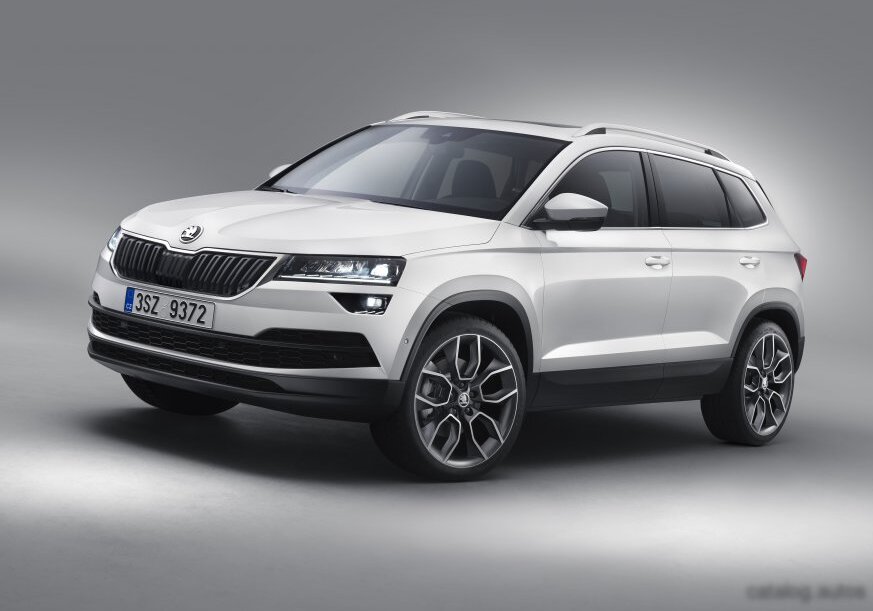
The Skoda Karoq 1.6 TDI, producing 116 horsepower, was a key variant in the first generation (2017-2020) of Skoda’s popular compact SUV. Positioned as an entry-level to mid-range option, it offered a balance of fuel efficiency and practicality for European buyers. The Karoq, launched as a replacement for the Yeti, aimed to provide a more spacious and refined experience while retaining the brand’s reputation for value. This particular engine and transmission combination was a significant part of the Karoq’s sales volume, appealing to customers prioritizing economy over outright performance.
Technical Specifications
| Brand | Skoda |
| Model | Karoq |
| Generation | Karoq |
| Type (Engine) | 1.6 TDI (116 Hp) |
| Start of production | July, 2017 |
| End of production | November, 2020 |
| Powertrain Architecture | Internal Combustion engine |
| Body type | SUV |
| Seats | 5 |
| Doors | 5 |
| Fuel consumption (urban) | 5 l/100 km (47 US mpg, 56.5 UK mpg, 20 km/l) |
| Fuel consumption (extra urban) | 4.4 l/100 km (53.5 US mpg, 64.2 UK mpg, 22.7 km/l) |
| Fuel consumption (combined) | 4.6 l/100 km (51.1 US mpg, 61.4 UK mpg, 21.7 km/l) |
| CO2 emissions | 120 g/km |
| Fuel Type | Diesel |
| Acceleration 0 – 100 km/h | 10.7 sec |
| Acceleration 0 – 62 mph | 10.7 sec |
| Acceleration 0 – 60 mph | 10.2 sec |
| Maximum speed | 188 km/h (116.82 mph) |
| Emission standard | Euro 6 |
| Weight-to-power ratio | 11.6 kg/Hp, 85.9 Hp/tonne |
| Weight-to-torque ratio | 5.4 kg/Nm, 185 Nm/tonne |
| Power | 116 Hp @ 3250-4000 rpm |
| Power per litre | 72.6 Hp/l |
| Torque | 250 Nm @ 1500-3200 rpm (184.39 lb.-ft. @ 1500-3200 rpm) |
| Engine layout | Front, Transverse |
| Engine Model/Code | EA288 / DDYA |
| Engine displacement | 1598 cm3 (97.52 cu. in.) |
| Number of cylinders | 4 |
| Engine configuration | Inline |
| Cylinder Bore | 79.5 mm (3.13 in.) |
| Piston Stroke | 80.5 mm (3.17 in.) |
| Compression ratio | 16.2:1 |
| Number of valves per cylinder | 4 |
| Fuel injection system | Diesel Commonrail |
| Engine aspiration | Turbocharger, Intercooler |
| Engine oil capacity | 4.6 l (4.86 US qt | 4.05 UK qt) |
| Kerb Weight | 1351 kg (2978.45 lbs.) |
| Max. weight | 1976 kg (4356.33 lbs.) |
| Max load | 625 kg (1377.89 lbs.) |
| Trunk (boot) space – minimum | 521 l (18.4 cu. ft.) |
| Trunk (boot) space – maximum | 1630 l (57.56 cu. ft.) |
| Fuel tank capacity | 50 l (13.21 US gal | 11 UK gal) |
| Max. roof load | 75 kg (165.35 lbs.) |
| Permitted trailer load with brakes (12%) | 1500 kg (3306.93 lbs.) |
| Permitted trailer load without brakes | 710 kg (1565.28 lbs.) |
| Length | 4382 mm (172.52 in.) |
| Width | 1841 mm (72.48 in.) |
| Height | 1603 mm (63.11 in.) |
| Wheelbase | 2638 mm (103.86 in.) |
| Front track | 1576 mm (62.05 in.) |
| Rear (Back) track | 1541 mm (60.67 in.) |
| Minimum turning circle | 10.9 m (35.76 ft.) |
| Drivetrain Architecture | The Internal combustion engine (ICE) drives the front wheels of the vehicle. |
| Drive wheel | Front wheel drive |
| Number of gears and type of gearbox | 6 gears, manual transmission |
| Front brakes | Ventilated discs |
| Rear brakes | Disc |
INTRODUCTION
The Skoda Karoq 1.6 TDI (116 hp) was produced from July 2017 to November 2020 as part of the first generation Karoq series, built on the Volkswagen Group’s MQB A1 platform (internally designated 1HX0/A3). It served as a practical and economical choice within the Karoq lineup, targeting families and individuals seeking a versatile SUV with low running costs. The 1.6 TDI engine was a mainstay of the Volkswagen Group’s diesel offerings, known for its fuel efficiency and relatively simple construction. This variant was particularly popular in European markets where diesel fuel was more prevalent and government incentives favored lower-emission vehicles.
Powertrain & Engine Architecture
The Karoq 1.6 TDI utilizes the EA288 series of diesel engines, specifically the DDYA code. This is a common rail, turbocharged four-cylinder engine. The 1598cc engine features four valves per cylinder and a relatively high compression ratio of 16.2:1, contributing to its efficiency. The fuel injection system is a Bosch common rail system, delivering precise fuel metering for optimized combustion. The turbocharger, coupled with an intercooler, provides a boost in power and torque. The 116 horsepower and 250 Nm (184 lb-ft) of torque are delivered between 1500 and 3200 rpm, providing a usable powerband for everyday driving. The engine is transversely mounted in the front of the vehicle. The Karoq 1.6 TDI was primarily offered with a 6-speed manual transmission, although a 7-speed DSG dual-clutch automatic was also available as an option, albeit less common with this engine.
Driving Characteristics
The 1.6 TDI engine in the Karoq, paired with the 6-speed manual transmission, provides adequate performance for typical driving conditions. Acceleration from 0-62 mph takes around 10.7 seconds, which is not particularly brisk but sufficient for merging onto highways and overtaking slower traffic. The engine feels most comfortable in the mid-range, delivering a smooth and linear power delivery. Compared to the more powerful 2.0 TDI variants, the 1.6 TDI feels noticeably less responsive, especially when fully loaded or climbing hills. The manual gearbox is well-matched to the engine, with relatively short throws and a precise feel. The gear ratios are optimized for fuel efficiency, meaning the engine operates at lower RPMs during cruising. The automatic transmission, when equipped, offers smoother shifts but can sometimes feel hesitant when requesting quick acceleration.
Equipment & Trim Levels
The Karoq 1.6 TDI was typically offered in base or mid-level trim configurations. Standard equipment generally included air conditioning, a touchscreen infotainment system with Bluetooth connectivity, alloy wheels, and a suite of safety features such as ABS, ESC, and multiple airbags. Higher trim levels added features like automatic climate control, parking sensors, a rearview camera, and upgraded interior upholstery. Interior materials were generally durable and well-assembled, reflecting Skoda’s commitment to quality. Optional extras included a panoramic sunroof, adaptive cruise control, and a premium sound system. The interior design was functional and user-friendly, with a focus on practicality and space.
Chassis & Braking
The Karoq’s chassis is based on the MQB A1 platform, providing a comfortable and stable ride. The front suspension utilizes MacPherson struts, while the rear suspension employs a torsion beam setup. This configuration strikes a good balance between ride comfort and handling. The Karoq 1.6 TDI typically featured ventilated front disc brakes and solid rear disc brakes. ABS (Anti-lock Braking System) and ESC (Electronic Stability Control) were standard safety features. The steering is electrically assisted, providing a light and precise feel. Stabilizer bars are fitted to both the front and rear axles to reduce body roll during cornering.
Market Reception & Comparison
The Skoda Karoq 1.6 TDI was well-received by automotive critics for its fuel efficiency, spacious interior, and competitive pricing. It was often praised as a practical and sensible choice for families. Compared to the more powerful 2.0 TDI variants, the 1.6 TDI offered significantly better fuel economy, making it an attractive option for high-mileage drivers. However, the 2.0 TDI provided noticeably stronger performance. The 1.6 TDI also compared favorably to competitors like the Nissan Qashqai and Kia Sportage in terms of value for money and interior space. Reliability reports generally indicate that the 1.6 TDI engine is relatively robust, although regular maintenance is essential to prevent issues with the diesel particulate filter (DPF).
Legacy
The Skoda Karoq 1.6 TDI remains a popular choice in the used car market, particularly for buyers seeking an affordable and economical SUV. The EA288 engine, while not without its potential issues (such as DPF clogging), has proven to be generally reliable when properly maintained. The Karoq’s spacious interior and practical design continue to appeal to families. As emissions regulations have tightened, the demand for diesel vehicles has decreased, but the Karoq 1.6 TDI still represents a viable option for those prioritizing fuel efficiency and low running costs. Its reputation for value and practicality ensures its continued presence on roads throughout Europe.
