
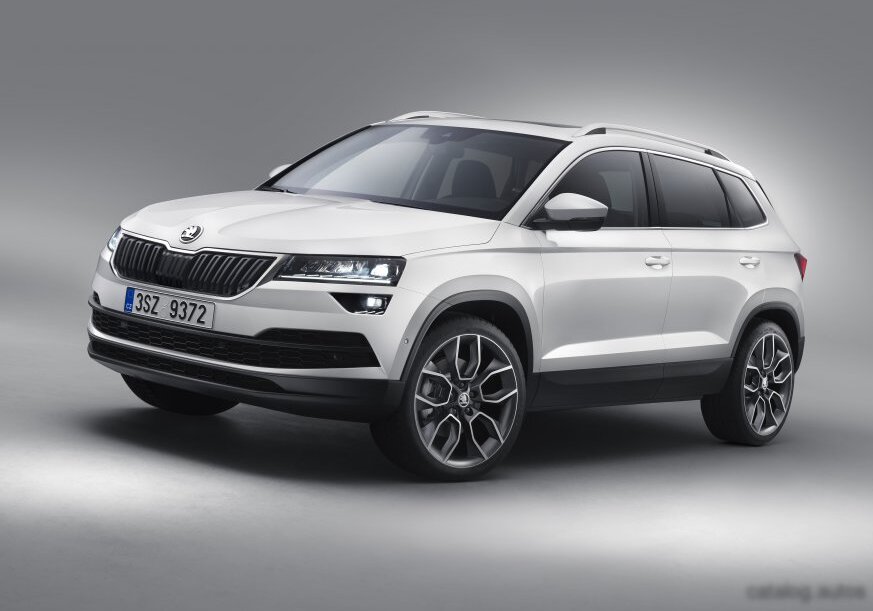
The Skoda Karoq 1.6 TDI Automatic, produced from July 2017 to November 2020, represented an entry-level diesel option within the first generation (2017-2022) of Skoda’s popular compact SUV. Positioned as a fuel-efficient and practical choice, it aimed to appeal to buyers prioritizing economy and everyday usability over outright performance. This variant utilized a 1.6-liter turbocharged diesel engine paired with a seven-speed dual-clutch transmission (DSG), offering a balance between reasonable power and comfortable driving. The Karoq itself was designed to replace the Skoda Yeti, offering a more spacious and refined package while maintaining the brand’s reputation for value and practicality.
Technical Specifications
| Brand | Skoda |
| Model | Karoq |
| Type (Engine) | 1.6 TDI (116 Hp) Automatic |
| Start of production | July, 2017 |
| End of production | November, 2020 |
| Powertrain Architecture | Internal Combustion engine |
| Body type | SUV |
| Seats | 5 |
| Doors | 5 |
| Fuel consumption (urban) | 4.6 l/100 km (51.1 US mpg, 61.4 UK mpg, 21.7 km/l) |
| Fuel consumption (extra urban) | 4.3 l/100 km (54.7 US mpg, 65.7 UK mpg, 23.3 km/l) |
| Fuel consumption (combined) | 4.4 l/100 km (53.5 US mpg, 64.2 UK mpg, 22.7 km/l) |
| CO2 emissions | 117 g/km |
| Fuel Type | Diesel |
| Acceleration 0 – 100 km/h | 10.9 sec |
| Acceleration 0 – 62 mph | 10.9 sec |
| Acceleration 0 – 60 mph | 10.4 sec |
| Maximum speed | 188 km/h (116.82 mph) |
| Emission standard | Euro 6 |
| Weight-to-power ratio | 11.8 kg/Hp, 84.9 Hp/tonne |
| Weight-to-torque ratio | 5.5 kg/Nm, 183 Nm/tonne |
| Power | 116 Hp @ 3250-4000 rpm |
| Power per litre | 72.6 Hp/l |
| Torque | 250 Nm @ 1500-3200 rpm (184.39 lb.-ft. @ 1500-3200 rpm) |
| Engine layout | Front, Transverse |
| Engine Model/Code | EA288 / DDYA |
| Engine displacement | 1598 cm3 (97.52 cu. in.) |
| Number of cylinders | 4 |
| Engine configuration | Inline |
| Cylinder Bore | 79.5 mm (3.13 in.) |
| Piston Stroke | 80.5 mm (3.17 in.) |
| Compression ratio | 16.2:1 |
| Number of valves per cylinder | 4 |
| Fuel injection system | Diesel Commonrail |
| Engine aspiration | Turbocharger, Intercooler |
| Engine oil capacity | 4.6 l (4.86 US qt | 4.05 UK qt) |
| Kerb Weight | 1366 kg (3011.51 lbs.) |
| Max. weight | 1962 kg (4325.47 lbs.) |
| Max load | 596 kg (1313.96 lbs.) |
| Trunk (boot) space – minimum | 521 l (18.4 cu. ft.) |
| Trunk (boot) space – maximum | 1630 l (57.56 cu. ft.) |
| Fuel tank capacity | 50 l (13.21 US gal | 11 UK gal) |
| Max. roof load | 75 kg (165.35 lbs.) |
| Permitted trailer load with brakes (12%) | 1500 kg (3306.93 lbs.) |
| Permitted trailer load without brakes | 720 kg (1587.33 lbs.) |
| Length | 4382 mm (172.52 in.) |
| Width | 1841 mm (72.48 in.) |
| Height | 1603 mm (63.11 in.) |
| Wheelbase | 2638 mm (103.86 in.) |
| Front track | 1576 mm (62.05 in.) |
| Rear (Back) track | 1541 mm (60.67 in.) |
| Minimum turning circle | 10.9 m (35.76 ft.) |
| Drivetrain Architecture | Front wheel drive |
| Number of gears | 7 |
| Gearbox type | Automatic transmission |
| Front brakes | Ventilated discs |
| Rear brakes | Disc |
Powertrain & Engine Architecture
The Karoq 1.6 TDI Automatic utilized the Volkswagen Group’s EA288 engine family, specifically the DDYA code. This 1.6-liter inline-four diesel engine featured common-rail direct injection, a turbocharger with intercooling, and four valves per cylinder. The engine was designed to meet stringent Euro 6 emissions standards, incorporating a diesel particulate filter (DPF) to reduce soot emissions. The common-rail system allowed for precise fuel delivery, optimizing combustion efficiency and reducing noise. The seven-speed dual-clutch transmission (DSG) provided quick and smooth gear changes, contributing to a more refined driving experience compared to a traditional torque-converter automatic. The DSG’s programming prioritized fuel economy, with taller gear ratios in the higher gears.
Driving Characteristics
The 116 horsepower and 250 Nm (184 lb-ft) of torque delivered by the 1.6 TDI engine provided adequate, but not exhilarating, performance. Acceleration from 0-60 mph took around 10.4 seconds, making it suitable for everyday commuting and highway cruising. The DSG transmission helped to keep the engine in its optimal power band, but noticeable turbo lag was present at lower engine speeds. Compared to the more powerful 2.0 TDI variants, the 1.6 TDI felt less responsive, particularly during overtaking maneuvers. However, the automatic transmission made it easier to drive in congested traffic than the manual versions. The gear ratios were tuned for fuel efficiency, resulting in a comfortable and relaxed driving experience at cruising speeds.
Equipment & Trim Levels
The Karoq 1.6 TDI Automatic typically came with a reasonable level of standard equipment. This included air conditioning, a touchscreen infotainment system with Bluetooth connectivity, alloy wheels, and a suite of safety features such as ABS, ESC (Electronic Stability Control), and multiple airbags. Higher trim levels, such as SE L and Elegance, added features like automatic climate control, parking sensors, a larger touchscreen display, and upgraded interior upholstery. Optional extras included a panoramic sunroof, adaptive cruise control, and a premium sound system. Interior materials were generally of good quality, reflecting Skoda’s commitment to providing a comfortable and well-equipped cabin.
Chassis & Braking
The Karoq’s chassis was designed to provide a comfortable ride and predictable handling. The front suspension utilized MacPherson struts, while the rear suspension employed a multi-link setup. This configuration helped to absorb bumps and provide a stable platform for cornering. The 1.6 TDI variant typically featured ventilated front disc brakes and solid rear disc brakes. The braking system was adequate for the vehicle’s weight and performance, providing sufficient stopping power in most situations. Electric power steering offered light and precise steering feel, making it easy to maneuver in urban environments.
Market Reception & Comparison
The Skoda Karoq 1.6 TDI Automatic was generally well-received by automotive critics for its fuel efficiency, practicality, and value for money. However, some reviewers noted that the engine lacked the punch of its larger counterparts. Compared to the 2.0 TDI models, the 1.6 TDI offered lower running costs but compromised on performance. It also faced competition from other compact SUVs such as the Nissan Qashqai and Kia Sportage. Fuel economy was a key selling point, with the Karoq 1.6 TDI achieving combined fuel consumption figures of around 53.5 US mpg. Reliability was generally good, although owners reported occasional issues with the DPF system, a common problem with modern diesel engines.
Legacy
The Karoq 1.6 TDI Automatic remains a popular choice in the used car market, particularly for buyers seeking a fuel-efficient and practical family SUV. The EA288 engine, while generally reliable, requires regular maintenance, including oil changes and DPF regeneration. The DSG transmission is also known to require servicing at specified intervals. Overall, the Karoq 1.6 TDI Automatic offers a compelling combination of affordability, practicality, and fuel economy, making it a sensible choice for those prioritizing value and everyday usability.
