
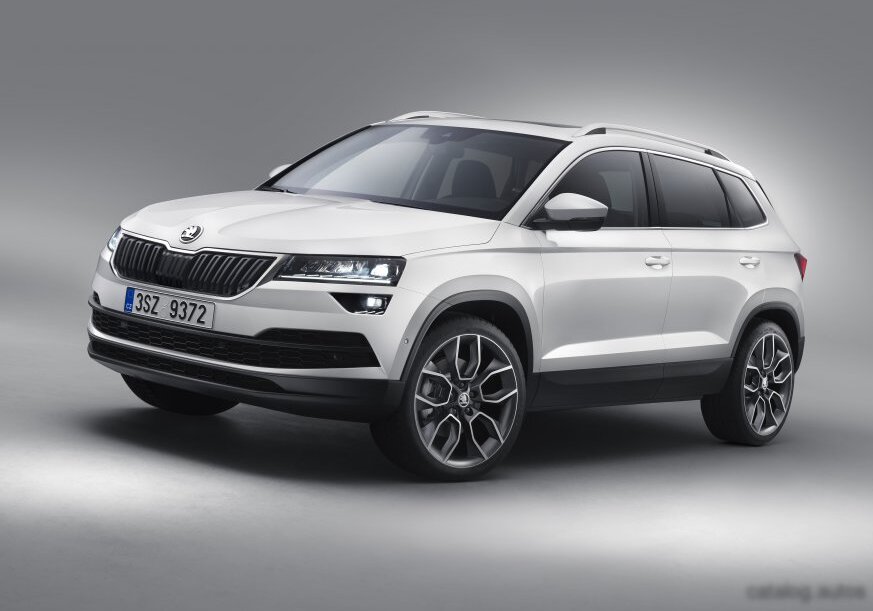
The Skoda Karoq 2.0 TDI 4×4 DSG represents a compelling offering within the compact SUV segment, produced between 2019 and September 2020. Positioned as a higher-trim level within the Karoq range, it catered to buyers seeking a blend of performance, practicality, and all-weather capability. This variant utilized a potent 2.0-liter turbocharged diesel engine paired with a sophisticated seven-speed dual-clutch transmission (DSG) and a four-wheel-drive system, making it a versatile vehicle for both daily commuting and longer journeys. It built upon the foundation of the A1 platform, shared with other Volkswagen Group vehicles like the VW Tiguan and SEAT Ateca.
Technical Specifications
| Brand | Skoda |
| Model | Karoq |
| Type (Engine) | 2.0 TDI (190 Hp) 4×4 DSG |
| Start of production | 2019 |
| End of production | September, 2020 |
| Fuel consumption (urban) | 6.0 l/100 km (39.2 US mpg, 47.1 UK mpg, 16.7 km/l) |
| Fuel consumption (extra urban) | 4.9 l/100 km (48 US mpg, 57.6 UK mpg, 20.4 km/l) |
| Fuel consumption (combined) | 5.3 l/100 km (44.4 US mpg, 53.3 UK mpg, 18.9 km/l) |
| CO2 emissions | 139 g/km |
| Fuel Type | Diesel |
| Acceleration 0 – 100 km/h | 7.4 sec |
| Acceleration 0 – 62 mph | 7.4 sec |
| Acceleration 0 – 60 mph | 7 sec |
| Maximum speed | 211 km/h (131.11 mph) |
| Emission standard | Euro 6 d-TEMP |
| Weight-to-power ratio | 8.5 kg/Hp, 118 Hp/tonne |
| Weight-to-torque ratio | 4 kg/Nm, 248.4 Nm/tonne |
| Power | 190 Hp @ 3500-4000 rpm |
| Torque | 400 Nm @ 1750-3250 rpm (295.02 lb.-ft. @ 1750-3250 rpm) |
| Engine layout | Front, Transverse |
| Engine Model/Code | EA288 / DFHA |
| Engine displacement | 1968 cm3 (120.09 cu. in.) |
| Number of cylinders | 4 |
| Engine configuration | Inline |
| Cylinder Bore | 81 mm (3.19 in.) |
| Piston Stroke | 95.5 mm (3.76 in.) |
| Compression ratio | 16.2:1 |
| Number of valves per cylinder | 4 |
| Fuel injection system | Diesel Commonrail |
| Engine aspiration | Turbocharger, Intercooler |
| Engine oil capacity | 4.7 l (4.97 US qt | 4.14 UK qt) |
| Kerb Weight | 1610 kg (3549.44 lbs.) |
| Trunk (boot) space – minimum | 521 l (18.4 cu. ft.) |
| Trunk (boot) space – maximum | 1630 l (57.56 cu. ft.) |
| Fuel tank capacity | 55 l (14.53 US gal | 12.1 UK gal) |
| Length | 4382 mm (172.52 in.) |
| Width | 1841 mm (72.48 in.) |
| Width including mirrors | 2025 mm (79.72 in.) |
| Height | 1607 mm (63.27 in.) |
| Wheelbase | 2630 mm (103.54 in.) |
| Tires size | 225/55 R17 97V |
| Number of gears | 7 |
| Type of gearbox | automatic transmission DSG |
INTRODUCTION
The Skoda Karoq 2.0 TDI 4×4 DSG, launched in 2019, represented a significant step up in the Karoq lineup. It was designed to appeal to drivers needing a practical, spacious SUV with enhanced performance and all-weather security. The Karoq itself replaced the Skoda Yeti, offering a larger, more refined package while retaining the brand’s reputation for value and functionality. This particular variant, with its 190 horsepower diesel engine and all-wheel drive, aimed to provide a comfortable and capable driving experience for families and individuals alike. It occupied a mid-to-high position in the Karoq range, offering more power and features than the entry-level petrol options.
Powertrain & Engine Architecture
At the heart of the Karoq 2.0 TDI 4×4 DSG lies the EA288 series 2.0-liter four-cylinder diesel engine, specifically the DFHA code. This engine is a common sight in Volkswagen Group vehicles, known for its robust construction and efficiency. It features a common-rail direct injection system, delivering fuel at extremely high pressure for optimized combustion. The engine also incorporates a turbocharger with an intercooler, boosting power output and improving throttle response. The valvetrain utilizes four valves per cylinder, enhancing breathing and contributing to the engine’s overall performance. The seven-speed DSG (Direct-Shift Gearbox) is a dual-clutch transmission that provides quick, seamless gear changes, contributing to both performance and fuel economy. The DSG’s programming is tuned to balance responsiveness with smooth operation, making it well-suited for everyday driving.
Driving Characteristics
The 190 horsepower and 400 Nm (295 lb-ft) of torque delivered by the 2.0 TDI engine provide brisk acceleration. The 0-60 mph sprint takes around 7 seconds, making it feel adequately powered for overtaking and merging onto highways. The DSG transmission plays a crucial role in maximizing the engine’s output, offering quick shifts and keeping the engine within its optimal power band. Compared to the lower-powered 1.6 TDI versions, the 2.0 TDI offers a noticeably more relaxed driving experience, particularly when fully loaded or tackling inclines. While not a sports SUV, the 4×4 system provides excellent traction in various conditions, enhancing stability and confidence. The gear ratios are well-chosen, providing a good balance between acceleration and fuel efficiency.
Equipment & Trim Levels
The Karoq 2.0 TDI 4×4 DSG typically came well-equipped, reflecting its position as a higher-trim level. Standard features often included alloy wheels, automatic climate control, a touchscreen infotainment system with Apple CarPlay and Android Auto compatibility, and a suite of safety features such as automatic emergency braking and lane departure warning. Interior upholstery was typically a combination of fabric and leatherette, with options for full leather available. Optional extras could include a panoramic sunroof, adaptive cruise control, and a premium sound system. The dashboard layout was clean and functional, with a focus on user-friendliness.
Chassis & Braking
The Karoq’s chassis is designed to provide a comfortable and composed ride. It utilizes independent suspension all around, with MacPherson struts at the front and a multi-link setup at the rear. The 4×4 system adds to the vehicle’s stability, particularly in challenging conditions. Braking duties are handled by ventilated discs at the front and solid discs at the rear. ABS (Anti-lock Braking System) and electronic stability control are standard features, enhancing safety and control. The steering is electrically assisted, providing a light and precise feel.
Market Reception & Comparison
The Karoq 2.0 TDI 4×4 DSG was generally well-received by automotive critics. It was praised for its spacious interior, comfortable ride, and strong performance. The diesel engine was noted for its efficiency and refinement, while the DSG transmission was lauded for its smooth operation. Compared to rivals like the Nissan Qashqai and Kia Sportage, the Karoq offered a more premium feel and a more engaging driving experience. Fuel economy was a strong point, with combined figures around 5.3 l/100 km (44.4 US mpg). Reliability was generally good, although, like all modern diesel vehicles, it was susceptible to issues with the diesel particulate filter (DPF) if not driven on longer journeys regularly.
Legacy
The Skoda Karoq 2.0 TDI 4×4 DSG has proven to be a reliable and durable vehicle. The EA288 engine, while complex, is generally robust when properly maintained. On the used car market, these models hold their value reasonably well, reflecting their practicality and reputation for reliability. The DSG transmission requires regular servicing, including fluid changes, to ensure optimal performance and longevity. Overall, the Karoq 2.0 TDI 4×4 DSG remains a compelling choice for buyers seeking a spacious, capable, and efficient compact SUV.
