
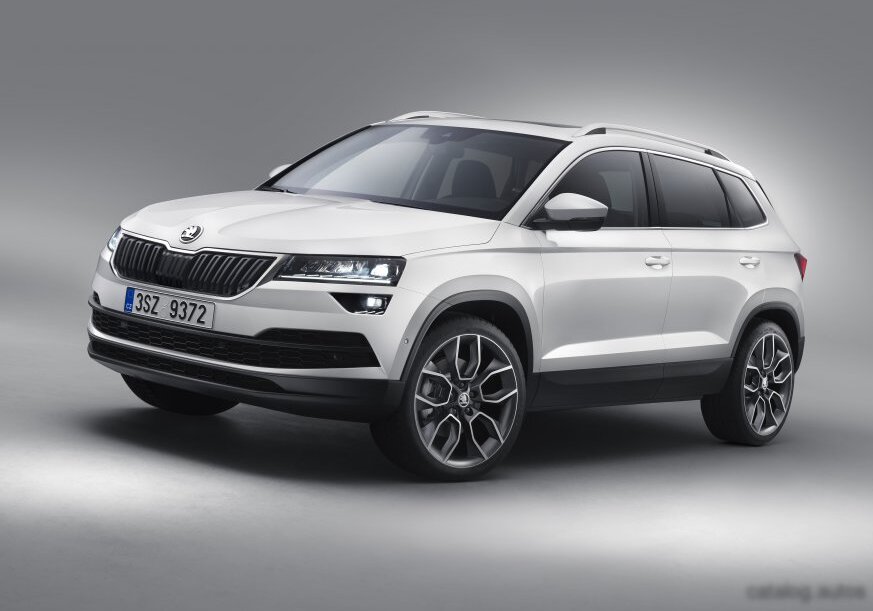
The Skoda Karoq 2.0 TSI 4×4 DSG represents a performance-oriented variant within the Karoq range, Skoda’s compact SUV. Introduced in January 2019 and continuing through November 2021, this model combined a potent turbocharged gasoline engine with a sophisticated all-wheel-drive system and a dual-clutch transmission. It occupied a mid-to-upper position in the Karoq lineup, offering a step up in performance and capability compared to the lower-powered engine options. The Karoq itself is built on the Volkswagen Group’s MQB platform (A1), shared with models like the Volkswagen Tiguan and SEAT Ateca, and aimed to provide a practical and spacious family vehicle with a focus on value.
Technical Specifications
| Brand | Skoda |
| Model | Karoq |
| Type (Engine) | 2.0 TSI (190 Hp) 4×4 DSG |
| Start of production | January, 2019 |
| End of production | November, 2021 |
| Powertrain Architecture | Internal Combustion engine |
| Body type | SUV |
| Seats | 5 |
| Doors | 5 |
| Fuel consumption at Low speed (WLTP) | 10.8-11.4 l/100 km (21.8 – 20.6 US mpg, 26.2 – 24.8 UK mpg, 9.3 – 8.8 km/l) |
| Fuel consumption at Medium speed (WLTP) | 7.7-8.8 l/100 km (30.5 – 26.7 US mpg, 36.7 – 32.1 UK mpg, 13 – 11.4 km/l) |
| Fuel consumption at high speed (WLTP) | 6.5-7.6 l/100 km (36.2 – 30.9 US mpg, 43.5 – 37.2 UK mpg, 15.4 – 13.2 km/l) |
| Fuel consumption at very high speed (WLTP) | 7.2-8.9 l/100 km (32.7 – 26.4 US mpg, 39.2 – 31.7 UK mpg, 13.9 – 11.2 km/l) |
| Combined fuel consumption (WLTP) | 7.6-8.8 l/100 km (30.9 – 26.7 US mpg, 37.2 – 32.1 UK mpg, 13.2 – 11.4 km/l) |
| CO2 emissions (WLTP) | 171-199 g/km |
| Fuel consumption (economy) – urban | 8.5-8.7 l/100 km (27.7 – 27 US mpg, 33.2 – 32.5 UK mpg, 11.8 – 11.5 km/l) |
| Fuel consumption (economy) – extra urban | 5.5-5.8 l/100 km (42.8 – 40.6 US mpg, 51.4 – 48.7 UK mpg, 18.2 – 17.2 km/l) |
| Fuel consumption (economy) – combined | 6.6-6.9 l/100 km (35.6 – 34.1 US mpg, 42.8 – 40.9 UK mpg, 15.2 – 14.5 km/l) |
| CO2 emissions | 151-156 g/km |
| Fuel Type | Petrol (Gasoline) |
| Acceleration 0 – 100 km/h | 7.3 sec |
| Acceleration 0 – 62 mph | 7.3 sec |
| Acceleration 0 – 60 mph | 6.9 sec |
| Maximum speed | 213 km/h (132.35 mph) |
| Emission standard | Euro 6 DG |
| Weight-to-power ratio | 7.8 kg/Hp, 128.4 Hp/tonne |
| Weight-to-torque ratio | 4.6 kg/Nm, 216.2 Nm/tonne |
| Power | 190 Hp @ 4200-6000 rpm |
| Power per litre | 95.8 Hp/l |
| Torque | 320 Nm @ 1500-4100 rpm (236.02 lb.-ft. @ 1500-4100 rpm) |
| Engine layout | Front, Transverse |
| Engine Model/Code | EA888 / DKZA |
| Engine displacement | 1984 cm3 (121.07 cu. in.) |
| Number of cylinders | 4 |
| Engine configuration | Inline |
| Cylinder Bore | 82.5 mm (3.25 in.) |
| Piston Stroke | 92.8 mm (3.65 in.) |
| Compression ratio | 11.65:1 |
| Number of valves per cylinder | 4 |
| Fuel injection system | Direct injection and Multi-port manifold injection |
| Engine aspiration | Turbocharger, Intercooler |
| Valvetrain | DOHC |
| Engine oil capacity | 5.7 l (6.02 US qt | 5.02 UK qt) |
| Kerb Weight | 1480-1709 kg (3262.84 – 3767.7 lbs.) |
| Max. weight | 2099-2213 kg (4627.5 – 4878.83 lbs.) |
| Max load | 504-619 kg (1111.13 – 1364.66 lbs.) |
| Trunk (boot) space – minimum | 521 l (18.4 cu. ft.) |
| Trunk (boot) space – maximum | 1630 l (57.56 cu. ft.) |
| Fuel tank capacity | 55 l (14.53 US gal | 12.1 UK gal) |
| Max. roof load | 75 kg (165.35 lbs.) |
| Permitted trailer load with brakes (8%) | 1900 kg (4188.78 lbs.) |
| Permitted trailer load with brakes (12%) | 1900 kg (4188.78 lbs.) |
| Permitted trailer load without brakes | 750 kg (1653.47 lbs.) |
| Permitted towbar download | 90 kg (198.42 lbs.) |
| Length | 4382 mm (172.52 in.) |
| Width | 1841 mm (72.48 in.) |
| Width including mirrors | 2025 mm (79.72 in.) |
| Height | 1603 mm (63.11 in.) |
| Wheelbase | 2638 mm (103.86 in.) |
| Front track | 1576 mm (62.05 in.) |
| Rear (Back) track | 1541 mm (60.67 in.) |
| Front overhang | 877 mm (34.53 in.) |
| Rear overhang | 866 mm (34.09 in.) |
| Ride height (ground clearance) | 167 mm (6.57 in.) |
| Drag coefficient (Cd) | 0.337 |
| Minimum turning circle (turning diameter) | 10.8 m (35.43 ft.) |
| Approach angle | 18.4° |
| Departure angle | 18.7° |
| Drivetrain Architecture | The Internal combustion engine (ICE) drives the front wheels permanently, and the rear wheels are driven through an electrically or mechanically operated clutch if necessary. |
| Drive wheel | All wheel drive (4×4) |
| Number of gears and type of gearbox | 7 gears, automatic transmission DSG |
| Front suspension | Independent, type McPherson with coil spring and anti-roll bar |
| Rear suspension | Independent multi-link spring suspension with stabilizer |
| Front brakes | Ventilated discs |
| Rear brakes | Disc |
| Assisting systems | ABS (Anti-lock braking system) |
| Steering type | Steering rack and pinion |
| Power steering | Electric Steering |
| Tires size | 225/50 R18 |
| Wheel rims size | 7J x 18 |
INTRODUCTION
The Skoda Karoq 2.0 TSI 4×4 DSG, produced from January 2019 to November 2021, is a five-door compact SUV that represents a significant step up in performance within the Karoq model range. Built on the Volkswagen Group’s MQB A1 platform, it shares its underpinnings with the Volkswagen Tiguan and SEAT Ateca. This variant was positioned as a premium offering, appealing to buyers seeking a blend of practicality, space, and dynamic driving characteristics. The ‘TSI’ designation indicates a turbocharged gasoline direct injection engine, while ‘4×4’ denotes the all-wheel-drive system, and ‘DSG’ signifies the dual-clutch gearbox. It aimed to provide a more engaging driving experience than the lower-powered engine options available in the Karoq lineup.
Powertrain & Engine Architecture
At the heart of the Karoq 2.0 TSI 4×4 DSG lies the EA888 engine, specifically the DKZA code variant. This is a 1.984-liter (121.07 cubic inches) inline-four cylinder engine featuring direct fuel injection and a turbocharger with an intercooler. The engine produces 190 horsepower at 4200-6000 rpm and 320 Nm (236.02 lb.-ft.) of torque between 1500-4100 rpm. The direct injection system delivers fuel directly into the combustion chamber, improving efficiency and power output. The engine also utilizes a dual overhead camshaft (DOHC) valvetrain with four valves per cylinder. The engine’s turbocharger provides a significant boost in power, while the intercooler helps to cool the intake air, further enhancing performance. The engine is paired with a seven-speed dual-clutch transmission (DSG), known for its quick and smooth gear changes. The 4×4 system utilizes a multi-plate clutch to distribute power between the front and rear axles as needed, providing enhanced traction and stability, particularly in adverse weather conditions.
Driving Characteristics
The Karoq 2.0 TSI 4×4 DSG delivers a noticeably more spirited driving experience compared to lower-powered Karoq models. The 190 hp engine and the responsive DSG transmission combine to provide brisk acceleration, achieving 0-100 km/h (0-62 mph) in 7.3 seconds. The all-wheel-drive system enhances grip and stability, particularly on slippery surfaces. The DSG transmission offers both automatic and manual shift modes, allowing drivers to tailor the driving experience to their preferences. The gear ratios are well-chosen to provide a balance between acceleration and fuel efficiency. While not a sports SUV, the Karoq 2.0 TSI 4×4 DSG offers a confident and capable driving experience, making it well-suited for both urban commuting and longer journeys. The all-wheel drive system adds weight, but the increased traction and stability are generally considered worthwhile trade-offs.
Equipment & Trim Levels
The 2.0 TSI 4×4 DSG trim typically included a generous level of standard equipment. This often included features such as alloy wheels (typically 18-inch), automatic climate control, a touchscreen infotainment system with Apple CarPlay and Android Auto compatibility, parking sensors, and a suite of safety features including automatic emergency braking and lane departure warning. Interior upholstery was typically a combination of fabric and leatherette, with options for full leather available. Higher trim levels within the 2.0 TSI 4×4 range could add features like a panoramic sunroof, adaptive cruise control, and a premium sound system. The dashboard layout was generally clean and functional, with a focus on user-friendliness.
Chassis & Braking
The Karoq 2.0 TSI 4×4 DSG features an independent suspension setup at both the front and rear. The front suspension utilizes a McPherson strut design with coil springs and an anti-roll bar, while the rear suspension employs a multi-link setup, also with coil springs and a stabilizer bar. This suspension configuration provides a comfortable ride quality while maintaining good handling characteristics. The braking system consists of ventilated discs at the front and solid discs at the rear. Anti-lock braking system (ABS) is standard, along with electronic stability control. The steering is a rack and pinion system with electric power assistance, providing precise and responsive steering feel.
Market Reception & Comparison
The Skoda Karoq 2.0 TSI 4×4 DSG was generally well-received by automotive critics. It was praised for its spacious interior, comfortable ride, and strong performance. The combination of the turbocharged engine, DSG transmission, and all-wheel-drive system was seen as a significant improvement over the lower-powered engine options. Compared to its siblings, such as the Volkswagen Tiguan and SEAT Ateca, the Karoq offered a similar level of performance and features at a more competitive price point. Fuel economy was respectable for a vehicle of this type, with combined fuel consumption figures ranging from 7.6 to 8.8 l/100 km. Reliability was generally considered good, although some owners have reported minor issues with the DSG transmission.
Legacy
The Skoda Karoq 2.0 TSI 4×4 DSG has proven to be a reliable and capable SUV in the used car market. The EA888 engine is known for its durability, and the DSG transmission, while requiring occasional maintenance, is generally robust. These models continue to be sought after by buyers looking for a practical and well-equipped family vehicle with a bit of extra performance. The combination of space, comfort, and all-wheel-drive capability makes it a versatile choice for a wide range of drivers. As with any used vehicle, it’s important to have a thorough inspection performed before purchasing, paying particular attention to the condition of the DSG transmission and the overall maintenance history.
