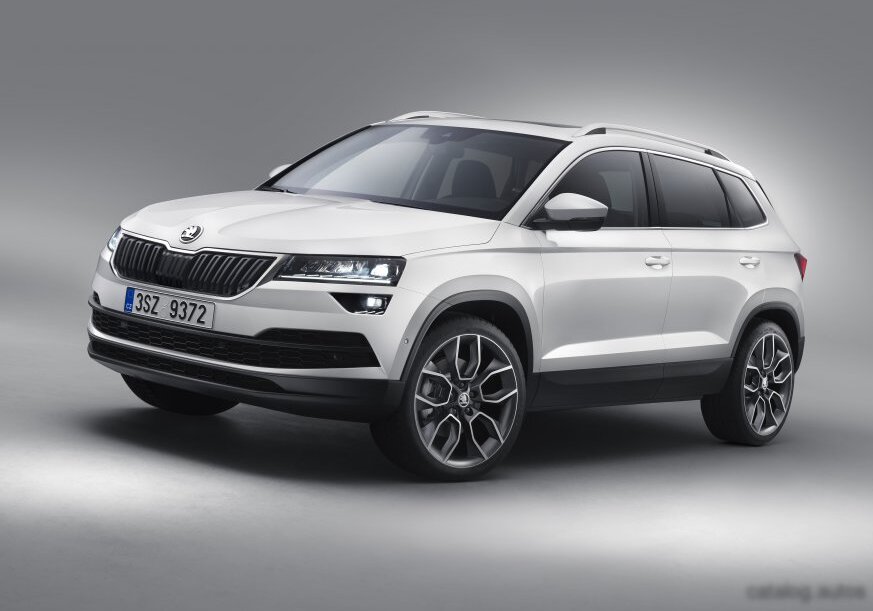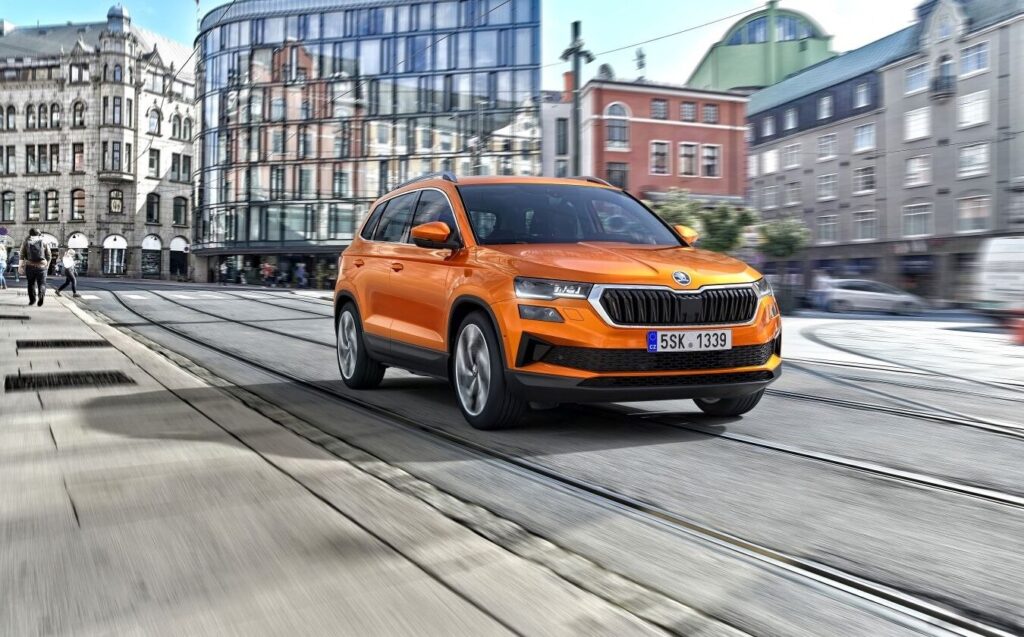
The Skoda Karoq, a compact SUV, was introduced in 2017 as a replacement for the Yeti, offering a more spacious and family-oriented vehicle. The facelifted version, launched in November 2021 and produced through April 2023, brought updated styling, enhanced technology, and refined engine options. Among these, the 1.0 TSI (110 hp) variant represented an entry-level offering, positioned as a fuel-efficient and accessible choice within the Karoq lineup. This version primarily targeted buyers seeking a practical and economical SUV for everyday use, particularly in European markets where smaller displacement engines are favored.
Technical Specifications
| Brand | Skoda |
| Model | Karoq |
| Generation | Karoq (facelift 2021) |
| Type (Engine) | 1.0 TSI (110 Hp) |
| Start of production | November, 2021 |
| End of production | April, 2023 |
| Powertrain Architecture | Internal Combustion engine |
| Body type | SUV |
| Seats | 5 |
| Doors | 5 |
| Combined fuel consumption (WLTP) | 5.7-6.4 l/100 km (41.3 – 36.8 US mpg, 49.6 – 44.1 UK mpg, 17.5 – 15.6 km/l) |
| CO2 emissions (WLTP) | 130-146 g/km |
| Fuel Type | Petrol (Gasoline) |
| Acceleration 0 – 100 km/h | 11.3 sec |
| Acceleration 0 – 62 mph | 11.3 sec |
| Acceleration 0 – 60 mph | 10.7 sec |
| Maximum speed | 190 km/h (118.06 mph) |
| Emission standard | Euro 6 AP |
| Weight-to-power ratio | 11.6 kg/Hp, 85.9 Hp/tonne |
| Weight-to-torque ratio | 6.4 kg/Nm, 156.3 Nm/tonne |
| Power | 110 Hp @ 5500 rpm |
| Power per litre | 110.1 Hp/l |
| Torque | 200 Nm @ 2000-3000 rpm (147.51 lb.-ft. @ 2000-3000 rpm) |
| Engine layout | Front, Transverse |
| Engine Model/Code | EA211 / DLAA |
| Engine displacement | 999 cm3 (60.96 cu. in.) |
| Number of cylinders | 3 |
| Engine configuration | Inline |
| Cylinder Bore | 74.5 mm (2.93 in.) |
| Piston Stroke | 76.4 mm (3.01 in.) |
| Compression ratio | 11.5:1 |
| Number of valves per cylinder | 4 |
| Fuel injection system | Direct injection |
| Engine aspiration | Turbocharger, Intercooler |
| Valvetrain | DOHC |
| Engine oil capacity | 4.5 l (4.76 US qt | 3.96 UK qt) |
| Kerb Weight | 1280-1500 kg (2821.92 – 3306.93 lbs.) |
| Max. weight | 1900 kg (4188.78 lbs.) |
| Max load | 400-620 kg (881.85 – 1366.87 lbs.) |
| Trunk (boot) space – minimum | 521 l (18.4 cu. ft.) |
| Trunk (boot) space – maximum | 1630 l (57.56 cu. ft.) |
| Fuel tank capacity | 50 l (13.21 US gal | 11 UK gal) |
| Max. roof load | 75 kg (165.35 lbs.) |
| Permitted trailer load with brakes (8%) | 1400 kg (3086.47 lbs.) |
| Permitted trailer load with brakes (12%) | 1200 kg (2645.55 lbs.) |
| Permitted trailer load without brakes | 670 kg (1477.1 lbs.) |
| Permitted towbar download | 90 kg (198.42 lbs.) |
| Length | 4390 mm (172.83 in.) |
| Width | 1841 mm (72.48 in.) |
| Width including mirrors | 2025 mm (79.72 in.) |
| Height | 1603 mm (63.11 in.) |
| Wheelbase | 2638 mm (103.86 in.) |
| Front track | 1576 mm (62.05 in.) |
| Rear (Back) track | 1541 mm (60.67 in.) |
| Front overhang | 876 mm (34.49 in.) |
| Rear overhang | 875 mm (34.45 in.) |
| Ride height (ground clearance) | 164 mm (6.46 in.) |
| Drag coefficient (Cd) | 0.301-0.356 |
| Minimum turning circle (turning diameter) | 10.2 m (33.46 ft.) |
| Approach angle | 18.3° |
| Departure angle | 19.4° |
| Drivetrain Architecture | The Internal combustion engine (ICE) drives the front wheels of the vehicle. |
| Drive wheel | Front wheel drive |
| Number of gears and type of gearbox | 6 gears, manual transmission |
| Front suspension | Independent type McPherson |
| Rear suspension | Elastic beam |
| Front brakes | Ventilated discs |
| Rear brakes | Disc |
| Assisting systems | ABS (Anti-lock braking system) |
| Steering type | Steering rack and pinion |
| Power steering | Electric Steering |
| Tires size | 215/60 R16 95V; 215/55 R17 94V |
| Wheel rims size | 6J x 16 ET43; 7J x 17 ET45 |
INTRODUCTION
The Skoda Karoq 1.0 TSI (110 hp) facelift, produced from late 2021 to early 2023, is a front-wheel-drive, five-seater compact SUV. It falls within the broader Karoq range, which is based on the Volkswagen Group’s MQB platform (specifically the A1 component set). This facelift brought cosmetic updates, including revised front and rear fascias, new LED headlights and taillights, and an updated interior with improved infotainment systems. The 1.0 TSI engine option was designed to provide a balance between affordability, fuel efficiency, and practicality, making it a popular choice for families and individuals seeking a versatile vehicle for urban and long-distance driving.
Powertrain & Engine Architecture
The heart of the Karoq 1.0 TSI is the EA211 series 1.0-liter turbocharged three-cylinder gasoline engine, designated with the code DLAA. This engine utilizes direct fuel injection and a single turbocharger with an intercooler to deliver 110 horsepower at 5500 rpm and 200 Nm (147.51 lb-ft) of torque between 2000 and 3000 rpm. The engine features a DOHC (Dual Overhead Camshaft) valvetrain with four valves per cylinder. The engine’s compact size and lightweight construction contribute to the Karoq’s overall efficiency. The 1.0 TSI is paired with a 6-speed manual transmission as standard, delivering power to the front wheels. This transmission is chosen for its efficiency and relatively simple maintenance. The engine also incorporates Start & Stop technology and a particulate filter to reduce emissions, meeting Euro 6 AP standards.
Driving Characteristics
The 1.0 TSI engine in the Karoq provides adequate performance for everyday driving, but it’s not designed for sporty acceleration. The 0-100 km/h (0-62 mph) sprint takes around 11.3 seconds. The turbocharger provides a noticeable boost in power at lower engine speeds, making it suitable for overtaking and merging onto highways. However, the engine can feel strained when fully loaded or climbing steep hills. The 6-speed manual transmission offers precise shifts, and the gear ratios are well-suited for both city and highway driving. Compared to higher-output Karoq variants (like the 1.5 TSI), the 1.0 TSI feels less responsive and requires more downshifting to maintain speed. The suspension setup prioritizes comfort, providing a smooth ride over most road surfaces, but it doesn’t offer the same level of handling precision as sportier SUVs.
Equipment & Trim Levels
The Karoq 1.0 TSI typically came with a good level of standard equipment, including air conditioning, a touchscreen infotainment system with Apple CarPlay and Android Auto compatibility, alloy wheels, and a suite of safety features such as ABS, ESC (Electronic Stability Control), and multiple airbags. Higher trim levels offered additional features like automatic climate control, parking sensors, a rearview camera, adaptive cruise control, and upgraded upholstery. Interior upholstery was typically cloth, with options for leather or Alcantara in higher trims. The dashboard layout was clean and functional, with a focus on user-friendliness. Optional extras included a panoramic sunroof, a premium sound system, and various driver assistance packages.
Chassis & Braking
The Karoq’s chassis features an independent McPherson strut suspension at the front and an elastic beam setup at the rear. This configuration provides a good balance between ride comfort and handling. The front brakes are ventilated discs, while the rear brakes are solid discs. The steering is electric power-assisted, offering light and precise control. The Karoq’s suspension is tuned for comfort, absorbing bumps and imperfections in the road effectively. Stabilizer bars are fitted to both the front and rear axles to reduce body roll during cornering. The braking system is reliable and provides adequate stopping power for everyday driving.
Market Reception & Comparison
The Skoda Karoq 1.0 TSI was generally well-received by automotive critics for its practicality, fuel efficiency, and value for money. It was often praised for its spacious interior, comfortable ride, and user-friendly technology. However, some reviewers noted that the 1.0 TSI engine could feel underpowered, especially when the vehicle is fully loaded. Compared to other Karoq trims, the 1.0 TSI offered the lowest price point but also the lowest performance. Fuel economy was a strong point, with combined WLTP figures ranging from 5.7 to 6.4 l/100 km (41.3 – 36.8 US mpg). In terms of reliability, the EA211 engine has proven to be generally robust, although regular maintenance is essential to prevent issues with the turbocharger and fuel injection system.
Legacy
The Skoda Karoq 1.0 TSI (facelift) represents a practical and economical choice in the compact SUV segment. While not the most powerful or dynamically engaging version of the Karoq, it offers a compelling combination of fuel efficiency, space, and features. On the used car market, these models are generally considered reliable and affordable, making them a popular option for budget-conscious buyers. The EA211 engine, while requiring regular servicing, has a good reputation for longevity. As a result, the Karoq 1.0 TSI continues to be a viable option for those seeking a versatile and dependable family SUV.