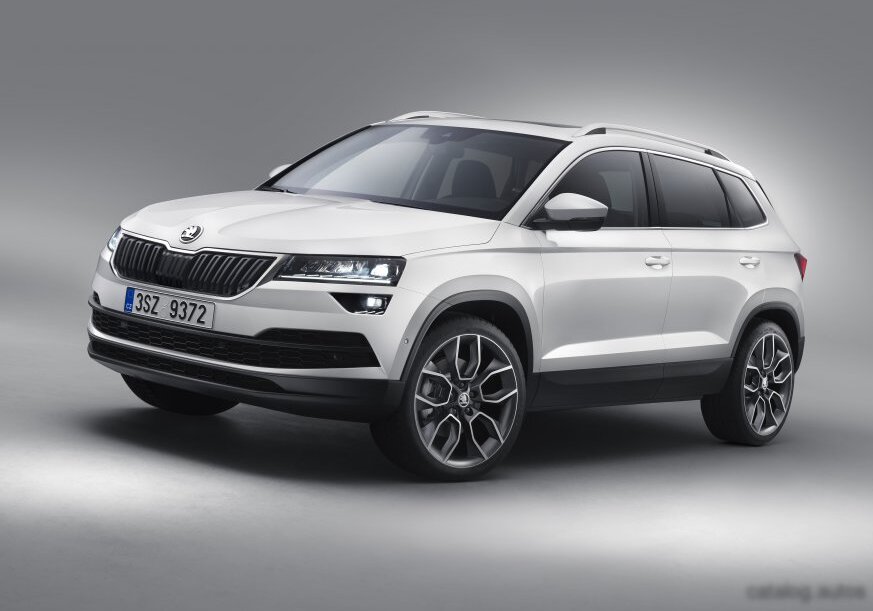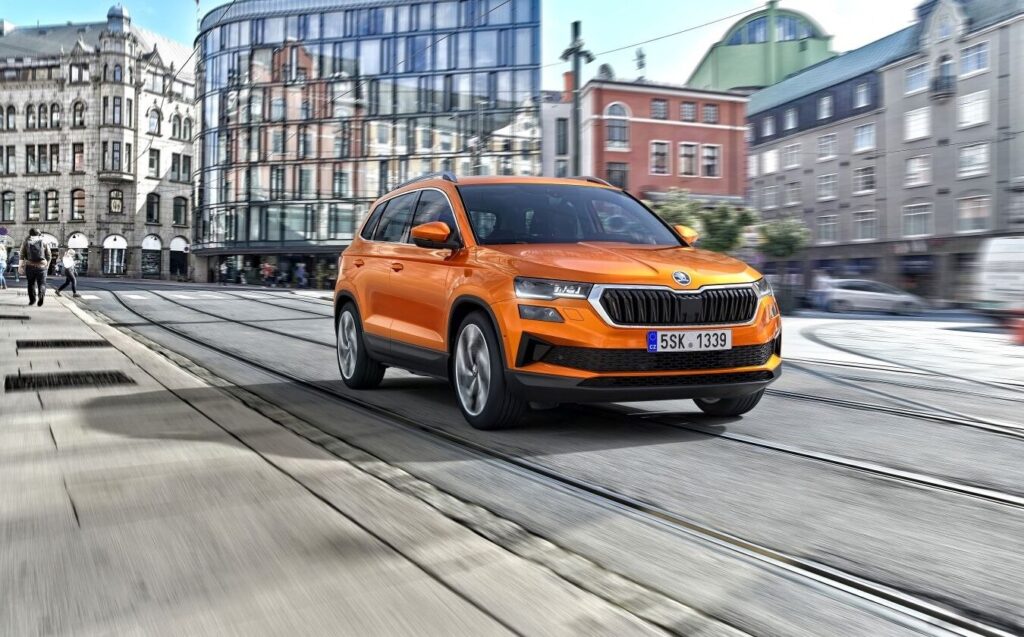
The Skoda Karoq (facelift, introduced in November 2021) 1.5 TSI 150 hp with a 7-speed Dual Clutch Gearbox (DSG) represents a mid-range offering within the second generation Karoq lineup. Positioned as a practical and efficient compact SUV, it aimed to balance performance with fuel economy, appealing to families and individuals seeking a versatile vehicle. This variant builds upon the foundation of the Karoq, which itself is based on the Volkswagen Group’s MQB platform (A1 in this case), shared with models like the Volkswagen T-Roc and SEAT Ateca. The 2021 facelift brought styling updates, enhanced technology, and refinements to the powertrain options, including this popular 1.5 TSI configuration.
Technical Specifications
| Brand | Skoda |
| Model | Karoq |
| Generation | Karoq (facelift 2021) |
| Type (Engine) | 1.5 TSI (150 Hp) DSG |
| Start of production | November, 2021 |
| Powertrain Architecture | Internal Combustion engine |
| Body type | SUV |
| Seats | 5 |
| Doors | 5 |
| Fuel consumption at Low speed (WLTP) | 6.1 l/100 km (38.6 US mpg, 46.3 UK mpg, 16.4 km/l) |
| Fuel consumption at Medium speed (WLTP) | 6.1 l/100 km (38.6 US mpg, 46.3 UK mpg, 16.4 km/l) |
| Fuel consumption at high speed (WLTP) | 6.1 l/100 km (38.6 US mpg, 46.3 UK mpg, 16.4 km/l) |
| Fuel consumption at very high speed (WLTP) | 6.1 l/100 km (38.6 US mpg, 46.3 UK mpg, 16.4 km/l) |
| Combined fuel consumption (WLTP) | 6.1 l/100 km (38.6 US mpg, 46.3 UK mpg, 16.4 km/l) |
| CO2 emissions (WLTP) | 140 g/km |
| Fuel consumption (economy) – urban | 6.5 l/100 km (36.2 US mpg, 43.5 UK mpg, 15.4 km/l) |
| Fuel consumption (economy) – extra urban | 4.5 l/100 km (52.3 US mpg, 62.8 UK mpg, 22.2 km/l) |
| Fuel consumption (economy) – combined | 5.2 l/100 km (45.2 US mpg, 54.3 UK mpg, 19.2 km/l) |
| CO2 emissions | 120 g/km |
| Fuel Type | Petrol (Gasoline) |
| Acceleration 0 – 100 km/h | 9.0 sec |
| Acceleration 0 – 62 mph | 9.0 sec |
| Acceleration 0 – 60 mph | 8.6 sec |
| Maximum speed | 210 km/h (130.49 mph) |
| Emission standard | Euro 6d |
| Weight-to-power ratio | 8.9 kg/Hp, 111.8 Hp/tonne |
| Weight-to-torque ratio | 5.4 kg/Nm, 186.3 Nm/tonne |
| Power | 150 Hp |
| Power per litre | 100.1 Hp/l |
| Torque | 250 Nm @ 1500-3500 rpm (184.39 lb.-ft. @ 1500-3500 rpm) |
| Engine layout | Front, Transverse |
| Engine Model/Code | EA211 evo / DPCA |
| Engine displacement | 1498 cm3 (91.41 cu. in.) |
| Number of cylinders | 4 |
| Engine configuration | Inline |
| Cylinder Bore | 74.5 mm (2.93 in.) |
| Piston Stroke | 86 mm (3.39 in.) |
| Number of valves per cylinder | 4 |
| Fuel injection system | Direct injection |
| Engine aspiration | Turbocharger, Intercooler |
| Engine oil capacity | 4.3 l (4.54 US qt | 3.78 UK qt) |
| Kerb Weight | 1342-1548 kg (2958.6 – 3412.76 lbs.) |
| Max. weight | 1930 kg (4254.92 lbs.) |
| Max load | 382-588 kg (842.17 – 1296.32 lbs.) |
| Trunk (boot) space – minimum | 521 l (18.4 cu. ft.) |
| Trunk (boot) space – maximum | 1630 l (57.56 cu. ft.) |
| Fuel tank capacity | 50 l (13.21 US gal | 11 UK gal) |
| Max. roof load | 75 kg (165.35 lbs.) |
| Permitted trailer load with brakes (12%) | 1500 kg (3306.93 lbs.) |
| Permitted trailer load without brakes | 700 kg (1543.24 lbs.) |
| Permitted towbar download | 90 kg (198.42 lbs.) |
| Length | 4384 mm (172.6 in.) |
| Width | 1841 mm (72.48 in.) |
| Height | 1629 mm (64.13 in.) |
| Wheelbase | 2625 mm (103.35 in.) |
| Front track | 1576 mm (62.05 in.) |
| Rear (Back) track | 1541 mm (60.67 in.) |
| Minimum turning circle (turning diameter) | 10.9 m (35.76 ft.) |
| Drivetrain Architecture | The Internal combustion engine (ICE) drives the front wheels of the vehicle. |
| Drive wheel | Front wheel drive |
| Number of gears and type of gearbox | 7 gears, automatic transmission DSG |
| Front brakes | Ventilated discs |
| Rear brakes | Disc |
| Assisting systems | ABS (Anti-lock braking system) |
| Steering type | Steering rack and pinion |
| Power steering | Electric Steering |
| Tires size | 215/55 R17 94V |
| Wheel rims size | 7J x 17 |
Powertrain & Engine Architecture
The Karoq 1.5 TSI utilizes the EA211 evo series of engines, specifically the DPCA code. This is a turbocharged, direct-injection four-cylinder gasoline engine displacing 1498 cc. The engine features a Miller cycle combustion process, which improves thermal efficiency. Direct injection delivers fuel directly into the combustion chamber, enhancing power and reducing emissions. The turbocharger, coupled with an intercooler, provides increased power output. The engine produces 150 horsepower and 250 Nm (184 lb-ft) of torque between 1500 and 3500 rpm. This torque curve provides good responsiveness in everyday driving situations. The engine is paired with a 7-speed Dual Clutch Gearbox (DSG). This transmission offers quick and smooth gear changes, contributing to both performance and fuel efficiency. The DSG automatically selects the optimal gear based on driving conditions and driver input.
Driving Characteristics
The 1.5 TSI with the DSG transmission delivers a balanced driving experience. Acceleration from 0-60 mph takes approximately 8.6 seconds, and 0-100 km/h in 9.0 seconds, making it adequately quick for most driving scenarios. The DSG transmission provides seamless shifts, and the engine’s torque band ensures sufficient power for overtaking and highway cruising. Compared to the more powerful 2.0 TSI variants, this engine prioritizes fuel economy over outright performance. The gear ratios are tuned for efficiency, meaning the engine doesn’t rev as high during normal driving. While a manual transmission was available on some Karoq models, the DSG offers a more refined and convenient driving experience, particularly in urban environments. The front-wheel-drive configuration provides predictable handling, although it lacks the all-weather capability of the optional all-wheel-drive system.
Equipment & Trim Levels
The Karoq 1.5 TSI typically came equipped with a solid base level of features. Standard equipment often included alloy wheels, an infotainment system with a touchscreen display (usually 8 inches), Apple CarPlay and Android Auto compatibility, air conditioning, and a suite of safety features like automatic emergency braking and lane departure warning. Higher trim levels added features such as adaptive cruise control, a larger infotainment screen, leather upholstery, heated seats, and a panoramic sunroof. Interior upholstery was typically cloth on base models, with leather options available on higher trims. Dashboard configurations were generally consistent across the range, with a focus on functionality and ease of use.
Chassis & Braking
The Karoq’s chassis is tuned for comfort and stability. The front suspension utilizes MacPherson struts, while the rear suspension employs a multi-link setup. This configuration provides a good balance between ride quality and handling. Braking systems typically consisted of ventilated discs on the front wheels and solid discs on the rear. ABS (Anti-lock Braking System) was standard. Stabilizer bars were fitted to both the front and rear axles to reduce body roll during cornering. The Karoq’s weight, ranging from 1342 to 1548 kg (2958.6 – 3412.76 lbs.) depending on equipment, is relatively moderate for its class, contributing to its manageable handling characteristics.
Market Reception & Comparison
The Skoda Karoq 1.5 TSI was generally well-received by automotive critics. It was praised for its spacious interior, comfortable ride, and fuel efficiency. The 1.5 TSI engine was considered a good compromise between performance and economy. Compared to other trims, such as the 2.0 TSI, the 1.5 TSI offered a lower price point and better fuel economy, making it an attractive option for budget-conscious buyers. However, some reviewers noted that the engine could feel slightly underpowered when fully loaded or driving uphill. Fuel economy figures of around 6.1 l/100 km (38.6 US mpg) combined were competitive within the compact SUV segment.
Legacy
The EA211 evo engine family, including the 1.5 TSI, has proven to be relatively reliable. Common issues are typically related to the timing chain (though less prevalent in the 1.5 TSI than earlier EA211 engines) and the DSG transmission (requiring regular fluid changes). On the used car market, the Karoq 1.5 TSI represents a good value proposition, offering a practical and well-equipped SUV at a reasonable price. Its fuel efficiency and relatively low running costs make it an appealing choice for those seeking a dependable and economical family vehicle. The Karoq, in general, has established a reputation for build quality and practicality, contributing to its continued popularity in the used car market.