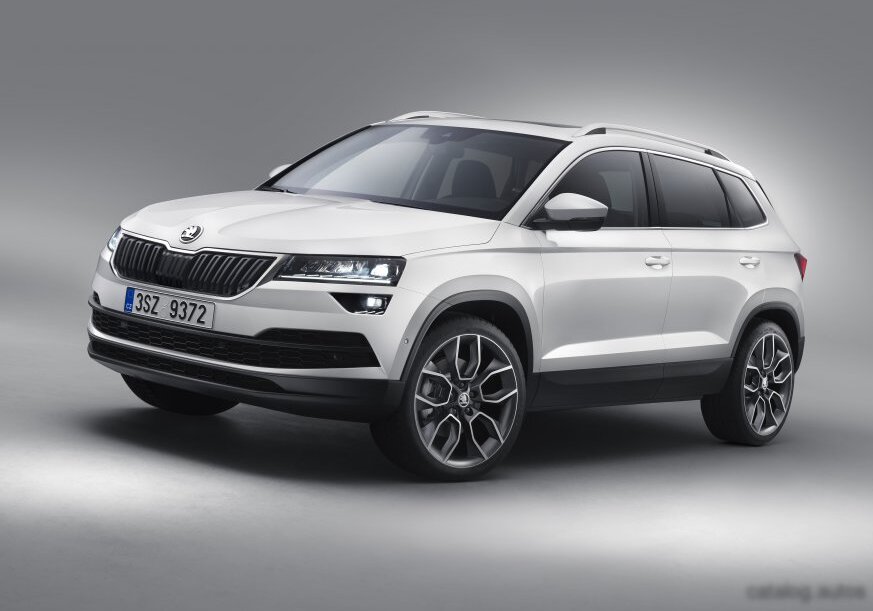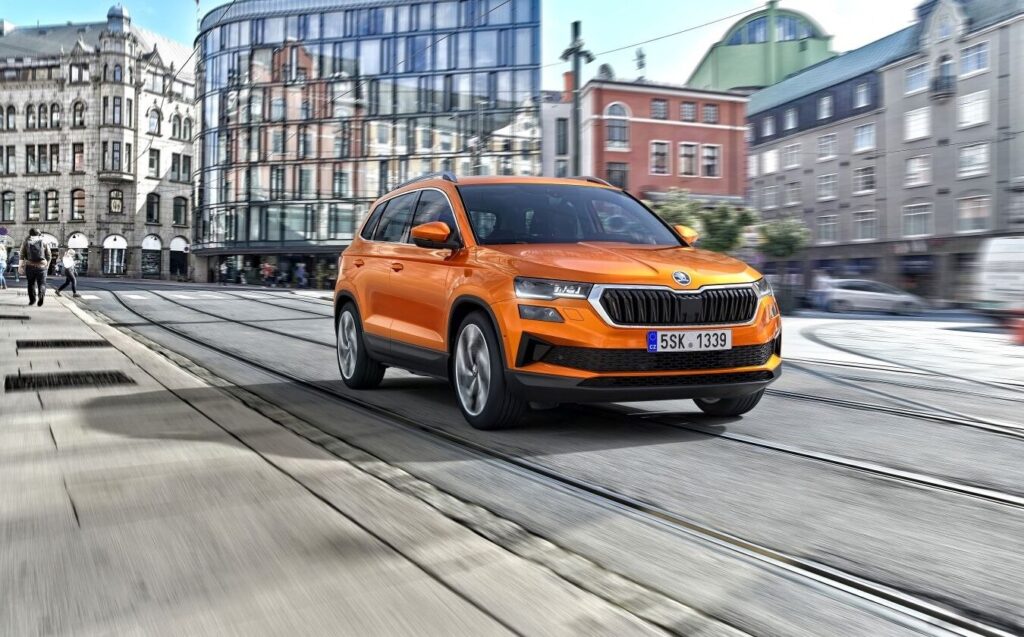
The Skoda Karoq, specifically the 2.0 TDI variant producing 116 horsepower, represents a significant offering in the compact SUV segment. Introduced with the 2021 facelift, this model aimed to balance fuel efficiency with practicality for European drivers. Positioned as a mid-range option within the Karoq lineup, it slotted between the lower-powered petrol engines and the more potent diesel options. The Karoq itself is built on the Volkswagen Group’s MQB platform (A1), shared with models like the Volkswagen Tiguan and SEAT Ateca, and was designed to offer a spacious and versatile family vehicle.
Technical Specifications
| Brand | Skoda |
| Model | Karoq |
| Generation | Karoq (facelift 2021) |
| Type (Engine) | 2.0 TDI (116 Hp) |
| Start of production | November, 2021 |
| Powertrain Architecture | Internal Combustion engine |
| Body type | SUV |
| Seats | 5 |
| Doors | 5 |
| Fuel consumption at Low speed (WLTP) | 4.7 l/100 km (50 US mpg, 60.1 UK mpg, 21.3 km/l) |
| Fuel consumption at Medium speed (WLTP) | 4.7 l/100 km (50 US mpg, 60.1 UK mpg, 21.3 km/l) |
| Fuel consumption at high speed (WLTP) | 4.7 l/100 km (50 US mpg, 60.1 UK mpg, 21.3 km/l) |
| Fuel consumption at very high speed (WLTP) | 4.7 l/100 km (50 US mpg, 60.1 UK mpg, 21.3 km/l) |
| Combined fuel consumption (WLTP) | 4.7 l/100 km (50 US mpg, 60.1 UK mpg, 21.3 km/l) |
| CO2 emissions (WLTP) | 124 g/km |
| Fuel consumption (economy) – urban | 5.7 l/100 km (41.3 US mpg, 49.6 UK mpg, 17.5 km/l) |
| Fuel consumption (economy) – extra urban | 3.5 l/100 km (67.2 US mpg, 80.7 UK mpg, 28.6 km/l) |
| Fuel consumption (economy) – combined | 4.3 l/100 km (54.7 US mpg, 65.7 UK mpg, 23.3 km/l) |
| CO2 emissions | 114 g/km |
| Fuel Type | Diesel |
| Acceleration 0 – 100 km/h | 10.6 sec |
| Acceleration 0 – 62 mph | 10.6 sec |
| Acceleration 0 – 60 mph | 10.1 sec |
| Maximum speed | 193 km/h (119.92 mph) |
| Emission standard | Euro 6d |
| Weight-to-power ratio | 12.3 kg/Hp, 81.6 Hp/tonne |
| Weight-to-torque ratio | 4.7 kg/Nm, 211.1 Nm/tonne |
| Power | 116 Hp |
| Power per litre | 58.9 Hp/l |
| Torque | 300 Nm @ 1600-2500 rpm (221.27 lb.-ft. @ 1600-2500 rpm) |
| Engine layout | Front, Transverse |
| Engine Model/Code | EA288 / DTRD |
| Engine displacement | 1968 cm3 (120.09 cu. in.) |
| Number of cylinders | 4 |
| Engine configuration | Inline |
| Cylinder Bore | 81 mm (3.19 in.) |
| Piston Stroke | 95.5 mm (3.76 in.) |
| Number of valves per cylinder | 4 |
| Fuel injection system | Diesel Commonrail |
| Engine aspiration | Turbocharger, Intercooler |
| Engine oil capacity | 4.7 l (4.97 US qt | 4.14 UK qt) |
| Kerb Weight | 1421-1627 kg (3132.77 – 3586.92 lbs.) |
| Max. weight | 2002 kg (4413.65 lbs.) |
| Max load | 375-581 kg (826.73 – 1280.89 lbs.) |
| Trunk (boot) space – minimum | 521 l (18.4 cu. ft.) |
| Trunk (boot) space – maximum | 1630 l (57.56 cu. ft.) |
| Fuel tank capacity | 50 l (13.21 US gal | 11 UK gal) |
| Max. roof load | 75 kg (165.35 lbs.) |
| Permitted trailer load with brakes (12%) | 1500 kg (3306.93 lbs.) |
| Permitted trailer load without brakes | 740 kg (1631.42 lbs.) |
| Permitted towbar download | 90 kg (198.42 lbs.) |
| Length | 4384 mm (172.6 in.) |
| Width | 1841 mm (72.48 in.) |
| Height | 1629 mm (64.13 in.) |
| Wheelbase | 2625 mm (103.35 in.) |
| Front track | 1576 mm (62.05 in.) |
| Rear (Back) track | 1541 mm (60.67 in.) |
| Minimum turning circle (turning diameter) | 10.9 m (35.76 ft.) |
| Drivetrain Architecture | The Internal combustion engine (ICE) drives the front wheels of the vehicle. |
| Drive wheel | Front wheel drive |
| Number of gears and type of gearbox | 6 gears, manual transmission |
| Front brakes | Ventilated discs |
| Rear brakes | Disc |
| Assisting systems | ABS (Anti-lock braking system) |
| Steering type | Steering rack and pinion |
| Power steering | Electric Steering |
| Tires size | 215/55 R17 94V |
| Wheel rims size | 7J x 17 |
Powertrain & Engine Architecture
The Karoq 2.0 TDI (116 Hp) utilizes the Volkswagen Group’s EA288 engine family. Specifically, the DTRD engine code designates a 2.0-liter four-cylinder diesel engine. This engine employs a common rail direct injection system, delivering fuel at extremely high pressures for optimized combustion. The engine features a turbocharger with an intercooler, enhancing power output and efficiency. The valvetrain consists of four valves per cylinder, contributing to improved breathing and overall performance. This particular variant was typically paired with a six-speed manual transmission, although a seven-speed DSG (Dual-Clutch Gearbox) was often available as an option. The engine is transversely mounted in the front of the vehicle, driving the front wheels.
Driving Characteristics
The 116 horsepower output and 300 Nm (221 lb-ft) of torque provide adequate, but not exhilarating, performance. Acceleration from 0-60 mph takes around 10.1 seconds, making it suitable for everyday driving and highway cruising. The manual transmission offers precise shifts, but the relatively low horsepower means frequent downshifting is required for overtaking maneuvers. Compared to the more powerful 2.0 TDI variants (typically around 150 hp or more), this version feels noticeably less responsive. However, it excels in fuel economy, offering a real-world combined fuel consumption of around 4.3 l/100km (54.7 mpg). The gear ratios are tuned for efficiency rather than outright speed, prioritizing fuel savings over rapid acceleration.
Equipment & Trim Levels
The 2.0 TDI (116 Hp) Karoq typically came equipped with a respectable level of standard features. These included air conditioning, a touchscreen infotainment system with Bluetooth connectivity, alloy wheels, and a suite of safety features such as ABS, ESC (Electronic Stability Control), and multiple airbags. Higher trim levels, such as SE L or Style, added features like automatic climate control, parking sensors, a larger touchscreen display, and upgraded interior upholstery. Optional extras included a panoramic sunroof, adaptive cruise control, and a premium sound system.
Chassis & Braking
The Karoq’s chassis is comprised of independent suspension at the front (MacPherson strut) and a multi-link suspension at the rear. This setup provides a comfortable ride quality, absorbing bumps and imperfections in the road effectively. The front brakes are ventilated discs, offering good stopping power, while the rear brakes are solid discs. The steering is electrically assisted, providing a light and precise feel. Stabilizer bars are fitted to both the front and rear axles to reduce body roll during cornering.
Market Reception & Comparison
The Skoda Karoq 2.0 TDI (116 Hp) was generally well-received by automotive critics. It was praised for its spacious interior, comfortable ride, and excellent fuel economy. However, some reviewers noted that the engine lacked the punch of its more powerful counterparts. Compared to the petrol-powered Karoq variants, the 2.0 TDI offered significantly better fuel efficiency and torque, making it a more practical choice for long-distance driving. Against competitors like the Nissan Qashqai and Kia Sportage, the Karoq stood out for its value for money and its well-built interior.
Legacy
The EA288 engine family, including the DTRD variant found in the Karoq, has proven to be relatively reliable. While diesel engines are inherently more complex than petrol engines, the EA288 has a good track record for durability. Common issues, when they arise, often relate to the diesel particulate filter (DPF) or the turbocharger, particularly on vehicles that are primarily used for short journeys. In the used car market, the Karoq 2.0 TDI (116 Hp) represents a sensible and economical choice for buyers seeking a practical and reliable compact SUV. Its fuel efficiency and spacious interior continue to make it an appealing option.