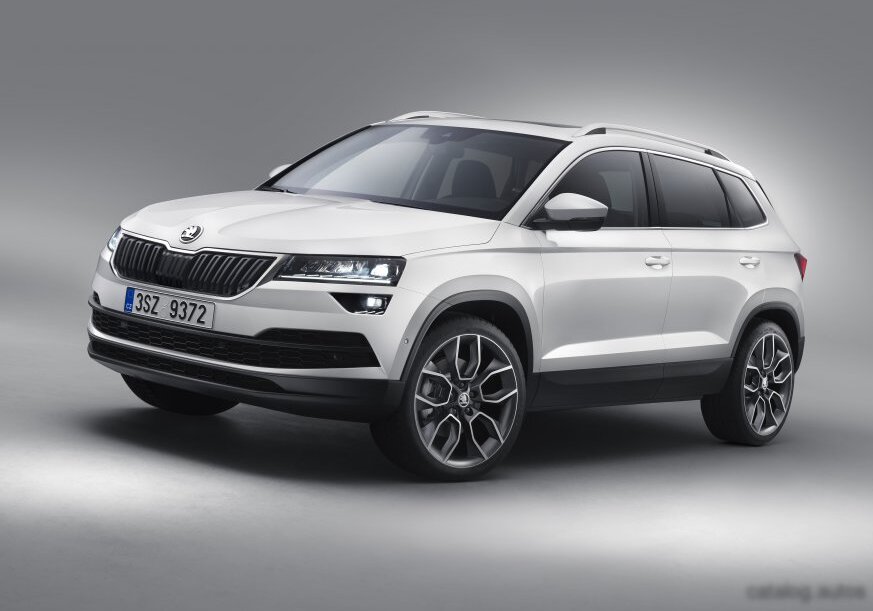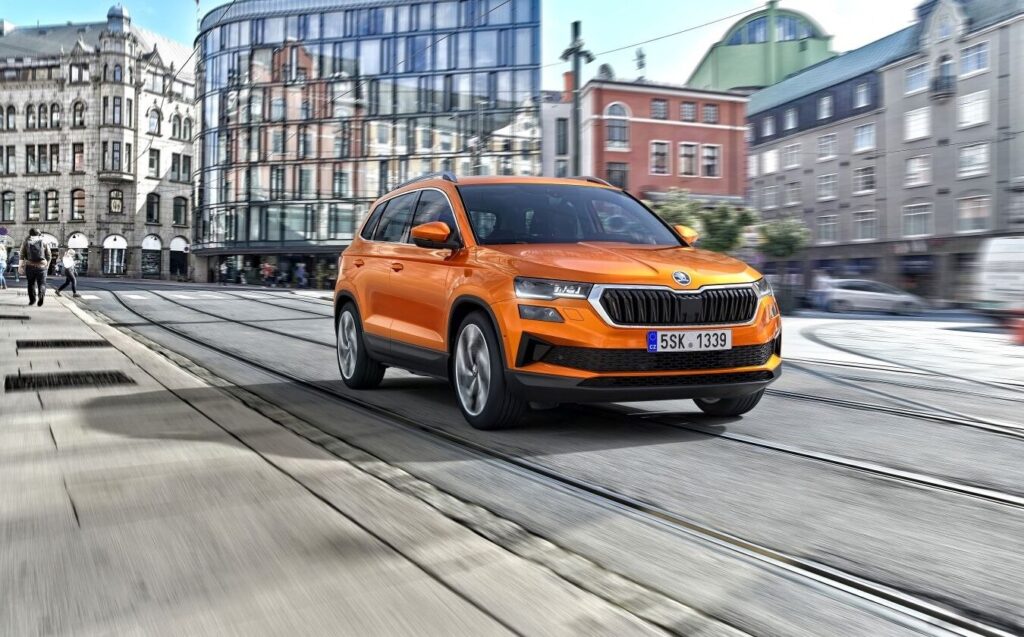
The Skoda Karoq 2.0 TDI (116 hp) DSG, part of the facelifted second generation introduced in November 2021, represents a key offering in Skoda’s compact SUV lineup. Positioned as a fuel-efficient and practical option, this variant caters to buyers prioritizing economy and comfortable driving over outright performance. It builds upon the foundation of the Karoq, which itself is based on the Volkswagen Group’s MQB platform (A1 in this generation), sharing components with models like the Volkswagen Tiguan and SEAT Ateca. The 2021 facelift brought styling updates, enhanced technology, and refined engine options, solidifying the Karoq’s position in the competitive European SUV market.
Technical Specifications
| Brand | Skoda |
| Model | Karoq |
| Generation | Karoq (facelift 2021) |
| Type (Engine) | 2.0 TDI (116 Hp) DSG |
| Start of production | November, 2021 |
| Powertrain Architecture | Internal Combustion engine |
| Body type | SUV |
| Seats | 5 |
| Doors | 5 |
| Fuel consumption at Low speed (WLTP) | 4.9 l/100 km (48 US mpg, 57.6 UK mpg, 20.4 km/l) |
| Fuel consumption at Medium speed (WLTP) | 4.9 l/100 km (48 US mpg, 57.6 UK mpg, 20.4 km/l) |
| Fuel consumption at high speed (WLTP) | 4.9 l/100 km (48 US mpg, 57.6 UK mpg, 20.4 km/l) |
| Fuel consumption at very high speed (WLTP) | 4.9 l/100 km (48 US mpg, 57.6 UK mpg, 20.4 km/l) |
| Combined fuel consumption (WLTP) | 4.9 l/100 km (48 US mpg, 57.6 UK mpg, 20.4 km/l) |
| CO2 emissions (WLTP) | 128 g/km |
| Fuel consumption (economy) – urban | 5.1 l/100 km (46.1 US mpg, 55.4 UK mpg, 19.6 km/l) |
| Fuel consumption (economy) – extra urban | 3.5 l/100 km (67.2 US mpg, 80.7 UK mpg, 28.6 km/l) |
| Fuel consumption (economy) – combined | 4.1 l/100 km (57.4 US mpg, 68.9 UK mpg, 24.4 km/l) |
| CO2 emissions | 108 g/km |
| Fuel Type | Diesel |
| Acceleration 0 – 100 km/h | 11.0 sec |
| Acceleration 0 – 62 mph | 11.0 sec |
| Acceleration 0 – 60 mph | 10.5 sec |
| Maximum speed | 192 km/h (119.3 mph) |
| Emission standard | Euro 6d |
| Weight-to-power ratio | 12.3 kg/Hp, 81.3 Hp/tonne |
| Weight-to-torque ratio | 5.7 kg/Nm, 175.2 Nm/tonne |
| Power | 116 Hp |
| Power per litre | 58.9 Hp/l |
| Torque | 250 Nm @ 1500-3250 rpm (184.39 lb.-ft. @ 1500-3250 rpm) |
| Engine layout | Front, Transverse |
| Engine Model/Code | EA288 / DTRD |
| Engine displacement | 1968 cm3 (120.09 cu. in.) |
| Number of cylinders | 4 |
| Engine configuration | Inline |
| Cylinder Bore | 81 mm (3.19 in.) |
| Piston Stroke | 95.5 mm (3.76 in.) |
| Number of valves per cylinder | 4 |
| Fuel injection system | Diesel Commonrail |
| Engine aspiration | Turbocharger, Intercooler |
| Engine oil capacity | 4.7 l (4.97 US qt | 4.14 UK qt) |
| Kerb Weight | 1427-1633 kg (3146 – 3600.15 lbs.) |
| Max. weight | 2008 kg (4426.88 lbs.) |
| Max load | 375-581 kg (826.73 – 1280.89 lbs.) |
| Trunk (boot) space – minimum | 521 l (18.4 cu. ft.) |
| Trunk (boot) space – maximum | 1630 l (57.56 cu. ft.) |
| Fuel tank capacity | 50 l (13.21 US gal | 11 UK gal) |
| Max. roof load | 75 kg (165.35 lbs.) |
| Permitted trailer load with brakes (12%) | 1500 kg (3306.93 lbs.) |
| Permitted trailer load without brakes | 750 kg (1653.47 lbs.) |
| Permitted towbar download | 90 kg (198.42 lbs.) |
| Length | 4384 mm (172.6 in.) |
| Width | 1841 mm (72.48 in.) |
| Height | 1629 mm (64.13 in.) |
| Wheelbase | 2625 mm (103.35 in.) |
| Front track | 1576 mm (62.05 in.) |
| Rear (Back) track | 1541 mm (60.67 in.) |
| Minimum turning circle | 10.9 m (35.76 ft.) |
| Drivetrain Architecture | The Internal combustion engine (ICE) drives the front wheels of the vehicle. |
| Drive wheel | Front wheel drive |
| Number of gears and type of gearbox | 7 gears, automatic transmission DSG |
| Front brakes | Ventilated discs |
| Rear brakes | Disc |
| Tires size | 215/55 R17 94V |
| Wheel rims size | 7J x 17 |
Powertrain & Engine Architecture
The Karoq 2.0 TDI (116 hp) utilizes the Volkswagen Group’s EA288 engine family, specifically the DTRD code. This is a four-cylinder, inline diesel engine with a displacement of 1968cc. It features a turbocharger with an intercooler to enhance power and efficiency. The engine employs a common rail direct injection system, delivering fuel directly into the combustion chamber at high pressure for optimized combustion. The valvetrain consists of four valves per cylinder, contributing to improved breathing and performance. The engine is transversely mounted in the front of the vehicle. Paired with this engine is a 7-speed dual-clutch transmission (DSG), known for its quick and smooth gear changes. The DSG transmission contributes to both fuel efficiency and a more engaging driving experience compared to a traditional automatic.
Driving Characteristics
The 116 hp output and the DSG transmission provide a balanced driving experience. Acceleration from 0-60 mph takes around 10.5 seconds, making it adequate for everyday driving but not particularly sporty. The engine delivers a respectable 250 Nm (184 lb-ft) of torque between 1500-3250 rpm, providing sufficient pulling power for overtaking and navigating hills. The DSG transmission is programmed for fuel efficiency, often upshifting quickly to maintain lower engine speeds. Compared to the more powerful 2.0 TDI variants (typically around 150 hp or higher), this version feels less urgent in its acceleration. However, the DSG transmission allows for manual gear selection, giving the driver more control when needed. The gear ratios are tuned to prioritize fuel economy, which is a key strength of this variant.
Equipment & Trim Levels
The Karoq 2.0 TDI (116 hp) DSG typically came with a solid base level of equipment. Standard features often included alloy wheels, air conditioning, a touchscreen infotainment system with Apple CarPlay and Android Auto compatibility, and a suite of safety features such as automatic emergency braking and lane departure warning. Interior upholstery was typically cloth, with options for leather upgrades. Higher trim levels added features like adaptive cruise control, a larger touchscreen display, heated seats, and a panoramic sunroof. The dashboard layout is functional and well-designed, with a focus on ergonomics and ease of use.
Chassis & Braking
The Karoq’s chassis is tuned for comfort and stability. The front suspension utilizes MacPherson struts, while the rear suspension employs a multi-link setup. This configuration provides a good balance between ride quality and handling. Braking duties are handled by ventilated discs on the front wheels and solid discs on the rear. Anti-lock Braking System (ABS) is standard, along with Electronic Stability Control (ESC). The Karoq’s weight, ranging from 1427 to 1633 kg (3146 to 3600 lbs) depending on equipment, is relatively moderate for its class, contributing to its manageable handling characteristics.
Market Reception & Comparison
The Skoda Karoq 2.0 TDI (116 hp) DSG was generally well-received by automotive critics as a practical and economical SUV. It was praised for its fuel efficiency, comfortable ride, and spacious interior. However, some reviewers noted that the engine could feel underpowered, especially when fully loaded or driving uphill. Compared to the higher-output TDI variants, this version offered a more affordable entry point into the Karoq range. Its fuel economy of around 4.9 l/100 km (48 US mpg) was a significant selling point, making it an attractive option for drivers covering long distances. Compared to petrol-powered Karoq models, the TDI offered superior fuel efficiency and torque.
Legacy
The EA288 engine family, including the DTRD code used in this Karoq variant, has proven to be relatively reliable, although diesel particulate filter (DPF) issues can occur, particularly with frequent short journeys. Regular maintenance, including oil changes and DPF regeneration, is crucial for long-term reliability. On the used car market, the Karoq 2.0 TDI (116 hp) DSG represents a good value proposition, offering a blend of practicality, economy, and comfort. Its reputation for reliability and relatively low running costs makes it a popular choice among buyers seeking a dependable compact SUV.