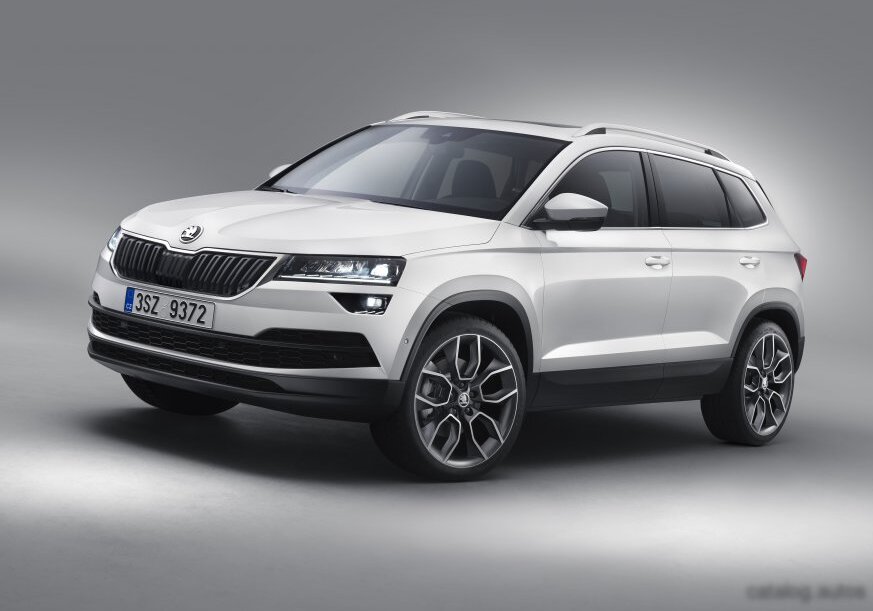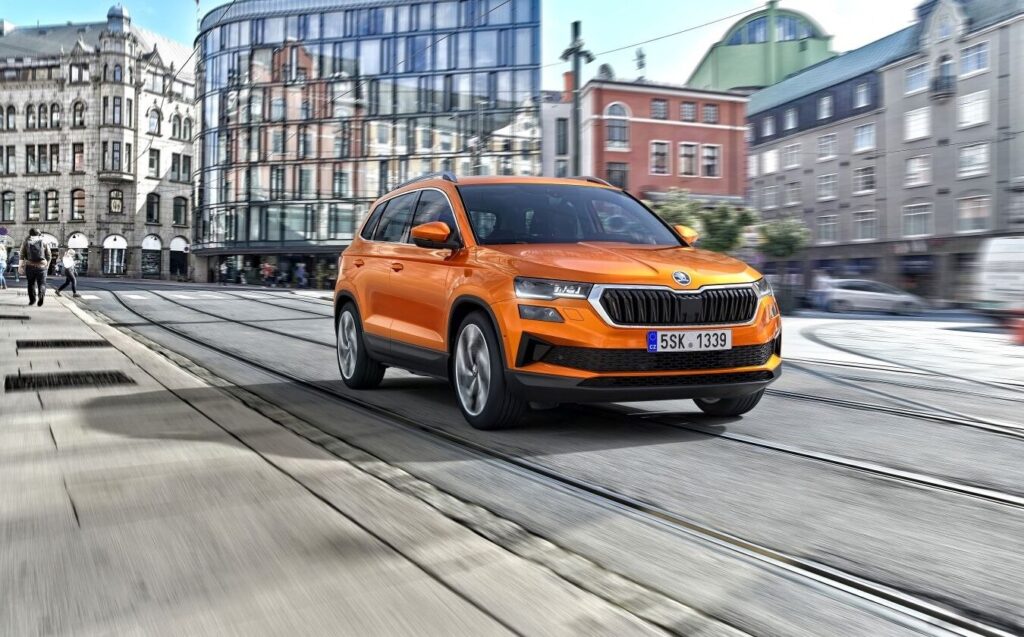
The Skoda Karoq (facelift, introduced in November 2021) 2.0 TDI 150 horsepower variant represents a significant offering within the compact SUV segment, particularly in European markets. Positioned as a mid-range option within the Karoq lineup, it balances fuel efficiency with respectable performance, appealing to buyers seeking a practical and economical family vehicle. This facelift brought updated styling, enhanced technology, and refinements to the existing powertrain options, including the 2.0 TDI engine. The Karoq itself is built on the Volkswagen Group’s MQB platform (A1), shared with models like the Volkswagen Tiguan and SEAT Ateca, providing a solid foundation for a versatile and comfortable SUV.
Technical Specifications
| Brand | Skoda |
| Model | Karoq |
| Generation | Karoq (facelift 2021) |
| Type (Engine) | 2.0 TDI (150 Hp) |
| Start of production | November, 2021 |
| Powertrain Architecture | Internal Combustion engine |
| Body type | SUV |
| Seats | 5 |
| Doors | 5 |
| Fuel consumption at Low speed (WLTP) | 4.8 l/100 km (49 US mpg, 58.9 UK mpg, 20.8 km/l) |
| Fuel consumption at Medium speed (WLTP) | 4.8 l/100 km (49 US mpg, 58.9 UK mpg, 20.8 km/l) |
| Fuel consumption at high speed (WLTP) | 4.8 l/100 km (49 US mpg, 58.9 UK mpg, 20.8 km/l) |
| Fuel consumption at very high speed (WLTP) | 4.8 l/100 km (49 US mpg, 58.9 UK mpg, 20.8 km/l) |
| Combined fuel consumption (WLTP) | 4.8 l/100 km (49 US mpg, 58.9 UK mpg, 20.8 km/l) |
| CO2 emissions (WLTP) | 127 g/km |
| Fuel consumption (economy) – urban | 5.5 l/100 km (42.8 US mpg, 51.4 UK mpg, 18.2 km/l) |
| Fuel consumption (economy) – extra urban | 3.6 l/100 km (65.3 US mpg, 78.5 UK mpg, 27.8 km/l) |
| Fuel consumption (economy) – combined | 4.3 l/100 km (54.7 US mpg, 65.7 UK mpg, 23.3 km/l) |
| CO2 emissions | 113 g/km |
| Fuel Type | Diesel |
| Acceleration 0 – 100 km/h | 8.8 sec |
| Acceleration 0 – 62 mph | 8.8 sec |
| Acceleration 0 – 60 mph | 8.4 sec |
| Maximum speed | 210 km/h (130.49 mph) |
| Emission standard | Euro 6d |
| Weight-to-power ratio | 9.5 kg/Hp, 105.3 Hp/tonne |
| Weight-to-torque ratio | 4.2 kg/Nm, 238.8 Nm/tonne |
| Power | 150 Hp |
| Power per litre | 76.2 Hp/l |
| Torque | 340 Nm @ 1600-3000 rpm (250.77 lb.-ft. @ 1600-3000 rpm) |
| Engine layout | Front, Transverse |
| Engine Model/Code | EA288 / DFFA |
| Engine displacement | 1968 cm3 (120.09 cu. in.) |
| Number of cylinders | 4 |
| Engine configuration | Inline |
| Cylinder Bore | 81 mm (3.19 in.) |
| Piston Stroke | 95.5 mm (3.76 in.) |
| Number of valves per cylinder | 4 |
| Fuel injection system | Diesel Commonrail |
| Engine aspiration | Turbocharger, Intercooler |
| Engine oil capacity | 4.7 l (4.97 US qt | 4.14 UK qt) |
| Kerb Weight | 1424-1630 kg (3139.38 – 3593.53 lbs.) |
| Max. weight | 2005 kg (4420.27 lbs.) |
| Max load | 375-581 kg (826.73 – 1280.89 lbs.) |
| Trunk (boot) space – minimum | 521 l (18.4 cu. ft.) |
| Trunk (boot) space – maximum | 1630 l (57.56 cu. ft.) |
| Fuel tank capacity | 50 l (13.21 US gal | 11 UK gal) |
| Max. roof load | 75 kg (165.35 lbs.) |
| Permitted trailer load with brakes (12%) | 1800 kg (3968.32 lbs.) |
| Permitted trailer load without brakes | 740 kg (1631.42 lbs.) |
| Permitted towbar download | 90 kg (198.42 lbs.) |
| Length | 4384 mm (172.6 in.) |
| Width | 1841 mm (72.48 in.) |
| Height | 1629 mm (64.13 in.) |
| Wheelbase | 2625 mm (103.35 in.) |
| Front track | 1576 mm (62.05 in.) |
| Rear (Back) track | 1541 mm (60.67 in.) |
| Minimum turning circle (turning diameter) | 10.9 m (35.76 ft.) |
| Drivetrain Architecture | The Internal combustion engine (ICE) drives the front wheels of the vehicle. |
| Drive wheel | Front wheel drive |
| Number of gears and type of gearbox | 6 gears, manual transmission |
| Front brakes | Ventilated discs |
| Rear brakes | Disc |
| Assisting systems | ABS (Anti-lock braking system) |
| Steering type | Steering rack and pinion |
| Power steering | Electric Steering |
| Tires size | 215/55 R17 94V |
| Wheel rims size | 7J x 17 |
INTRODUCTION
The Skoda Karoq 2.0 TDI 150 hp (facelift, 2021) is a five-door compact SUV designed to offer a blend of practicality, efficiency, and comfort. Introduced as part of the Karoq’s mid-life refresh, this variant utilizes a refined version of the Volkswagen Group’s EA288 diesel engine. It slots into the Karoq range as a strong all-rounder, offering more performance than the lower-powered diesel options while remaining more economical than the petrol variants. The facelift brought with it subtle styling updates, improved interior materials, and enhanced infotainment systems, further solidifying the Karoq’s position as a competitive offering in the crowded compact SUV market.
Powertrain & Engine Architecture
At the heart of the Karoq 2.0 TDI is the EA288 series four-cylinder diesel engine, specifically the DFFA code variant. This engine is a common rail direct injection diesel, utilizing piezo injectors for precise fuel delivery. The 1968cc engine benefits from a turbocharger with an intercooler, boosting power output to 150 horsepower and 340 Nm (250.77 lb-ft) of torque between 1600 and 3000 rpm. The engine features four valves per cylinder and is constructed with a cast iron block and aluminum cylinder head. The 2021 facelift models generally paired this engine with a 6-speed manual transmission, although a 7-speed DSG dual-clutch automatic was also available as an option. The engine incorporates a diesel particulate filter (DPF) to meet stringent Euro 6d emission standards, and a Start & Stop system is standard to further improve fuel economy.
Driving Characteristics
The 2.0 TDI 150 hp Karoq offers a composed and refined driving experience. Acceleration from 0-100 km/h (0-62 mph) takes approximately 8.8 seconds, making it adequately quick for everyday driving and overtaking maneuvers. The engine delivers strong low-end torque, providing responsive acceleration from a standstill and making it easy to navigate urban environments. Compared to the lower-powered 1.6 TDI variants, the 2.0 TDI offers noticeably more punch, particularly when fully loaded or tackling inclines. While not a sports SUV, the Karoq handles corners with confidence, thanks to its well-tuned suspension. The 6-speed manual transmission provides a precise and engaging shift feel, while the optional DSG automatic offers smooth and rapid gear changes. The steering is light and accurate, making it easy to maneuver in tight spaces.
Equipment & Trim Levels
The Karoq 2.0 TDI 150 hp was typically offered in several trim levels, including SE, SEL, and Laurin & Klement. Standard equipment on the base SE trim included alloy wheels, air conditioning, a touchscreen infotainment system with Apple CarPlay and Android Auto compatibility, and a suite of safety features such as ABS, ESC, and multiple airbags. Higher trims like the SEL added features such as dual-zone climate control, parking sensors, and a larger touchscreen display. The top-of-the-line Laurin & Klement trim offered premium features like leather upholstery, heated front seats, and a panoramic sunroof. Optional extras included adaptive cruise control, lane assist, and a premium sound system.
Chassis & Braking
The Karoq utilizes a MacPherson strut front suspension and a multi-link rear suspension, providing a comfortable and controlled ride. The suspension is tuned to prioritize comfort, absorbing bumps and imperfections in the road surface effectively. Front brakes are ventilated discs, while rear brakes are solid discs. ABS (Anti-lock Braking System) and ESC (Electronic Stability Control) are standard safety features. The Karoq’s chassis is designed to provide a stable and predictable handling experience, with minimal body roll in corners. The steering is electrically assisted, providing a light and responsive feel.
Market Reception & Comparison
The Skoda Karoq 2.0 TDI 150 hp was generally well-received by automotive critics. It was praised for its spacious interior, comfortable ride, and fuel-efficient engine. Compared to its rivals, such as the Volkswagen Tiguan, SEAT Ateca, and Nissan Qashqai, the Karoq offered a compelling combination of value, practicality, and refinement. The 2.0 TDI engine was considered a good balance between performance and economy, offering more power than the smaller diesel options without sacrificing fuel efficiency. Some critics noted that the interior design was somewhat conservative, but the build quality was generally considered to be excellent. Fuel economy figures of around 4.8 l/100 km (49 US mpg) combined were competitive within its class.
Legacy
The Skoda Karoq 2.0 TDI 150 hp, particularly the 2021 facelift models, have proven to be reliable and durable vehicles. The EA288 diesel engine, while subject to scrutiny in earlier iterations, has been refined over the years and is generally considered to be a robust and dependable unit. Regular maintenance, including oil changes and DPF servicing, is crucial for ensuring long-term reliability. On the used car market, these Karoq models hold their value reasonably well, reflecting their practicality, fuel efficiency, and reputation for reliability. They remain a popular choice for families and individuals seeking a comfortable and economical compact SUV.