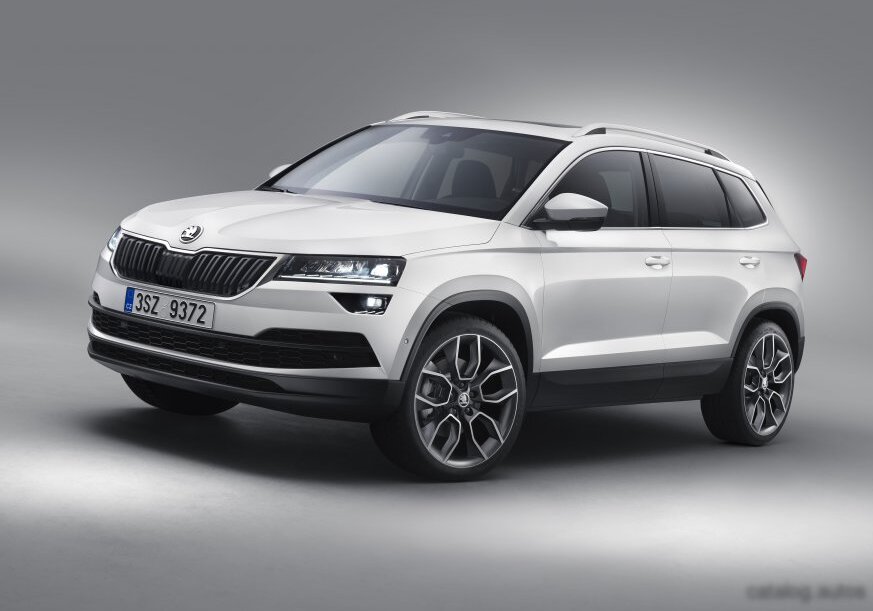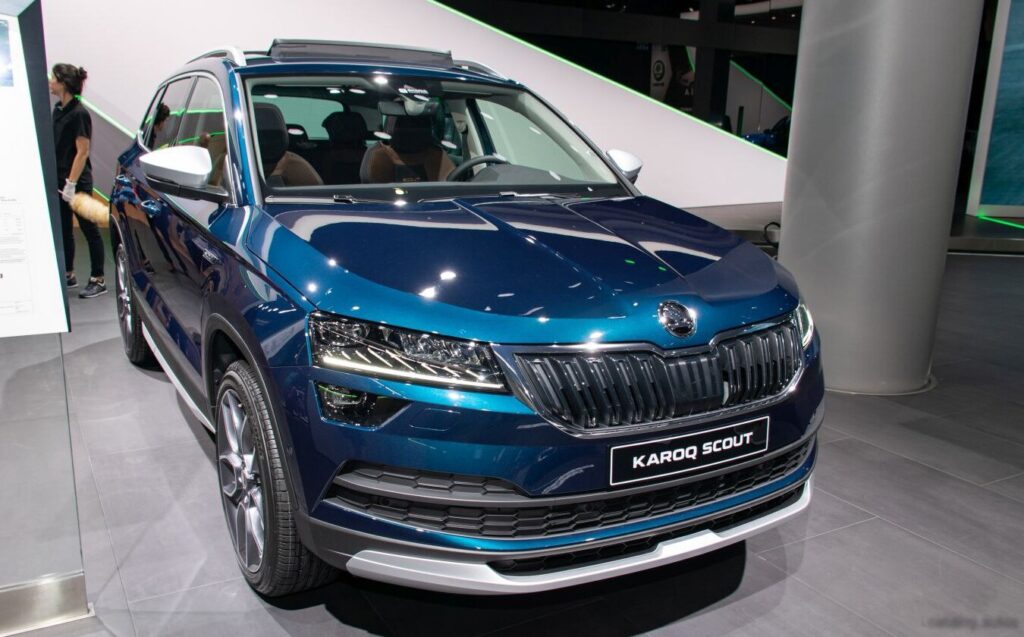
The Skoda Karoq Scout 2.0 TDI 4×4 DSG was a trim level of the Karoq compact SUV produced by the Czech automaker Skoda between 2019 and September 2020. Positioned as the more rugged, all-wheel-drive variant of the Karoq, the Scout aimed to blend practicality with a degree of off-road capability. It occupied the upper-mid range of the Karoq lineup, offering more standard equipment and a more powerful engine than the base models, but stopping short of the outright luxury of potential future trims. The Karoq itself is based on the Volkswagen Group’s MQB platform (A1), shared with models like the Volkswagen Tiguan and SEAT Ateca.
Technical Specifications
| Brand | Skoda |
| Model | Karoq |
| Generation | Karoq Scout |
| Type (Engine) | 2.0 TDI (190 Hp) 4×4 DSG |
| Start of production | 2019 |
| End of production | September, 2020 |
| Powertrain Architecture | Internal Combustion engine |
| Body type | SUV |
| Seats | 5 |
| Doors | 5 |
| Fuel consumption at Low speed (WLTP) | 8.1 l/100 km (29 US mpg, 34.9 UK mpg, 12.3 km/l) |
| Fuel consumption at Medium speed (WLTP) | 6.7 l/100 km (35.1 US mpg, 42.2 UK mpg, 14.9 km/l) |
| Fuel consumption at high speed (WLTP) | 5.9 l/100 km (39.9 US mpg, 47.9 UK mpg, 16.9 km/l) |
| Fuel consumption at very high speed (WLTP) | 6.9 l/100 km (34.1 US mpg, 40.9 UK mpg, 14.5 km/l) |
| Combined fuel consumption (WLTP) | 6.7 l/100 km (35.1 US mpg, 42.2 UK mpg, 14.9 km/l) |
| CO2 emissions (WLTP) | 176 g/km |
| Fuel consumption (economy) – urban (NEDC) | 6 l/100 km (39.2 US mpg, 47.1 UK mpg, 16.7 km/l) |
| Fuel consumption (economy) – extra urban (NEDC) | 4.8 l/100 km (49 US mpg, 58.9 UK mpg, 20.8 km/l) |
| Fuel consumption (economy) – combined (NEDC) | 5.2 l/100 km (45.2 US mpg, 54.3 UK mpg, 19.2 km/l) |
| CO2 emissions (NEDC) | 137 g/km |
| Fuel Type | Diesel |
| Acceleration 0 – 100 km/h | 7.4 sec |
| Acceleration 0 – 62 mph | 7.4 sec |
| Acceleration 0 – 60 mph | 7 sec (Calculated) |
| Maximum speed | 214 km/h (132.97 mph) |
| Emission standard | Euro 6d-TEMP |
| Weight-to-power ratio | 8 kg/Hp, 124.4 Hp/tonne |
| Weight-to-torque ratio | 3.8 kg/Nm, 262 Nm/tonne |
| Power | 190 Hp @ 3500-4000 rpm |
| Torque | 400 Nm @ 1900-3300 rpm (295.02 lb.-ft. @ 1900-3300 rpm) |
| Engine layout | Front, Transverse |
| Engine Model/Code | EA288 / DFHA |
| Engine displacement | 1968 cm3 (120.09 cu. in.) |
| Number of cylinders | 4 |
| Engine configuration | Inline |
| Number of valves per cylinder | 4 |
| Fuel injection system | Diesel Commonrail |
| Engine aspiration | Turbocharger, Intercooler |
| Valvetrain | DOHC |
| Engine oil capacity | 4.7 l (4.97 US qt | 4.14 UK qt) |
| Kerb Weight | 1527-1696 kg (3366.46 – 3739.04 lbs.) |
| Max. weight | 2252 kg (4964.81 lbs.) |
| Max load | 556-725 kg (1225.77 – 1598.35 lbs.) |
| Trunk (boot) space – minimum | 588 l (20.77 cu. ft.) |
| Trunk (boot) space – maximum | 1605 l (56.68 cu. ft.) |
| Fuel tank capacity | 50 l (13.21 US gal | 11 UK gal) |
| Max. roof load | 75 kg (165.35 lbs.) |
| Permitted trailer load with brakes (12%) | 2100 kg (4629.71 lbs.) |
| Permitted trailer load without brakes | 750 kg (1653.47 lbs.) |
| Permitted towbar download | 90 kg (198.42 lbs.) |
| Length | 4398 mm (173.15 in.) |
| Width | 1841 mm (72.48 in.) |
| Height | 1628 mm (64.09 in.) |
| Wheelbase | 2629 mm (103.5 in.) |
| Front track | 1576 mm (62.05 in.) |
| Rear (Back) track | 1547 mm (60.91 in.) |
| Ride height (ground clearance) | 167 mm (6.57 in.) |
| Drag coefficient (Cd) | 0.362 |
| Minimum turning circle (turning diameter) | 10.9 m (35.76 ft.) |
| Drivetrain Architecture | All wheel drive (4×4). ICE drives front wheels, rear driven via clutch. |
| Number of gears and type of gearbox | 7 gears, automatic transmission DSG |
| Front suspension | Independent, McPherson with coil spring and anti-roll bar |
| Rear suspension | Independent multi-link spring suspension with stabilizer |
| Front brakes | Ventilated discs |
| Rear brakes | Disc |
INTRODUCTION
The Skoda Karoq Scout 2.0 TDI 4×4 DSG, launched in 2019, represented Skoda’s attempt to capitalize on the growing popularity of compact SUVs with all-wheel drive. The “Scout” designation, previously used on the Octavia, signified a more adventurous, outdoor-oriented trim level. Built on the MQB platform, the Karoq Scout offered a blend of practicality, fuel efficiency, and a more capable drivetrain than the standard front-wheel-drive Karoq models. It was produced until September 2020, after which Skoda revised the Karoq lineup.
Powertrain & Engine Architecture
At the heart of the Karoq Scout 2.0 TDI 4×4 DSG lies the Volkswagen Group’s EA288 series 2.0-liter turbocharged diesel engine, specifically the DFHA code variant. This engine produces 190 horsepower at 3500-4000 rpm and a substantial 400 Nm (295 lb-ft) of torque between 1900 and 3300 rpm. The engine utilizes a common rail direct injection system, delivering fuel at extremely high pressures for optimized combustion. The cylinder head features a dual overhead camshaft (DOHC) design with four valves per cylinder, enhancing breathing and contributing to the engine’s power output. A turbocharger with an intercooler further boosts performance. The engine is paired with a seven-speed dual-clutch transmission (DSG), known for its quick and smooth gear changes. The 4×4 system employs a multi-plate clutch to distribute power between the front and rear axles as needed, providing enhanced traction in slippery conditions.
Driving Characteristics
The Karoq Scout 2.0 TDI 4×4 DSG offered a composed and refined driving experience. The 190 hp engine and DSG transmission provided brisk acceleration, with a 0-60 mph time of around 7 seconds. While not a sports SUV, the engine delivered ample power for everyday driving and overtaking maneuvers. The DSG transmission’s quick shifts contributed to a responsive feel. The all-wheel-drive system provided enhanced stability and grip, particularly on loose surfaces. Compared to the lower-powered 1.6 TDI Karoq models, the 2.0 TDI Scout offered a noticeable performance improvement. The DSG transmission, while efficient, could sometimes feel slightly hesitant at low speeds, a characteristic of some dual-clutch systems. The gear ratios were tuned for a balance of fuel economy and performance, prioritizing mid-range torque for everyday usability.
Equipment & Trim Levels
The Scout trim level came generously equipped. Standard features typically included alloy wheels, roof rails, off-road driving mode selection, automatic climate control, a touchscreen infotainment system with Apple CarPlay and Android Auto compatibility, and a suite of safety features such as automatic emergency braking and lane departure warning. Interior upholstery was typically a combination of fabric and Alcantara, with Scout-specific design elements. Optional extras included a panoramic sunroof, leather upholstery, adaptive cruise control, and a premium sound system. The Scout trim aimed to provide a balance of comfort, convenience, and off-road capability.
Chassis & Braking
The Karoq Scout featured a fully independent suspension system, with McPherson struts at the front and a multi-link setup at the rear. This provided a comfortable ride quality, even on uneven surfaces. The suspension was tuned to offer a good balance between handling and comfort. The Scout trim often included a slightly raised ride height compared to standard Karoq models, further enhancing its off-road capability. Braking duties were handled by ventilated discs at the front and solid discs at the rear. Anti-lock braking system (ABS) and electronic stability control (ESC) were standard features, ensuring safe and controlled braking performance.
Market Reception & Comparison
The Skoda Karoq Scout 2.0 TDI 4×4 DSG was generally well-received by automotive critics. It was praised for its spacious interior, comfortable ride, and capable all-wheel-drive system. The 2.0 TDI engine was considered a good compromise between performance and fuel economy. Compared to rivals like the Volkswagen Tiguan Allspace and the SEAT Ateca X-Perience, the Karoq Scout offered a compelling value proposition, often undercutting its competitors in price while offering similar levels of equipment and performance. However, some critics noted that the interior design, while functional, lacked the premium feel of some rivals. Fuel economy figures were competitive, with combined WLTP figures around 6.7 l/100 km (35.1 US mpg).
Legacy
The Karoq Scout 2.0 TDI 4×4 DSG has proven to be a relatively reliable vehicle in the used car market. The EA288 diesel engine, while subject to scrutiny in the past regarding emissions, has generally proven durable when properly maintained. The DSG transmission, while potentially requiring servicing at higher mileages, is generally reliable. The all-wheel-drive system has also proven robust. Today, these vehicles represent a good value for buyers seeking a practical, spacious, and capable compact SUV. Regular maintenance, including oil changes and DSG fluid changes, is crucial to ensure long-term reliability.