
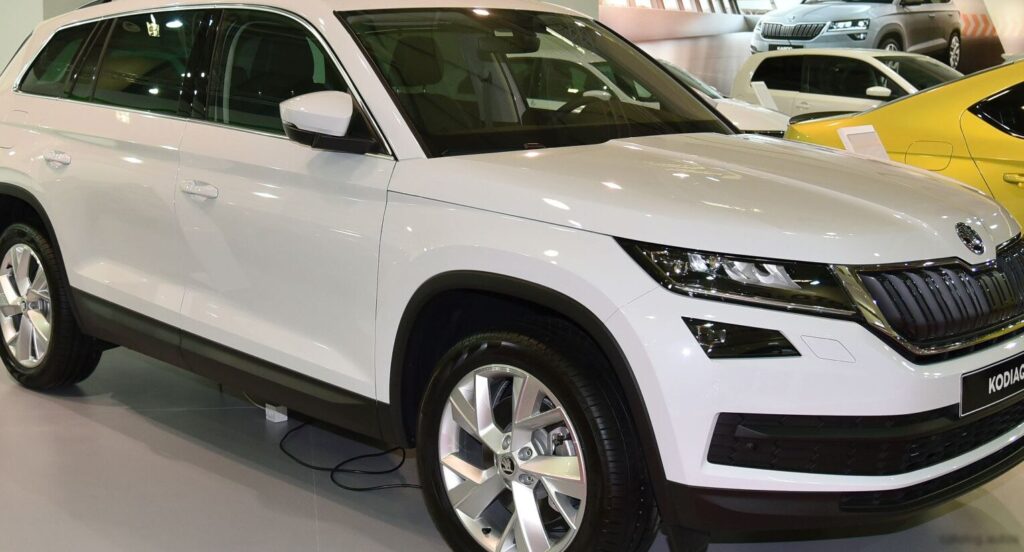
The Skoda Kodiaq 1.4 TSI (125 hp) was a front-wheel-drive, five-seater Sport Utility Vehicle (SUV) produced by the Czech automaker Skoda Auto from 2016 to 2018. It represented an entry point into the first generation Kodiaq (Typ NS7) lineup, which was built on the Volkswagen Group’s MQB platform – specifically the A7 iteration. The Kodiaq was Skoda’s first foray into the mid-size SUV segment, designed to appeal to families and those seeking a practical, spacious vehicle with a touch of European styling. This 1.4 TSI variant aimed to balance affordability with reasonable performance and fuel efficiency.
Technical Specifications
| Brand | Skoda |
| Model | Kodiaq |
| Generation | Kodiaq I |
| Type (Engine) | 1.4 TSI (125 Hp) |
| Start of production | 2016 |
| End of production | 2018 |
| Powertrain Architecture | Internal Combustion engine |
| Body type | SUV |
| Seats | 5 |
| Doors | 5 |
| Fuel consumption (urban) | 7.4-7.5 l/100 km (31.8 – 31.4 US mpg) |
| Fuel consumption (extra urban) | 5.2-5.3 l/100 km (45.2 – 44.4 US mpg) |
| Fuel consumption (combined) | 6.0-6.1 l/100 km (39.2 – 38.6 US mpg) |
| CO2 emissions | 137-139 g/km |
| Fuel Type | Petrol (Gasoline) |
| Acceleration 0 – 100 km/h | 10.7 sec |
| Acceleration 0 – 62 mph | 10.7 sec |
| Acceleration 0 – 60 mph | 10.2 sec |
| Maximum speed | 190 km/h (118.06 mph) |
| Emission standard | Euro 6 |
| Weight-to-power ratio | 11.6 kg/Hp |
| Weight-to-torque ratio | 7.3 kg/Nm |
| Power | 125 Hp @ 5000-6000 rpm |
| Torque | 200 Nm @ 1400-4000 rpm (147.51 lb.-ft.) |
| Engine layout | Front, Transverse |
| Engine Model/Code | EA211 / CZCA |
| Engine displacement | 1395 cm3 (85.13 cu. in.) |
| Number of cylinders | 4 |
| Engine configuration | Inline |
| Cylinder Bore | 74.5 mm (2.93 in.) |
| Piston Stroke | 80 mm (3.15 in.) |
| Compression ratio | 10:1 |
| Number of valves per cylinder | 4 |
| Fuel injection system | Direct injection |
| Engine aspiration | Turbocharger, Intercooler |
| Valvetrain | DOHC |
| Engine oil capacity | 4 l (4.23 US qt | 3.52 UK qt) |
| Coolant | 10 l (10.57 US qt | 8.8 UK qt) |
| Kerb Weight | 1452 kg (3201.11 lbs.) |
| Max. weight | 2102 kg (4634.12 lbs.) |
| Max load | 650 kg (1433 lbs.) |
| Trunk (boot) space – minimum | 650-835 l (22.95 – 29.49 cu. ft.) |
| Trunk (boot) space – maximum | 2065 l (72.92 cu. ft.) |
| Fuel tank capacity | 58 l (15.32 US gal | 12.76 UK gal) |
| Max. roof load | 75 kg (165.35 lbs.) |
| Permitted trailer load with brakes (8%) | 1600 kg (3527.4 lbs.) |
| Permitted trailer load with brakes (12%) | 1600 kg (3527.4 lbs.) |
| Permitted trailer load without brakes | 750 kg (1653.47 lbs.) |
| Permitted towbar download | 75 kg (165.35 lbs.) |
| Length | 4697 mm (184.92 in.) |
| Width | 1882 mm (74.09 in.) |
| Height | 1655 mm (65.16 in.) |
| Wheelbase | 2791 mm (109.88 in.) |
| Front track | 1586 mm (62.44 in.) |
| Rear (Back) track | 1576 mm (62.05 in.) |
| Ride height (ground clearance) | 187 mm (7.36 in.) |
| Drag coefficient (Cd) | 0.33 |
| Minimum turning circle (turning diameter) | 11.6 m (38.06 ft.) |
| Drivetrain Architecture | Front wheel drive |
| Number of gears and type of gearbox | 6 gears, manual transmission |
| Front suspension | Independent, type McPherson with coil spring and anti-roll bar |
| Rear suspension | Independent multi-link suspension |
| Front brakes | Ventilated discs |
| Rear brakes | Disc |
| Assisting systems | ABS (Anti-lock braking system) |
| Steering type | Steering rack and pinion |
| Power steering | Electric Steering |
| Tires size | 215/65 R17 |
| Wheel rims size | 7J x 17 |
INTRODUCTION
The Skoda Kodiaq 1.4 TSI (125 hp) served as the entry-level engine option for the Kodiaq range when it launched in 2016. Positioned below the 1.8 TSI and 2.0 TDI variants, it was designed to offer a more affordable and fuel-efficient choice for buyers. The Kodiaq itself was a significant vehicle for Skoda, marking its first entry into the competitive mid-size SUV market. Built on the versatile MQB platform, it offered a spacious interior, practical features, and a comfortable ride. The 1.4 TSI engine, while not the most powerful in the lineup, provided adequate performance for everyday driving and was particularly well-suited to urban and highway conditions.
Powertrain & Engine Architecture
The heart of the Kodiaq 1.4 TSI was the EA211 engine, a turbocharged, direct-injection four-cylinder petrol engine. Specifically, the CZCA engine code identifies this particular iteration. This engine featured a single-scroll turbocharger with an intercooler, boosting power output to 125 horsepower at 5000-6000 rpm and 200 Nm (147.51 lb-ft) of torque between 1400-4000 rpm. Direct fuel injection, operating at pressures up to 200 bar, ensured precise fuel delivery and efficient combustion. The engine utilized a dual overhead camshaft (DOHC) valvetrain with four valves per cylinder. The 1.4 TSI was paired with a six-speed manual transmission, sending power to the front wheels. While a DSG (Direct-Shift Gearbox) automatic transmission was available on other Kodiaq trims, it wasn’t offered with this specific engine/power output combination.
Driving Characteristics
The Kodiaq 1.4 TSI offered a comfortable and composed driving experience, prioritizing ride quality over outright performance. Acceleration from 0-100 km/h (0-62 mph) took around 10.7 seconds, which was noticeably slower than the more powerful 1.8 TSI or 2.0 TDI models. However, the engine provided sufficient torque for everyday driving situations, such as overtaking on the highway or merging into traffic. The six-speed manual transmission was well-matched to the engine’s characteristics, offering smooth gear changes and a reasonable spread of ratios. The front-wheel-drive configuration contributed to good fuel economy, but it also meant that the Kodiaq 1.4 TSI lacked the all-weather capability of its all-wheel-drive siblings. The steering was light and precise, making it easy to maneuver in urban environments.
Equipment & Trim Levels
The Kodiaq 1.4 TSI typically came with a respectable level of standard equipment, although it was less lavishly equipped than the higher-spec trims. Standard features generally included air conditioning, a touchscreen infotainment system with Bluetooth connectivity, alloy wheels, and a suite of safety features such as ABS, ESC (Electronic Stability Control), and multiple airbags. Interior upholstery was typically cloth, and the dashboard featured a functional, if somewhat understated, design. Optional extras included features such as a larger touchscreen display, navigation system, parking sensors, automatic climate control, and a panoramic sunroof. Trim levels varied slightly depending on the market, but generally followed a progressive structure with increasing levels of equipment and refinement.
Chassis & Braking
The Kodiaq’s chassis was tuned to prioritize comfort and stability. The front suspension utilized a McPherson strut design with coil springs and an anti-roll bar, while the rear suspension employed a more sophisticated multi-link setup. This combination provided a good balance between ride comfort and handling. Braking duties were handled by ventilated discs at the front and solid discs at the rear. ABS (Anti-lock Braking System) was standard, providing enhanced braking performance in emergency situations. The Kodiaq 1.4 TSI’s relatively lower weight compared to its more powerful counterparts contributed to its balanced handling characteristics.
Market Reception & Comparison
The Skoda Kodiaq 1.4 TSI was generally well-received by automotive critics, who praised its spacious interior, comfortable ride, and competitive price point. However, some reviewers noted that the 1.4 TSI engine felt underpowered, particularly when the vehicle was fully loaded with passengers and luggage. Compared to the 1.8 TSI, the 1.4 TSI offered lower performance but better fuel economy. The 2.0 TDI, while more expensive, provided significantly more torque and a more refined driving experience. The 1.4 TSI appealed to buyers who prioritized affordability and fuel efficiency over outright performance.
Legacy
The Skoda Kodiaq 1.4 TSI, while not the most sought-after variant, has proven to be a relatively reliable and durable vehicle. The EA211 engine is known for its robustness, and the Kodiaq’s MQB platform is well-engineered. On the used car market, the 1.4 TSI models tend to be more affordable than their higher-powered counterparts, making them an attractive option for budget-conscious buyers. Regular maintenance, including oil changes and timing belt replacements, is crucial to ensure the long-term reliability of this powertrain. The Kodiaq 1.4 TSI remains a practical and versatile family SUV, offering a good balance of space, comfort, and affordability.