
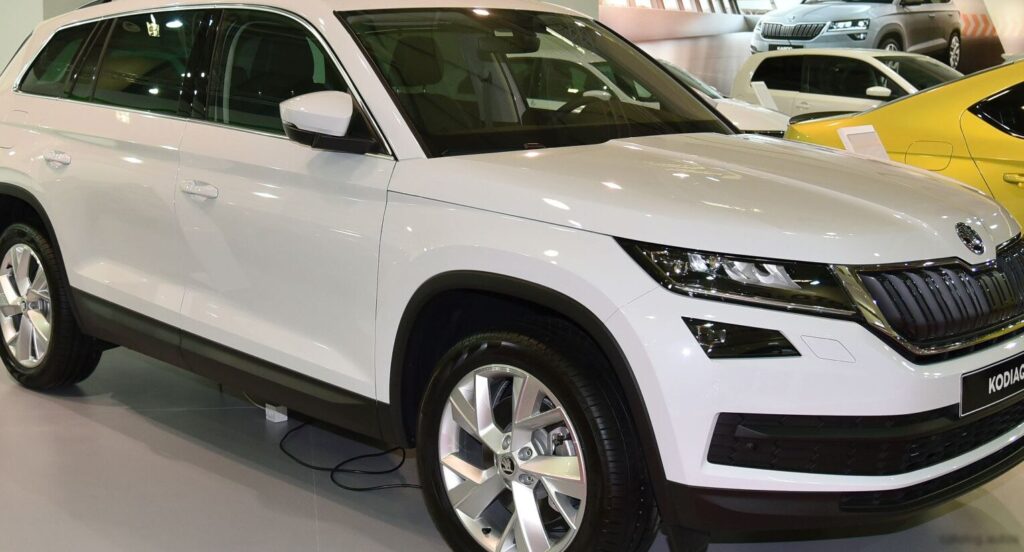
The Skoda Kodiaq 1.4 TSI (150 hp) ACT DSG was a front-wheel-drive, five-seater Sport Utility Vehicle (SUV) produced by the Czech automaker Skoda between 2016 and 2018. It represented a key entry point into the Kodiaq range, Skoda’s first foray into the mid-size SUV segment. Positioned as a practical and family-oriented vehicle, the 1.4 TSI variant aimed to balance affordability with reasonable performance and fuel efficiency, leveraging Volkswagen Group’s modular transverse matrix (MQB) platform – specifically the A3 variant – shared with models like the Volkswagen Tiguan and SEAT Ateca. This model was primarily marketed in Europe and other regions where smaller displacement, turbocharged engines were favored.
Technical Specifications
| Brand | Skoda |
| Model | Kodiaq |
| Generation | Kodiaq I |
| Type (Engine) | 1.4 TSI (150 Hp) ACT DSG |
| Start of production | 2016 |
| End of production | 2018 |
| Powertrain Architecture | Internal Combustion engine |
| Body type | SUV |
| Seats | 5 |
| Doors | 5 |
| Fuel consumption (urban) | 7.4-7.5 l/100 km (31.8 – 31.4 US mpg) |
| Fuel consumption (extra urban) | 5.5-5.6 l/100 km (42.8 – 42 US mpg) |
| Fuel consumption (combined) | 6.2-6.3 l/100 km (37.9 – 37.3 US mpg) |
| CO2 emissions | 141-143 g/km |
| Fuel Type | Petrol (Gasoline) |
| Acceleration 0 – 100 km/h | 9.4 sec |
| Acceleration 0 – 62 mph | 9.4 sec |
| Acceleration 0 – 60 mph | 8.9 sec |
| Maximum speed | 198 km/h (123.03 mph) |
| Emission standard | Euro 6 |
| Weight-to-power ratio | 9.8 kg/Hp |
| Weight-to-torque ratio | 5.9 kg/Nm |
| Power | 150 Hp @ 5000-6000 rpm |
| Torque | 250 Nm @ 1500-3500 rpm (184.39 lb.-ft.) |
| Engine layout | Front, Transverse |
| Engine Model/Code | EA211 / CZEA |
| Engine displacement | 1395 cm3 (85.13 cu. in.) |
| Number of cylinders | 4 |
| Engine configuration | Inline |
| Cylinder Bore | 74.5 mm (2.93 in.) |
| Piston Stroke | 80 mm (3.15 in.) |
| Compression ratio | 10:1 |
| Number of valves per cylinder | 4 |
| Fuel injection system | Direct injection |
| Engine aspiration | Turbocharger, Intercooler |
| Valvetrain | DOHC |
| Engine oil capacity | 4 l (4.23 US qt | 3.52 UK qt) |
| Kerb Weight | 1476 kg (3254.02 lbs.) |
| Max. weight | 2126 kg (4687.03 lbs.) |
| Max load | 650 kg (1433 lbs.) |
| Trunk (boot) space – minimum | 650-835 l (22.95 – 29.49 cu. ft.) |
| Trunk (boot) space – maximum | 2065 l (72.92 cu. ft.) |
| Fuel tank capacity | 58 l (15.32 US gal | 12.76 UK gal) |
| Max. roof load | 75 kg (165.35 lbs.) |
| Permitted trailer load with brakes (8%) | 1800 kg (3968.32 lbs.) |
| Permitted trailer load with brakes (12%) | 1800 kg (3968.32 lbs.) |
| Permitted trailer load without brakes | 750 kg (1653.47 lbs.) |
| Permitted towbar download | 75 kg (165.35 lbs.) |
| Length | 4697 mm (184.92 in.) |
| Width | 1882 mm (74.09 in.) |
| Height | 1655 mm (65.16 in.) |
| Wheelbase | 2791 mm (109.88 in.) |
| Front track | 1586 mm (62.44 in.) |
| Rear (Back) track | 1576 mm (62.05 in.) |
| Ride height (ground clearance) | 187 mm (7.36 in.) |
| Drag coefficient (Cd) | 0.33 |
| Minimum turning circle (turning diameter) | 11.6 m (38.06 ft.) |
| Drivetrain Architecture | Front wheel drive |
| Number of gears and type of gearbox | 6 gears, automatic transmission DSG |
| Front suspension | Independent, type McPherson with coil spring and anti-roll bar |
| Rear suspension | Independent multi-link suspension |
| Front brakes | Ventilated discs |
| Rear brakes | Disc |
| Assisting systems | ABS (Anti-lock braking system) |
| Steering type | Steering rack and pinion |
| Power steering | Electric Steering |
| Tires size | 215/65 R17 |
| Wheel rims size | 7J x 17 |
Powertrain & Engine Architecture
The Kodiaq 1.4 TSI utilized the EA211 engine family, a widely used turbocharged, direct-injection petrol engine from the Volkswagen Group. Specifically, the CZEA engine code designates this particular variant. This 1.4-liter inline-four engine featured direct fuel injection, a turbocharger with an intercooler, and a double overhead camshaft (DOHC) valvetrain with four valves per cylinder. A key feature was its Active Cylinder Technology (ACT), which could deactivate the second and third cylinders under light load conditions to improve fuel economy. The engine produced 150 horsepower at 5000-6000 rpm and 250 Nm (184 lb-ft) of torque between 1500-3500 rpm. The engine was paired with a seven-speed dual-clutch transmission (DSG), known for its quick and smooth gear changes. This combination provided a balance between performance and efficiency.
Driving Characteristics
The 1.4 TSI DSG Kodiaq offered a comfortable and refined driving experience, prioritizing ease of use over outright performance. Acceleration from 0-62 mph (0-100 km/h) took around 9.4 seconds, making it adequate for everyday driving but not particularly sporty. The DSG transmission provided responsive shifts, and the engine delivered sufficient torque for overtaking maneuvers. Compared to the more powerful 2.0 TSI variants, the 1.4 TSI felt less eager to accelerate, especially when fully loaded. The gear ratios were tuned for fuel efficiency, resulting in a slightly higher engine speed at highway cruising speeds. The front-wheel-drive configuration provided predictable handling, but lacked the all-weather capability of the available all-wheel-drive system.
Equipment & Trim Levels
The Kodiaq 1.4 TSI typically came with a respectable level of standard equipment. This included air conditioning, a touchscreen infotainment system with Apple CarPlay and Android Auto compatibility, alloy wheels, and a suite of safety features such as ABS, ESC, and multiple airbags. Higher trim levels offered upgrades like leather upholstery, heated seats, a panoramic sunroof, and advanced driver-assistance systems like adaptive cruise control and lane assist. Interior upholstery was typically cloth on base models, with optional leather available. Dashboard configurations were generally consistent across the range, featuring a clean and modern design.
Chassis & Braking
The Kodiaq’s chassis was tuned for comfort and stability. The front suspension utilized McPherson struts with coil springs and an anti-roll bar, while the rear featured an independent multi-link suspension. This setup provided a good balance between ride quality and handling. Braking duties were handled by ventilated discs at the front and solid discs at the rear. The ABS (Anti-lock Braking System) was standard, enhancing braking performance and safety. Stabilizer bar thickness was moderate, contributing to reduced body roll during cornering.
Market Reception & Comparison
The Skoda Kodiaq 1.4 TSI was generally well-received by automotive critics as a practical and well-equipped family SUV. It was praised for its spacious interior, comfortable ride, and fuel efficiency. However, some reviewers noted that the 1.4 TSI engine could feel underpowered, especially when the vehicle was fully loaded or driving uphill. Compared to the 2.0 TSI variants, the 1.4 TSI offered lower running costs but compromised on performance. Against competitors like the Nissan X-Trail and Hyundai Santa Fe, the Kodiaq 1.4 TSI offered a compelling combination of value, space, and features.
Legacy
The Skoda Kodiaq 1.4 TSI (150 hp) ACT DSG, while superseded by newer models and engine options, remains a relatively reliable and affordable option in the used car market. The EA211 engine, when properly maintained, is known for its durability. Common issues are typically related to the DSG transmission, such as mechatronic unit failures, but these are often covered by extended warranties or can be addressed with preventative maintenance. The Kodiaq’s spacious interior and practical design continue to appeal to families seeking a versatile and comfortable SUV.
