
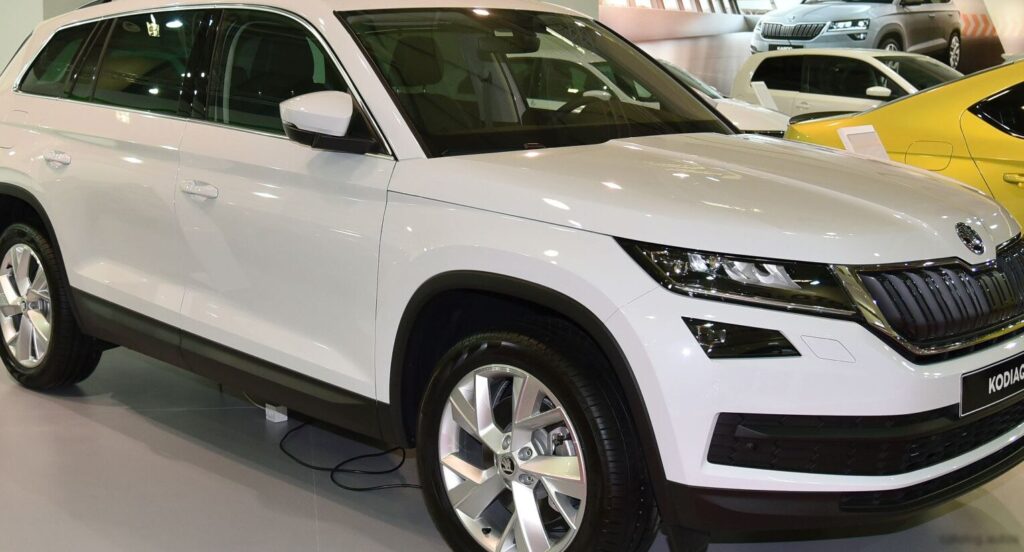
The Skoda Kodiaq 1.4 TSI (150 hp) ACT DSG, produced from 2016 to 2018, represents a key variant within the first generation (Kodiaq I) of Skoda’s flagship seven-seater SUV. Introduced as a mid-range option, it aimed to balance fuel efficiency with acceptable performance for family transport. Positioned within the Kodiaq lineup, which also included engines ranging from a 1.4 TSI with lower horsepower to a 2.0 TDI diesel and a more potent 2.0 TSI petrol, the 1.4 TSI 150 hp model offered a compelling package for buyers prioritizing practicality and running costs. It was built on the Volkswagen Group’s MQB platform (A7 variant), shared with models like the Volkswagen Tiguan and SEAT Ateca.
Technical Specifications
| Brand | Skoda |
| Model | Kodiaq |
| Generation | Kodiaq I |
| Type (Engine) | 1.4 TSI (150 Hp) ACT DSG 7 Seat |
| Start of production | 2016 |
| End of production | 2018 |
| Powertrain Architecture | Internal Combustion engine |
| Body type | SUV |
| Seats | 7 |
| Doors | 5 |
| Fuel consumption (combined) | 6.1 l/100 km (38.6 US mpg, 46.3 UK mpg, 16.4 km/l) |
| CO2 emissions | 141 g/km |
| Fuel Type | Petrol (Gasoline) |
| Acceleration 0 – 100 km/h | 9.6 sec |
| Acceleration 0 – 62 mph | 9.6 sec |
| Acceleration 0 – 60 mph | 9.1 sec |
| Maximum speed | 197 km/h (122.41 mph) |
| Emission standard | Euro 6 |
| Weight-to-power ratio | 10.1 kg/Hp, 98.7 Hp/tonne |
| Weight-to-torque ratio | 6.1 kg/Nm, 164.6 Nm/tonne |
| Power | 150 Hp @ 5000-6000 rpm |
| Power per litre | 107.5 Hp/l |
| Torque | 250 Nm @ 1500-3500 rpm (184.39 lb.-ft. @ 1500-3500 rpm) |
| Engine layout | Front, Transverse |
| Engine Model/Code | EA211 / CZEA |
| Engine displacement | 1395 cm3 (85.13 cu. in.) |
| Number of cylinders | 4 |
| Engine configuration | Inline |
| Cylinder Bore | 74.5 mm (2.93 in.) |
| Piston Stroke | 80 mm (3.15 in.) |
| Compression ratio | 10:1 |
| Number of valves per cylinder | 4 |
| Fuel injection system | Direct injection |
| Engine aspiration | Turbocharger, Intercooler |
| Valvetrain | DOHC |
| Engine oil capacity | 4 l (4.23 US qt | 3.52 UK qt) |
| Kerb Weight | 1519 kg (3348.82 lbs.) |
| Max. weight | 2199 kg (4847.97 lbs.) |
| Max load | 680 kg (1499.14 lbs.) |
| Trunk (boot) space – minimum | 560-765 l (19.78 – 27.02 cu. ft.) |
| Trunk (boot) space – maximum | 2005 l (70.81 cu. ft.) |
| Fuel tank capacity | 58 l (15.32 US gal | 12.76 UK gal) |
| Max. roof load | 75 kg (165.35 lbs.) |
| Permitted trailer load with brakes (8%) | 1800 kg (3968.32 lbs.) |
| Permitted trailer load with brakes (12%) | 1800 kg (3968.32 lbs.) |
| Permitted trailer load without brakes | 750 kg (1653.47 lbs.) |
| Permitted towbar download | 72 kg (158.73 lbs.) |
| Length | 4697 mm (184.92 in.) |
| Width | 1882 mm (74.09 in.) |
| Height | 1655 mm (65.16 in.) |
| Wheelbase | 2791 mm (109.88 in.) |
| Front track | 1586 mm (62.44 in.) |
| Rear (Back) track | 1576 mm (62.05 in.) |
| Ride height (ground clearance) | 188 mm (7.4 in.) |
| Drag coefficient (Cd) | 0.33 |
| Minimum turning circle (turning diameter) | 11.6 m (38.06 ft.) |
| Drivetrain Architecture | The Internal combustion engine (ICE) drives the front wheels of the vehicle. |
| Drive wheel | Front wheel drive |
| Number of gears and type of gearbox | 6 gears, automatic transmission DSG |
| Front suspension | Independent, type McPherson with coil spring and anti-roll bar |
| Rear suspension | Independent multi-link suspension |
| Front brakes | Ventilated discs |
| Rear brakes | Disc |
| Assisting systems | ABS (Anti-lock braking system) |
| Steering type | Steering rack and pinion |
| Power steering | Electric Steering |
| Tires size | 215/65 R17 |
| Wheel rims size | 7J x 17 |
INTRODUCTION
The Skoda Kodiaq, launched in 2016, was Skoda’s first foray into the seven-seat SUV segment. The 1.4 TSI (150 hp) ACT DSG variant, available throughout much of the Kodiaq I’s production run (2016-2018), was designed to appeal to families seeking a spacious and practical vehicle with reasonable fuel economy. The “ACT” designation stands for Active Cylinder Technology, a fuel-saving feature that deactivates two cylinders under light load. This engine, coupled with the seven-speed DSG (Direct-Shift Gearbox) automatic transmission, offered a balance between performance and efficiency, making it a popular choice in European markets.
Powertrain & Engine Architecture
At the heart of the Kodiaq 1.4 TSI is the EA211 engine family, specifically the CZEA engine code. This is a turbocharged, direct-injection four-cylinder petrol engine displacing 1395cc. The engine utilizes a single-scroll turbocharger with an intercooler to boost power and torque. Direct injection ensures precise fuel delivery, optimizing combustion efficiency. The cylinder head features a double overhead camshaft (DOHC) valvetrain with four valves per cylinder. The key feature, Active Cylinder Technology (ACT), shuts down cylinders two and three during cruising or low-load situations, reducing fuel consumption. The seven-speed DSG transmission is a dual-clutch unit, offering quick and smooth gear changes. It features a sophisticated electronic control unit that adapts shift points based on driving style and conditions.
Driving Characteristics
The 150 hp 1.4 TSI engine, while not overtly sporty, provided adequate performance for everyday driving and family duties. Acceleration from 0-60 mph took around 9.1 seconds, and the top speed was 122.41 mph. The DSG transmission contributed to a responsive driving experience, with quick shifts and minimal torque interruption. However, compared to the more powerful 2.0 TSI variants, the 1.4 TSI felt less eager, particularly when fully loaded with passengers and luggage. The ACT system was generally seamless in operation, though some drivers reported a slight vibration when cylinders were deactivated. The gear ratios in the DSG were well-chosen for both fuel efficiency and usability, providing sufficient torque in most situations. The front-wheel-drive configuration offered predictable handling, but lacked the all-weather capability of the available all-wheel-drive Kodiaq models.
Equipment & Trim Levels
The Kodiaq 1.4 TSI typically came with a generous level of standard equipment. This included air conditioning, a touchscreen infotainment system with Apple CarPlay and Android Auto compatibility, alloy wheels, and a suite of safety features such as ABS, ESC (Electronic Stability Control), and multiple airbags. Higher trim levels, such as SE L and Elegance, added features like leather upholstery, heated front seats, parking sensors, and a panoramic sunroof. Optional extras included adaptive cruise control, a premium sound system, and a tow bar. Interior upholstery was typically cloth on base models, with leather options available on higher trims. The dashboard layout was clean and functional, with a focus on user-friendliness.
Chassis & Braking
The Kodiaq’s chassis was tuned for comfort and stability. The front suspension utilized a McPherson strut setup with coil springs and an anti-roll bar, while the rear employed an independent multi-link suspension. This configuration provided a good balance between ride quality and handling. Braking duties were handled by ventilated discs at the front and solid discs at the rear. ABS (Anti-lock Braking System) was standard, ensuring effective braking performance in various conditions. Stabilizer bars were fitted to both the front and rear axles to reduce body roll during cornering.
Market Reception & Comparison
The Skoda Kodiaq 1.4 TSI was generally well-received by automotive critics. It was praised for its spacious interior, comfortable ride, and good fuel economy. However, some reviewers noted that the 1.4 TSI engine could feel underpowered when the vehicle was fully loaded. Compared to the 2.0 TDI diesel, the 1.4 TSI offered lower emissions but less torque. Against the 2.0 TSI petrol, it provided better fuel economy but significantly less power. The 1.4 TSI’s fuel economy of around 38.6 US mpg was competitive within its class, making it an attractive option for buyers prioritizing running costs. Reliability reports have been generally positive, with few major issues reported with the engine or transmission.
Legacy
The Skoda Kodiaq 1.4 TSI (150 hp) ACT DSG has proven to be a reliable and practical family SUV. On the used car market, these models represent good value for money, offering a spacious interior and a comfortable driving experience at a reasonable price. The EA211 engine, while not known for being particularly exciting, is generally robust and relatively inexpensive to maintain. The DSG transmission, if properly serviced, is also known for its longevity. The Kodiaq’s success helped establish Skoda as a major player in the European SUV market, and the 1.4 TSI variant played a significant role in attracting buyers seeking a balance between practicality, efficiency, and affordability.
