
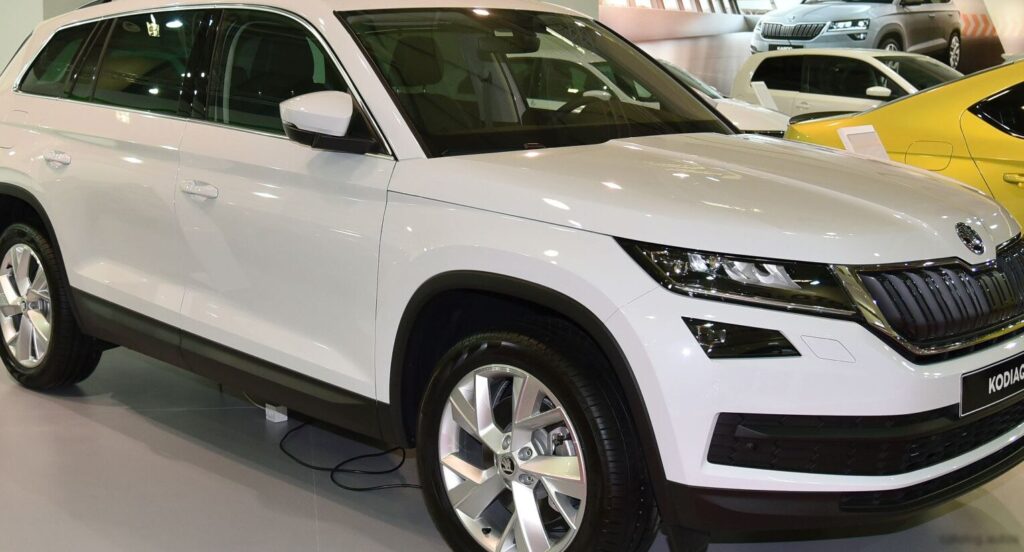
The Skoda Kodiaq 1.5 TSI 7-seat variant, produced from 2018 to April 2021, represents a key offering within the first generation (Kodiaq I) of Skoda’s flagship SUV. Positioned as a mid-range option in the Kodiaq lineup, it aimed to provide a balance between fuel efficiency, practicality, and family-oriented space. Built on the Volkswagen Group’s MQB platform (specifically the A7 iteration), the Kodiaq was Skoda’s first foray into the seven-seater SUV segment, designed primarily for the European market where larger vehicles were gaining popularity. This variant offered a compelling alternative to competitors like the Nissan X-Trail and Hyundai Santa Fe, emphasizing value and a spacious interior.
Technical Specifications
| Brand | Skoda |
| Model | Kodiaq |
| Generation | Kodiaq I |
| Type (Engine) | 1.5 TSI (150 Hp) 7 Seat |
| Start of production | 2018 |
| End of production | April, 2021 |
| Powertrain Architecture | Internal Combustion engine |
| Body type | SUV |
| Seats | 7 |
| Doors | 5 |
| Fuel Type | Petrol (Gasoline) |
| Acceleration 0 – 100 km/h | 9.9 sec |
| Acceleration 0 – 62 mph | 9.9 sec |
| Acceleration 0 – 60 mph | 9.4 sec |
| Maximum speed | 200 km/h (124.27 mph) |
| Weight-to-power ratio | 10.6 kg/Hp, 94.2 Hp/tonne |
| Weight-to-torque ratio | 6.4 kg/Nm, 157 Nm/tonne |
| Power | 150 Hp @ 5000-6000 rpm |
| Power per litre | 100.1 Hp/l |
| Torque | 250 Nm @ 1500-3500 rpm (184.39 lb.-ft. @ 1500-3500 rpm) |
| Engine layout | Front, Transverse |
| Engine Model/Code | EA211 evo / DADA |
| Engine displacement | 1498 cm3 (91.41 cu. in.) |
| Number of cylinders | 4 |
| Engine configuration | Inline |
| Number of valves per cylinder | 4 |
| Fuel injection system | Direct injection |
| Engine aspiration | Turbocharger, Intercooler |
| Engine oil capacity | 4.3 l (4.54 US qt | 3.78 UK qt) |
| Kerb Weight | 1592 kg (3509.76 lbs) |
| Fuel tank capacity | 60 l (15.85 US gal | 13.2 UK gal) |
| Length | 4697 mm (184.92 in) |
| Width | 1882 mm (74.09 in) |
| Width including mirrors | 2087 mm (82.17 in) |
| Height | 1659 mm (65.31 in) |
| Wheelbase | 2791 mm (109.88 in) |
| Front track | 1586 mm (62.44 in) |
| Rear (Back) track | 1576 mm (62.05 in) |
| Ride height (ground clearance) | 191-192 mm (7.52 – 7.56 in) |
| Minimum turning circle | 11.6 m (38.06 ft) |
| Drivetrain Architecture | Front wheel drive |
| Number of gears and type of gearbox | 6 gears, manual transmission |
| Front suspension | Independent, type McPherson with coil spring and anti-roll bar |
| Rear suspension | Independent multi-link suspension |
| Front brakes | Ventilated discs |
| Rear brakes | Disc |
| Tires size | 215/65 R17 |
| Wheel rims size | 17 |
Powertrain & Engine Architecture
The heart of the Kodiaq 1.5 TSI is the EA211 evo series engine, specifically the DADA code. This 1.5-liter inline-four cylinder engine utilizes direct fuel injection and a single turbocharger with intercooling. A key feature of this engine is its ability to operate on a Miller cycle at lower loads, improving efficiency. This is achieved through variable valve timing on both the intake and exhaust sides. The engine produces 150 horsepower at 5000-6000 rpm and 250 Nm (184 lb-ft) of torque between 1500-3500 rpm. The six-speed manual transmission was standard, offering a relatively long-legged gear ratio spread designed for comfortable highway cruising. The transmission’s ratios were tuned to maximize fuel economy and provide adequate acceleration, though it wasn’t geared for particularly sporty performance.
Driving Characteristics
The 1.5 TSI engine, paired with the manual transmission, delivers a respectable, if not exhilarating, driving experience. Acceleration from 0-60 mph takes approximately 9.4 seconds. The engine feels responsive in the mid-range, making overtaking maneuvers on the highway manageable. However, it can feel somewhat strained when pushed hard, particularly when fully loaded with passengers and luggage. The manual gearbox is precise and easy to operate, but the long gearing can sometimes require frequent downshifts when encountering hills or needing a quick burst of acceleration. Compared to the more powerful 2.0 TSI variants, the 1.5 TSI offers a more economical driving experience, but at the expense of outright performance. The front-wheel-drive configuration contributes to predictable handling, but lacks the all-weather capability of the available all-wheel-drive options.
Equipment & Trim Levels
The Kodiaq 1.5 TSI 7-seat typically came standard with features such as air conditioning, a touchscreen infotainment system with Apple CarPlay and Android Auto compatibility, alloy wheels, and a suite of safety features including ABS, ESC, and multiple airbags. Higher trim levels added features like automatic climate control, parking sensors, a rearview camera, and upgraded upholstery. Optional extras included a panoramic sunroof, leather seats, and a more advanced infotainment system with navigation. The interior design was functional and well-built, with a focus on practicality and durability. The seven seats, while best suited for children or shorter adults, significantly enhanced the Kodiaq’s versatility.
Chassis & Braking
The Kodiaq’s chassis features an independent McPherson strut suspension at the front and a multi-link suspension at the rear, providing a comfortable and controlled ride. The suspension was tuned to prioritize comfort over sporty handling. The front brakes are ventilated discs, while the rear brakes are solid discs. ABS (Anti-lock Braking System) and ESC (Electronic Stability Control) are standard safety features. The steering is electrically assisted, providing light and precise control. The standard tire size is 215/65 R17, offering a good balance between comfort and grip.
Market Reception & Comparison
The Skoda Kodiaq 1.5 TSI 7-seat was generally well-received by automotive critics. It was praised for its spacious interior, comfortable ride, and good fuel economy. However, some reviewers noted that the engine could feel underpowered when fully loaded. Compared to the higher-output 2.0 TSI variants, the 1.5 TSI offered a more affordable entry point into the Kodiaq range, appealing to families seeking a practical and economical SUV. The 1.5 TSI also offered better fuel economy than the 2.0 TDI diesel option, making it a popular choice for drivers who primarily cover shorter distances.
Legacy
The EA211 evo engine family, including the 1.5 TSI, has proven to be relatively reliable, although some owners have reported issues with the turbocharger and fuel injectors. Regular maintenance, including oil changes and timely replacement of wear items, is crucial for ensuring long-term reliability. On the used car market, the Kodiaq 1.5 TSI 7-seat represents a good value proposition, offering a spacious and practical SUV at a competitive price. Its blend of practicality, fuel efficiency, and affordability has ensured its continued popularity among families seeking a versatile vehicle.
