
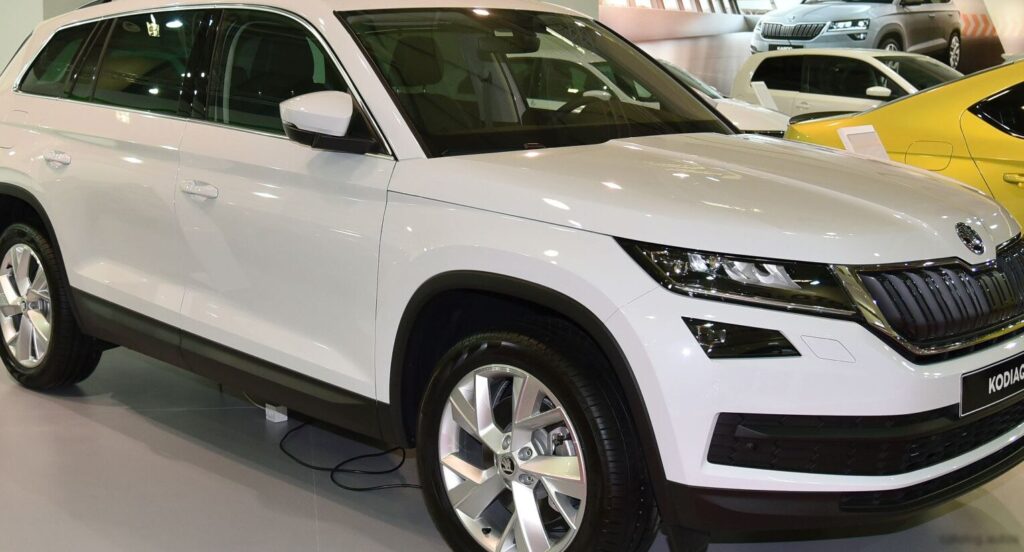
The Skoda Kodiaq 2.0 TDI (116 hp) was a front-wheel-drive, five-seater SUV produced from 2018 to April 2021. It represented an entry-level diesel option within the first generation (Kodiaq I) of the Kodiaq model range, which itself was built on the Volkswagen Group’s MQB platform – also known as the A7 platform. Positioned as a practical and spacious family vehicle, the 2.0 TDI 116 hp variant aimed to balance fuel efficiency with reasonable performance, appealing to buyers prioritizing economy and value.
Technical Specifications
| Brand | Skoda |
| Model | Kodiaq |
| Generation | Kodiaq I |
| Type (Engine) | 2.0 TDI (116 Hp) |
| Start of production | 2018 |
| End of production | April, 2021 |
| Powertrain Architecture | Internal Combustion engine |
| Body type | SUV |
| Seats | 5 |
| Doors | 5 |
| Fuel consumption (economy) – urban (NEDC) | 5.6 l/100 km (42 US mpg, 50.4 UK mpg, 17.9 km/l) |
| Fuel consumption (economy) – extra urban (NEDC) | 4.3 l/100 km (54.7 US mpg, 65.7 UK mpg, 23.3 km/l) |
| Fuel consumption (economy) – combined (NEDC) | 4.8 l/100 km (49 US mpg, 58.9 UK mpg, 20.8 km/l) |
| CO2 emissions (NEDC) | 126 g/km |
| Fuel Type | Diesel |
| Acceleration 0 – 100 km/h | 11.6 sec |
| Acceleration 0 – 62 mph | 11.6 sec |
| Acceleration 0 – 60 mph | 11 sec |
| Maximum speed | 184 km/h (114.33 mph) |
| Emission standard | Euro 6 BG |
| Weight-to-power ratio | 13.6 kg/Hp, 73.6 Hp/tonne |
| Weight-to-torque ratio | 4.9 kg/Nm, 203 Nm/tonne |
| Power | 116 Hp @ 2750-4500 rpm |
| Power per litre | 58.9 Hp/l |
| Torque | 320 Nm @ 1700-2500 rpm (236.02 lb.-ft. @ 1700-2500 rpm) |
| Engine layout | Front, Transverse |
| Engine Model/Code | EA288 / DFGC |
| Engine displacement | 1968 cm3 (120.09 cu. in.) |
| Number of cylinders | 4 |
| Engine configuration | Inline |
| Cylinder Bore | 81 mm (3.19 in.) |
| Piston Stroke | 95.5 mm (3.76 in.) |
| Compression ratio | 16:1 |
| Number of valves per cylinder | 4 |
| Fuel injection system | Diesel Commonrail |
| Engine aspiration | Turbocharger, Intercooler |
| Valvetrain | DOHC |
| Engine oil capacity | 4.7 l (4.97 US qt | 4.14 UK qt) |
| Kerb Weight | 1576 kg (3474.49 lbs.) |
| Max. weight | 2276 kg (5017.72 lbs.) |
| Max load | 700 kg (1543.24 lbs.) |
| Trunk (boot) space – minimum | 835 l (29.49 cu. ft.) |
| Trunk (boot) space – maximum | 2065 l (72.92 cu. ft.) |
| Fuel tank capacity | 58 l (15.32 US gal | 12.76 UK gal) |
| Max. roof load | 75 kg (165.35 lbs.) |
| Permitted trailer load with brakes (8%) | 1800 kg (3968.32 lbs.) |
| Permitted trailer load with brakes (12%) | 1800 kg (3968.32 lbs.) |
| Permitted trailer load without brakes | 750 kg (1653.47 lbs.) |
| Permitted towbar download | 100 kg (220.46 lbs.) |
| Length | 4697 mm (184.92 in.) |
| Width | 1882 mm (74.09 in.) |
| Width including mirrors | 2087 mm (82.17 in.) |
| Height | 1660 mm (65.35 in.) |
| Wheelbase | 2791 mm (109.88 in.) |
| Front track | 1586 mm (62.44 in.) |
| Rear (Back) track | 1576 mm (62.05 in.) |
| Front overhang | 898 mm (35.35 in.) |
| Rear overhang | 1009 mm (39.72 in.) |
| Ride height (ground clearance) | 193 mm (7.6 in.) |
| Drag coefficient (Cd) | 0.331 |
| Minimum turning circle (turning diameter) | 11.6 m (38.06 ft.) |
| Approach angle | 19.4° |
| Departure angle | 15.9° |
| Drivetrain Architecture | The Internal combustion engine (ICE) drives the front wheels of the vehicle. |
| Drive wheel | Front wheel drive |
| Number of gears and type of gearbox | 6 gears, manual transmission |
| Front suspension | Independent, type McPherson with coil spring and anti-roll bar |
| Rear suspension | Independent multi-link suspension |
| Front brakes | Ventilated discs |
| Rear brakes | Disc |
| Assisting systems | ABS (Anti-lock braking system) |
| Steering type | Steering rack and pinion |
| Power steering | Electric Steering |
| Tires size | 215/65 R17 |
| Wheel rims size | 17 |
Powertrain & Engine Architecture
The Kodiaq 2.0 TDI 116 hp utilized the Volkswagen Group’s EA288 engine family, specifically the DFGC code variant. This is a 1.968-liter, inline-four cylinder diesel engine. It featured a turbocharger with an intercooler to enhance power output and efficiency. The engine employed a common rail direct fuel injection system, delivering fuel directly into the combustion chamber at high pressure for optimized combustion. The engine also featured a Dual Overhead Camshaft (DOHC) valvetrain with four valves per cylinder, contributing to improved breathing and performance. The 6-speed manual transmission was standard, chosen for its efficiency and cost-effectiveness. The engine’s design prioritized torque delivery at lower RPMs, making it suitable for everyday driving and towing.
Driving Characteristics
The 116 hp output, coupled with 320 Nm (236 lb-ft) of torque, provided adequate, but not exhilarating, performance. Acceleration from 0-60 mph took around 11 seconds, and the top speed was 114.33 mph. The engine’s strength lay in its mid-range torque, making it easy to maintain highway speeds and navigate hills. Compared to higher-output versions of the 2.0 TDI (like the 150 hp or 190 hp variants), the 116 hp model felt noticeably slower, particularly during overtaking maneuvers. The manual transmission offered precise shifts, but the gear ratios were tuned for fuel economy rather than outright performance. The front-wheel-drive configuration contributed to a slight tendency for understeer in spirited driving.
Equipment & Trim Levels
The 2.0 TDI 116 hp Kodiaq typically came with a reasonable level of standard equipment. This included air conditioning, a touchscreen infotainment system with Bluetooth connectivity, alloy wheels, and a suite of safety features like ABS, ESC (Electronic Stability Control), and multiple airbags. Higher trim levels offered upgrades such as automatic climate control, parking sensors, a rearview camera, and more advanced infotainment options. Interior upholstery was typically cloth, with options for leather available on higher trims. The dashboard layout was functional and well-designed, prioritizing ergonomics and ease of use.
Chassis & Braking
The Kodiaq’s chassis was tuned for comfort and stability. The front suspension utilized McPherson struts with coil springs and an anti-roll bar, while the rear suspension employed an independent multi-link setup. This configuration provided a good balance between ride quality and handling. The braking system consisted of ventilated discs on the front wheels and solid discs on the rear. ABS (Anti-lock Braking System) was standard, enhancing braking performance and safety. The suspension setup was generally softer than that of sportier SUVs, prioritizing comfort for passengers.
Market Reception & Comparison
The Kodiaq 2.0 TDI 116 hp was generally well-received as a practical and affordable family SUV. Critics praised its spacious interior, comfortable ride, and fuel efficiency. However, some reviewers noted that the engine lacked the punch of higher-output alternatives. Compared to the 150 hp TDI, the 116 hp version offered lower running costs but compromised on performance. Against competitors like the Nissan X-Trail or Hyundai Santa Fe, the Kodiaq offered a compelling combination of value, space, and build quality. Fuel economy was a strong point, with combined figures around 49 US mpg.
Legacy
The EA288 engine family, including the DFGC variant, has proven to be relatively reliable, although diesel particulate filter (DPF) issues can occur, particularly with frequent short journeys. Regular maintenance, including oil changes and DPF regeneration, is crucial for long-term reliability. On the used car market, the Kodiaq 2.0 TDI 116 hp represents a good value proposition for buyers seeking a spacious and economical SUV. Its relatively simple mechanicals and proven engine design contribute to its appeal. While not the fastest Kodiaq variant, it remains a capable and practical vehicle for everyday use.
