
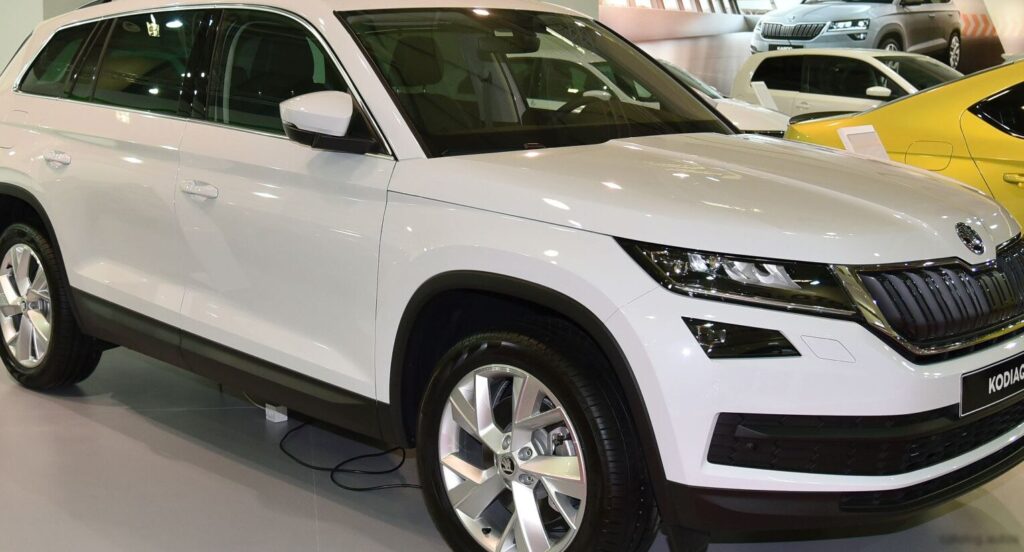
The Skoda Kodiaq 2.0 TDI 4×4, produced from 2016 to 2018, represents a significant entry for Skoda into the increasingly popular mid-size SUV segment. Built on the Volkswagen Group’s MQB platform (specifically the A7 iteration), the Kodiaq aimed to offer a spacious, practical, and technologically advanced vehicle at a competitive price point. This particular variant, equipped with the 2.0-liter TDI engine producing 150 horsepower and paired with a six-speed manual transmission, served as a strong mid-range offering within the Kodiaq lineup, balancing performance, fuel efficiency, and affordability. It was primarily marketed towards families and those seeking a versatile vehicle capable of both everyday commuting and longer journeys.
Technical Specifications
| Brand | Skoda |
| Model | Kodiaq |
| Generation | Kodiaq I |
| Type (Engine) | 2.0 TDI (150 Hp) 4×4 |
| Start of production | 2016 |
| End of production | 2018 |
| Powertrain Architecture | Internal Combustion engine |
| Body type | SUV |
| Seats | 5 |
| Doors | 5 |
| Fuel consumption (urban) | 6.3-6.4 l/100 km (37.3 – 36.8 US mpg, 44.8 – 44.1 UK mpg, 15.9 – 15.6 km/l) |
| Fuel consumption (extra urban) | 4.7-4.8 l/100 km (50 – 49 US mpg, 60.1 – 58.9 UK mpg, 21.3 – 20.8 km/l) |
| Fuel consumption (combined) | 5.3-5.4 l/100 km (44.4 – 43.6 US mpg, 53.3 – 52.3 UK mpg, 18.9 – 18.5 km/l) |
| CO2 emissions | 139-141 g/km |
| Fuel Type | Diesel |
| Acceleration 0 – 100 km/h | 9.6 sec |
| Acceleration 0 – 62 mph | 9.6 sec |
| Acceleration 0 – 60 mph | 9.1 sec |
| Maximum speed | 196 km/h (121.79 mph) |
| Emission standard | Euro 6 |
| Weight-to-power ratio | 10.9 kg/Hp, 91.5 Hp/tonne |
| Weight-to-torque ratio | 4.8 kg/Nm, 207.4 Nm/tonne |
| Power | 150 Hp @ 3500-4000 rpm |
| Power per litre | 76.2 Hp/l |
| Torque | 340 Nm @ 1750-3000 rpm (250.77 lb.-ft. @ 1750-3000 rpm) |
| Engine layout | Front, Transverse |
| Engine Model/Code | EA288 / DFGA |
| Engine displacement | 1968 cm3 (120.09 cu. in.) |
| Number of cylinders | 4 |
| Engine configuration | Inline |
| Cylinder Bore | 81 mm (3.19 in.) |
| Piston Stroke | 95.5 mm (3.76 in.) |
| Compression ratio | 16.2:1 |
| Number of valves per cylinder | 4 |
| Fuel injection system | Diesel Commonrail |
| Engine aspiration | Turbocharger, Intercooler |
| Valvetrain | DOHC |
| Engine oil capacity | 4.7 l (4.97 US qt | 4.14 UK qt) |
| Kerb Weight | 1639 kg (3613.38 lbs.) |
| Max. weight | 2314 kg (5101.5 lbs.) |
| Max load | 675 kg (1488.12 lbs.) |
| Trunk (boot) space – minimum | 650-835 l (22.95 – 29.49 cu. ft.) |
| Trunk (boot) space – maximum | 2065 l (72.92 cu. ft.) |
| Fuel tank capacity | 60 l (15.85 US gal | 13.2 UK gal) |
| Max. roof load | 75 kg (165.35 lbs.) |
| Permitted trailer load with brakes (8%) | 2000 kg (4409.25 lbs.) |
| Permitted trailer load with brakes (12%) | 2000 kg (4409.25 lbs.) |
| Permitted trailer load without brakes | 750 kg (1653.47 lbs.) |
| Permitted towbar download | 100 kg (220.46 lbs.) |
| Length | 4697 mm (184.92 in.) |
| Width | 1882 mm (74.09 in.) |
| Height | 1655 mm (65.16 in.) |
| Wheelbase | 2791 mm (109.88 in.) |
| Front track | 1586 mm (62.44 in.) |
| Rear (Back) track | 1576 mm (62.05 in.) |
| Ride height (ground clearance) | 187 mm (7.36 in.) |
| Drag coefficient (Cd) | 0.33 |
| Minimum turning circle (turning diameter) | 11.6 m (38.06 ft.) |
| Drive wheel | All wheel drive (4×4) |
| Number of gears and type of gearbox | 6 gears, manual transmission |
| Front suspension | Independent, type McPherson with coil spring and anti-roll bar |
| Rear suspension | Independent multi-link suspension |
| Front brakes | Ventilated discs |
| Rear brakes | Disc |
| Assisting systems | ABS (Anti-lock braking system) |
| Steering type | Steering rack and pinion |
| Power steering | Electric Steering |
| Tires size | 215/65 R17 |
| Wheel rims size | 7J x 17 |
Powertrain & Engine Architecture
The heart of this Kodiaq variant is the EA288 series 2.0-liter four-cylinder diesel engine. This engine, a staple in the Volkswagen Group’s lineup, is known for its robust construction and relatively good fuel economy. The DFGA engine code signifies a specific calibration of the EA288, tuned for 150 horsepower at 3500-4000 rpm and 340 Nm (250.77 lb-ft) of torque between 1750 and 3000 rpm. It utilizes a common rail direct injection system, delivering fuel at extremely high pressures for efficient combustion. The engine also features a turbocharger with an intercooler, boosting power and torque output. The valvetrain employs a dual overhead camshaft (DOHC) design with four valves per cylinder, optimizing gas flow. The six-speed manual transmission provides a direct connection between the engine and the all-wheel-drive system, offering drivers greater control over gear selection.
Driving Characteristics
The 2.0 TDI 150 hp Kodiaq 4×4 delivers a composed and comfortable driving experience. While not overtly sporty, the engine provides sufficient power for everyday driving and overtaking maneuvers. The manual transmission allows for precise gear changes, and the all-wheel-drive system provides excellent traction in various conditions. Compared to the more powerful 2.0 TDI variants (like the 190 hp version), this model offers a more relaxed driving style, prioritizing fuel efficiency over outright performance. The gear ratios are tuned for economy, meaning the engine doesn’t feel strained at highway speeds, but requires downshifts for quicker acceleration. The all-wheel-drive system is primarily front-wheel drive biased, engaging the rear wheels when traction is needed, enhancing stability and control.
Equipment & Trim Levels
The 2.0 TDI 4×4 typically came equipped with a respectable level of standard features. These included air conditioning, a touchscreen infotainment system with Bluetooth connectivity, alloy wheels, and a suite of safety features like ABS, ESC (Electronic Stability Control), and multiple airbags. Higher trim levels offered upgrades such as leather upholstery, a panoramic sunroof, adaptive cruise control, and a more advanced infotainment system with navigation. Interior upholstery was typically cloth on the base models, with leather options available as upgrades. Dashboard configurations were generally straightforward and functional, emphasizing ease of use.
Chassis & Braking
The Kodiaq’s chassis is designed to provide a comfortable ride while maintaining good handling characteristics. The front suspension utilizes a McPherson strut setup, while the rear employs a multi-link suspension, offering a good balance between ride comfort and stability. Braking duties are handled by ventilated discs at the front and solid discs at the rear. The ABS system ensures effective braking performance in emergency situations. Stabilizer bars are fitted to both the front and rear axles to reduce body roll during cornering.
Market Reception & Comparison
The Skoda Kodiaq 2.0 TDI 4×4 was generally well-received by automotive critics. It was praised for its spacious interior, comfortable ride, and competitive pricing. The 150 hp engine was considered adequate for most drivers, and the all-wheel-drive system provided added confidence in challenging conditions. Compared to other trims in the Kodiaq lineup, this variant offered a good balance between performance and fuel economy. It was often seen as a more sensible choice than the higher-powered versions, particularly for those prioritizing practicality and running costs. Fuel economy figures consistently hovered around the 5.3-5.4 l/100km mark, making it an attractive option for those covering long distances.
Legacy
The EA288 engine, in its various iterations, has proven to be a reliable and durable powertrain. While diesel engines, in general, have faced increased scrutiny regarding emissions, the Kodiaq’s Euro 6 compliant engine meets stringent environmental standards. In the used car market, the 2.0 TDI 4×4 Kodiaq remains a popular choice, offering a compelling combination of space, practicality, and affordability. Regular maintenance, including timely oil changes and filter replacements, is crucial for ensuring the long-term reliability of this powertrain. The Kodiaq established Skoda as a serious contender in the mid-size SUV segment, and this particular variant continues to offer a solid and dependable option for buyers seeking a versatile family vehicle.
