
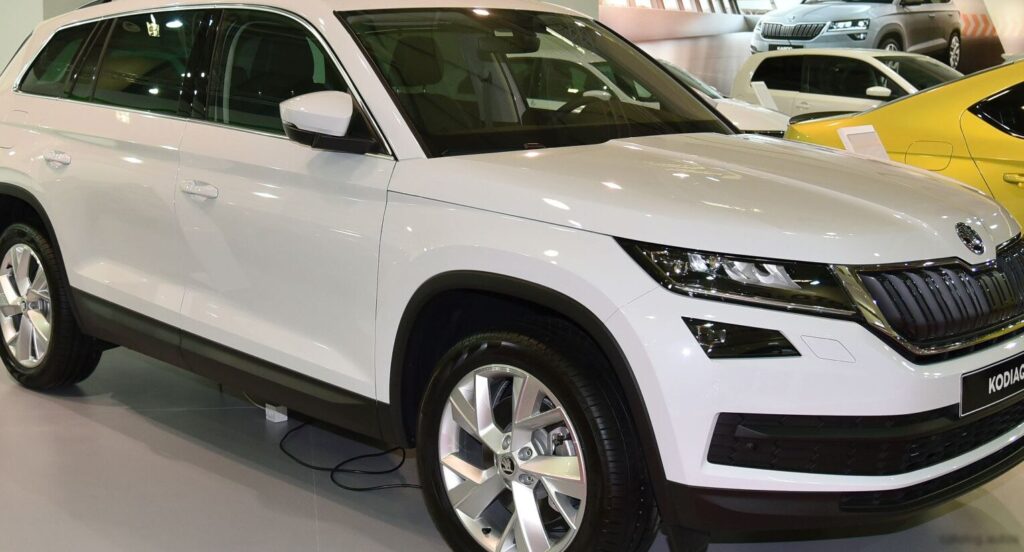
The Skoda Kodiaq, launched in 2016, represented Skoda’s entry into the competitive mid-size SUV segment. Designed to appeal to families and those seeking a practical yet stylish vehicle, the Kodiaq quickly became a popular choice in Europe and other markets. The 2.0 TDI variant, producing 150 horsepower and paired with a 7-speed DSG (Direct-Shift Gearbox) transmission, was a significant offering within the Kodiaq range, typically available with seven-seat configurations. Production of this specific configuration ran from 2016 to 2018, forming part of the first generation (Kodiaq I) based on the Volkswagen Group’s MQB platform.
Technical Specifications
| Brand | Skoda |
| Model | Kodiaq |
| Generation | Kodiaq I |
| Type | 2.0 TDI (150 Hp) DSG 7 Seat |
| Start of production | 2016 |
| End of production | 2018 |
| Powertrain Architecture | Internal Combustion engine |
| Body type | SUV |
| Seats | 7 |
| Doors | 5 |
| Fuel consumption (urban) | 5.7-5.8 l/100 km (41.3 – 40.6 US mpg) |
| Fuel consumption (extra urban) | 4.5-4.6 l/100 km (52.3 – 51.1 US mpg) |
| Fuel consumption (combined) | 4.9-5 l/100 km (48 – 47 US mpg) |
| CO2 emissions | 121-131 g/km |
| Fuel Type | Diesel |
| Acceleration 0 – 100 km/h | 10 sec |
| Acceleration 0 – 62 mph | 10 sec |
| Acceleration 0 – 60 mph | 9.5 sec |
| Maximum speed | 198 km/h (123.03 mph) |
| Emission standard | Euro 6 |
| Weight-to-power ratio | 10.9 kg/Hp |
| Weight-to-torque ratio | 4.8 kg/Nm |
| Power | 150 Hp @ 3500-4000 rpm |
| Torque | 340 Nm @ 1750-3000 rpm (250.77 lb.-ft.) |
| Engine layout | Front, Transverse |
| Engine Model/Code | EA288 / DFGA |
| Engine displacement | 1968 cm3 (120.09 cu. in.) |
| Number of cylinders | 4 |
| Engine configuration | Inline |
| Cylinder Bore | 81 mm (3.19 in.) |
| Piston Stroke | 95.5 mm (3.76 in.) |
| Compression ratio | 16.2:1 |
| Number of valves per cylinder | 4 |
| Fuel injection system | Diesel Commonrail |
| Engine aspiration | Turbocharger, Intercooler |
| Valvetrain | DOHC |
| Engine oil capacity | 4.7 l (4.97 US qt | 4.14 UK qt) |
| Kerb Weight | 1639 kg (3613.38 lbs.) |
| Max. weight | 2320 kg (5114.72 lbs.) |
| Max load | 681 kg (1501.35 lbs.) |
| Trunk (boot) space – minimum | 560-765 l (19.78 – 27.02 cu. ft.) |
| Trunk (boot) space – maximum | 2005 l (70.81 cu. ft.) |
| Fuel tank capacity | 58 l (15.32 US gal | 12.76 UK gal) |
| Max. roof load | 75 kg (165.35 lbs.) |
| Permitted trailer load with brakes (8%) | 2000 kg (4409.25 lbs.) |
| Permitted trailer load with brakes (12%) | 2000 kg (4409.25 lbs.) |
| Permitted trailer load without brakes | 750 kg (1653.47 lbs.) |
| Permitted towbar download | 80 kg (176.37 lbs.) |
| Length | 4697 mm (184.92 in.) |
| Width | 1882 mm (74.09 in.) |
| Height | 1655 mm (65.16 in.) |
| Wheelbase | 2791 mm (109.88 in.) |
| Front track | 1586 mm (62.44 in.) |
| Rear track | 1576 mm (62.05 in.) |
| Ride height (ground clearance) | 188 mm (7.4 in.) |
| Drag coefficient (Cd) | 0.32 |
| Minimum turning circle | 11.6 m (38.06 ft.) |
| Drivetrain Architecture | Front wheel drive |
| Number of gears | 7 |
| Gearbox type | Automatic transmission DSG |
| Front suspension | Independent, McPherson with coil spring and anti-roll bar |
| Rear suspension | Independent multi-link suspension |
| Front brakes | Ventilated discs |
| Rear brakes | Disc |
| Assisting systems | ABS (Anti-lock braking system) |
| Steering type | Steering rack and pinion |
| Power steering | Electric |
| Tires size | 215/65 R17 |
| Wheel rims size | 7J x 17 |
Powertrain & Engine Architecture
The heart of this Kodiaq variant is the EA288 series 2.0-liter four-cylinder diesel engine. This engine, a mainstay in the Volkswagen Group’s lineup, is known for its robust construction and relatively good fuel efficiency. The ‘DFGA’ engine code specifically denotes a version tuned to produce 150 horsepower at 3500-4000 rpm and 340 Nm (250.77 lb.-ft.) of torque between 1750 and 3000 rpm. It utilizes a common rail direct injection system, delivering fuel directly into the cylinders at high pressure for optimized combustion. The engine also features a turbocharger with an intercooler, enhancing power output. The double overhead camshaft (DOHC) valvetrain, with four valves per cylinder, further contributes to efficient engine breathing. Paired with this engine is the 7-speed DSG dual-clutch transmission. This gearbox offers quick and smooth gear changes, contributing to both performance and fuel economy. The DSG automatically selects the optimal gear based on driving conditions and driver input.
Driving Characteristics
The 150 hp 2.0 TDI with the DSG transmission provides a comfortable and capable driving experience. While not overtly sporty, it offers sufficient power for everyday driving and highway cruising. Acceleration from 0-60 mph takes around 9.5 seconds, and top speed is rated at 198 km/h (123.03 mph). The DSG transmission helps to keep the engine in its optimal power band, providing responsive acceleration. Compared to the more powerful 2.0 TDI variants (e.g., 190 hp), this version feels less urgent, but the difference is often negligible for typical use cases. The automatic transmission makes it easier to drive in congested traffic, and the seven-speed configuration allows for efficient highway cruising. Compared to manual transmission versions, the DSG offers convenience but may slightly reduce fuel economy in some driving scenarios.
Equipment & Trim Levels
The 2.0 TDI 150 hp DSG Kodiaq was typically offered in mid-range trim levels, often including features like alloy wheels, air conditioning, a touchscreen infotainment system with Apple CarPlay and Android Auto compatibility, and a suite of safety features including ABS, ESC (Electronic Stability Control), and multiple airbags. Seven-seat configurations were common for this engine/transmission pairing. Optional extras could include leather upholstery, a panoramic sunroof, adaptive cruise control, and parking sensors. Interior upholstery was generally cloth or a combination of cloth and synthetic leather, depending on the specific trim package.
Chassis & Braking
The Kodiaq utilizes a McPherson strut front suspension and a multi-link rear suspension, providing a comfortable ride and good handling characteristics. The suspension is tuned to prioritize comfort over outright sportiness. Braking duties are handled by ventilated discs at the front and solid discs at the rear. ABS (Anti-lock Braking System) is standard, enhancing braking performance and stability. The Kodiaq’s chassis is designed to accommodate the weight of a full complement of passengers and luggage, while maintaining a stable and predictable driving experience.
Market Reception & Comparison
The Skoda Kodiaq 2.0 TDI 150 hp DSG was well-received by automotive critics for its practicality, spaciousness, and fuel efficiency. It was often praised as a strong value proposition in the mid-size SUV segment. Compared to other trims in the Kodiaq lineup, this variant offered a good balance between performance and economy. The higher-powered TDI models provided more exhilarating acceleration, but at the cost of increased fuel consumption and a higher price tag. The 1.4 TSI petrol engine offered a more affordable entry point, but lacked the torque and fuel efficiency of the 2.0 TDI. Fuel economy figures of 4.9-5 l/100 km (48-47 US mpg) were competitive for its class.
Legacy
The EA288 engine, used in this Kodiaq variant, has proven to be a reliable powertrain when properly maintained. Common issues, such as diesel particulate filter (DPF) clogging, can be mitigated with regular servicing and appropriate driving habits. The DSG transmission, while generally reliable, may require fluid changes and occasional maintenance to ensure smooth operation. On the used car market, the Skoda Kodiaq 2.0 TDI 150 hp DSG remains a popular choice, offering a practical and well-equipped SUV at a reasonable price. Its reputation for reliability and spaciousness continues to attract buyers seeking a family-friendly vehicle.
