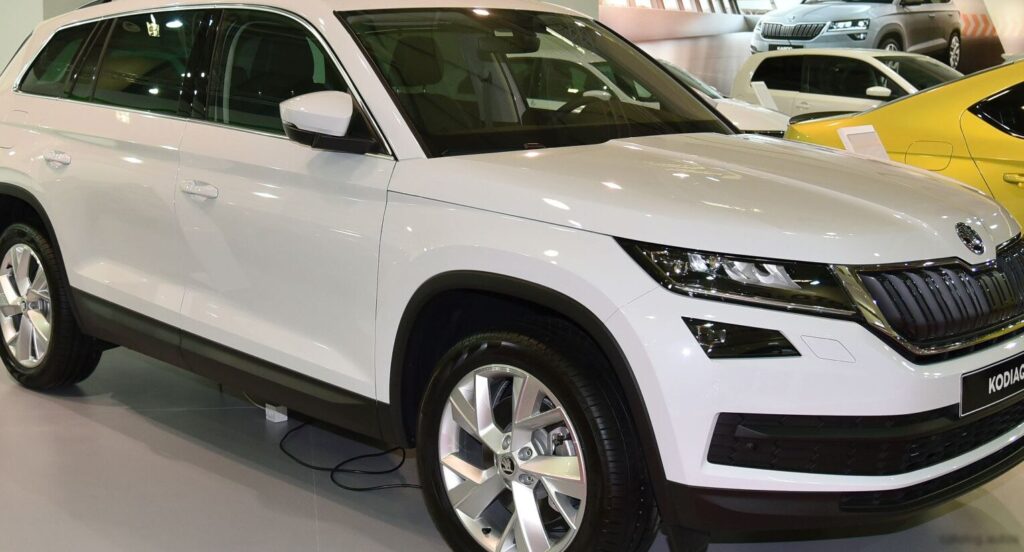
The Skoda Kodiaq I (facelift, introduced in 2021) 1.5 TSI 150 horsepower (HP) with a dual-clutch gearbox (DSG) represents a significant iteration within the Kodiaq range. Positioned as a mid-range offering, this variant aimed to balance fuel efficiency, performance, and affordability within Skoda’s popular seven-seater SUV lineup. Production of this specific configuration ran from 2021 through 2023, building upon the foundation of the initial Kodiaq launched in 2016, which itself was based on the Volkswagen Group’s MQB platform (specifically the A7 variant). The facelift brought styling updates, enhanced technology, and refinements to the powertrain options, including this 1.5 TSI engine.
Technical Specifications
| Brand | Skoda |
| Model | Kodiaq |
| Generation | Kodiaq I (facelift 2021) |
| Type (Engine) | 1.5 TSI (150 Hp) DSG |
| Start of production | 2021 |
| End of production | 2023 |
| Powertrain Architecture | Internal Combustion engine |
| Body type | SUV |
| Seats | 5 |
| Doors | 5 |
| Fuel consumption at Low speed (WLTP) | 8.9 l/100 km (26.4 US mpg, 31.7 UK mpg, 11.2 km/l) |
| Fuel consumption at Medium speed (WLTP) | 6.8 l/100 km (34.6 US mpg, 41.5 UK mpg, 14.7 km/l) |
| Fuel consumption at high speed (WLTP) | 5.9 l/100 km (39.9 US mpg, 47.9 UK mpg, 16.9 km/l) |
| Fuel consumption at very high speed (WLTP) | 6.9 l/100 km (34.1 US mpg, 40.9 UK mpg, 14.5 km/l) |
| Combined fuel consumption (WLTP) | 6.9 l/100 km (34.1 US mpg, 40.9 UK mpg, 14.5 km/l) |
| CO2 emissions (WLTP) | 156 g/km |
| Fuel consumption (economy) – urban (NEDC) | 7.1 l/100 km (33.1 US mpg, 39.8 UK mpg, 14.1 km/l) |
| Fuel consumption (economy) – extra urban (NEDC) | 5 l/100 km (47 US mpg, 56.5 UK mpg, 20 km/l) |
| Fuel consumption (economy) – combined (NEDC) | 5.8 l/100 km (40.6 US mpg, 48.7 UK mpg, 17.2 km/l) |
| CO2 emissions (NEDC) | 132 g/km |
| Fuel Type | Petrol (Gasoline) |
| Acceleration 0 – 100 km/h | 9.8 sec |
| Acceleration 0 – 62 mph | 9.8 sec |
| Acceleration 0 – 60 mph | 9.3 sec |
| Maximum speed | 205 km/h (127.38 mph) |
| Weight-to-power ratio | 10.2 kg/Hp, 98.4 Hp/tonne |
| Weight-to-torque ratio | 6.1 kg/Nm, 164 Nm/tonne |
| Power | 150 Hp @ 5000-6000 rpm |
| Power per litre | 100.1 Hp/l |
| Torque | 250 Nm @ 1500-3500 rpm (184.39 lb.-ft. @ 1500-3500 rpm) |
| Engine layout | Front, Transverse |
| Engine Model/Code | EA211 evo / DPCA |
| Engine displacement | 1498 cm3 (91.41 cu. in.) |
| Number of cylinders | 4 |
| Engine configuration | Inline |
| Cylinder Bore | 74.5 mm (2.93 in.) |
| Piston Stroke | 85.9 mm (3.38 in.) |
| Compression ratio | 10.5:1 |
| Number of valves per cylinder | 4 |
| Fuel injection system | Direct injection |
| Engine aspiration | Turbocharger, Intercooler |
| Valvetrain | DOHC |
| Engine oil capacity | 4.3 l (4.54 US qt | 3.78 UK qt) |
| Kerb Weight | 1524 kg (3359.84 lbs.) |
| Max. weight | 2244 kg (4947.17 lbs.) |
| Max load | 720 kg (1587.33 lbs.) |
| Trunk (boot) space – minimum | 835 l (29.49 cu. ft.) |
| Trunk (boot) space – maximum | 2065 l (72.92 cu. ft.) |
| Fuel tank capacity | 58 l (15.32 US gal | 12.76 UK gal) |
| Max. roof load | 75 kg (165.35 lbs.) |
| Permitted trailer load with brakes (12%) | 1800 kg (3968.32 lbs.) |
| Permitted trailer load without brakes | 750 kg (1653.47 lbs.) |
| Permitted towbar download | 100 kg (220.46 lbs.) |
| Length | 4697 mm (184.92 in.) |
| Width | 1882 mm (74.09 in.) |
| Height | 1681 mm (66.18 in.) |
| Wheelbase | 2788 mm (109.76 in.) |
| Front track | 1585 mm (62.4 in.) |
| Rear (Back) track | 1575 mm (62.01 in.) |
| Minimum turning circle (turning diameter) | 12.2 m (40.03 ft.) |
| Drivetrain Architecture | The Internal combustion engine (ICE) drives the front wheels of the vehicle. |
| Drive wheel | Front wheel drive |
| Number of gears and type of gearbox | 7 gears, automatic transmission DSG |
| Front suspension | Independent type McPherson, Transverse stabilizer |
| Rear suspension | Independent multi-link suspension, Transverse stabilizer |
| Front brakes | Ventilated discs |
| Rear brakes | Disc |
| Assisting systems | ABS (Anti-lock braking system) |
| Steering type | Steering rack and pinion |
| Power steering | Electric Steering |
| Tires size | 215/65 R17; 235/55 R18 |
| Wheel rims size | 7J x 17; 7J x 18 |
Powertrain & Engine Architecture
At the heart of this Kodiaq variant lies the EA211 evo series 1.5-liter turbocharged four-cylinder gasoline engine, identified by the DPCA engine code. This engine is a key component of Volkswagen Group’s modular engine family, designed for efficiency and versatility. It features direct fuel injection, a single turbocharger with an intercooler, and a dual overhead camshaft (DOHC) valvetrain with four valves per cylinder. A notable feature of the EA211 evo is its cylinder deactivation system, which can shut down two cylinders under light load conditions to reduce fuel consumption. The engine produces 150 HP between 5000 and 6000 rpm and 250 Nm (184 lb-ft) of torque from 1500 to 3500 rpm. This torque band provides good everyday drivability. The engine is paired with a seven-speed dual-clutch transmission (DSG), which offers quick and smooth gear changes. The DSG transmission contributes to both performance and fuel economy.
Driving Characteristics
The 1.5 TSI 150 HP/DSG combination in the Kodiaq delivers a comfortable and capable driving experience. Acceleration from 0-60 mph takes approximately 9.3 seconds, and 0-100 km/h in 9.8 seconds, making it adequately quick for most driving situations. While not a performance-oriented trim, the engine provides sufficient power for highway cruising and overtaking. The DSG transmission is well-tuned for smooth shifts and responsive acceleration. Compared to the more powerful 2.0 TSI variants, this engine offers a more relaxed driving experience, prioritizing fuel efficiency over outright speed. The gear ratios in the DSG are optimized for both acceleration and fuel economy, with taller gears for highway cruising. Compared to a manual transmission, the DSG offers convenience and potentially slightly improved fuel economy, but some drivers may prefer the greater control of a manual.
Equipment & Trim Levels
The 1.5 TSI DSG Kodiaq typically came equipped with a solid range of standard features. These generally included alloy wheels (typically 17 or 18-inch), an infotainment system with a touchscreen display (usually 8 or 9.2 inches), Apple CarPlay and Android Auto compatibility, automatic climate control, and a suite of safety features such as automatic emergency braking, lane departure warning, and adaptive cruise control. Interior upholstery was typically cloth or a combination of cloth and leatherette. Optional extras included a panoramic sunroof, leather seats, a premium sound system, and parking assist features. The specific trim level (e.g., SE, SEL, or Sport) determined the level of standard equipment and available options.
Chassis & Braking
The Kodiaq’s chassis features an independent McPherson strut suspension at the front and a multi-link suspension at the rear, providing a comfortable ride and good handling characteristics. Stabilizer bars are fitted to both axles to reduce body roll. Braking duties are handled by ventilated discs at the front and solid discs at the rear. The Kodiaq is equipped with ABS (Anti-lock Braking System) and electronic stability control as standard safety features. The suspension tuning is geared towards comfort, making it well-suited for long journeys. The weight distribution is fairly balanced, contributing to predictable handling.
Market Reception & Comparison
The 1.5 TSI DSG Kodiaq was generally well-received by automotive critics as a practical and efficient family SUV. It was praised for its spacious interior, comfortable ride, and good fuel economy. Critics noted that while the engine wasn’t particularly powerful, it was adequate for most drivers’ needs. Compared to the 2.0 TSI variants, the 1.5 TSI offered a more affordable entry point into the Kodiaq range, making it attractive to budget-conscious buyers. The diesel variants (like the 2.0 TDI) offered even better fuel economy, but the 1.5 TSI provided a smoother and quieter driving experience. Reliability reports have been generally positive, with the EA211 engine proving to be a robust and dependable unit.
Legacy
The Skoda Kodiaq 1.5 TSI DSG has established itself as a reliable and practical used car option. The EA211 engine has a good reputation for longevity, and the DSG transmission, while requiring occasional maintenance, is generally durable. These models continue to be popular on the used car market, offering a compelling combination of space, comfort, and efficiency. Regular maintenance, including oil changes and DSG fluid changes, is crucial to ensure the long-term reliability of this powertrain. As a mid-range Kodiaq variant, it represents a sweet spot in the lineup, offering a good balance of features and affordability.