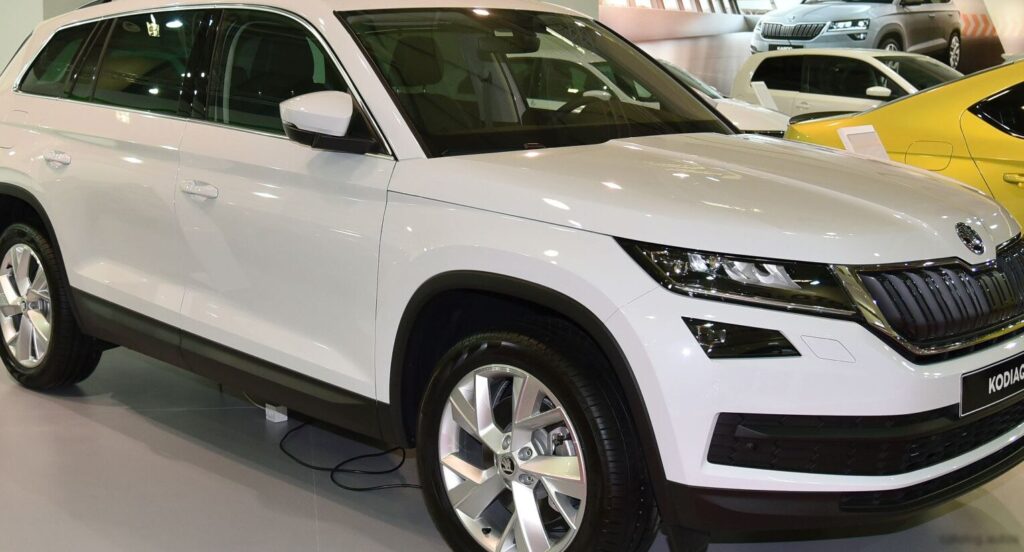
The Skoda Kodiaq I (facelift, produced from 2021 to 2023) 2.0 TDI 150 horsepower (HP) with a Dual Clutch Gearbox (DSG) represents a significant iteration within the Kodiaq range. Positioned as a mid-range offering, this variant aimed to balance fuel efficiency, practicality, and a reasonable level of performance for family SUV buyers, primarily in the European market. The Kodiaq, launched in 2016, was Skoda’s first foray into the seven-seater SUV segment, and the 2021 facelift brought styling updates, enhanced technology, and refined powertrain options, including this popular 2.0 TDI DSG configuration. It’s built on the Volkswagen Group’s MQB platform (specifically the A1 variant), shared with models like the Volkswagen Tiguan and SEAT Tarraco.
Technical Specifications
| Brand | Skoda |
| Model | Kodiaq |
| Generation | Kodiaq I (facelift 2021) |
| Type (Engine) | 2.0 TDI (150 Hp) DSG |
| Start of production | 2021 |
| End of production | 2023 |
| Powertrain Architecture | Internal Combustion engine |
| Body type | SUV |
| Seats | 5 |
| Doors | 5 |
| Fuel consumption at Low speed (WLTP) | 7.1 l/100 km (33.1 US mpg, 39.8 UK mpg, 14.1 km/l) |
| Fuel consumption at Medium speed (WLTP) | 5.2 l/100 km (45.2 US mpg, 54.3 UK mpg, 19.2 km/l) |
| Fuel consumption at high speed (WLTP) | 4.5 l/100 km (52.3 US mpg, 62.8 UK mpg, 22.2 km/l) |
| Fuel consumption at very high speed (WLTP) | 5.4 l/100 km (43.6 US mpg, 52.3 UK mpg, 18.5 km/l) |
| Combined fuel consumption (WLTP) | 5.3 l/100 km (44.4 US mpg, 53.3 UK mpg, 18.9 km/l) |
| CO2 emissions (WLTP) | 139 g/km |
| Fuel consumption (economy) – urban (NEDC) | 5.4 l/100 km (43.6 US mpg, 52.3 UK mpg, 18.5 km/l) |
| Fuel consumption (economy) – extra urban (NEDC) | 4 l/100 km (58.8 US mpg, 70.6 UK mpg, 25 km/l) |
| Fuel consumption (economy) – combined (NEDC) | 4.5 l/100 km (52.3 US mpg, 62.8 UK mpg, 22.2 km/l) |
| CO2 emissions (NEDC) | 119 g/km |
| Fuel Type | Diesel |
| Maximum speed | 204 km/h (126.76 mph) |
| Weight-to-power ratio | 10.9 kg/Hp, 91.9 Hp/tonne |
| Weight-to-torque ratio | 4.5 kg/Nm, 220.5 Nm/tonne |
| Power | 150 Hp |
| Power per litre | 76.2 Hp/l |
| Torque | 360 Nm @ 1600-2750 rpm (265.52 lb.-ft. @ 1600-2750 rpm) |
| Engine layout | Front, Transverse |
| Engine Model/Code | EA288 / DFGA |
| Engine displacement | 1968 cm3 (120.09 cu. in.) |
| Number of cylinders | 4 |
| Engine configuration | Inline |
| Cylinder Bore | 81 mm (3.19 in.) |
| Piston Stroke | 95.5 mm (3.76 in.) |
| Number of valves per cylinder | 4 |
| Fuel injection system | Diesel Commonrail |
| Engine aspiration | Turbocharger, Intercooler |
| Valvetrain | DOHC |
| Engine oil capacity | 4.7 l (4.97 US qt | 4.14 UK qt) |
| Kerb Weight | 1633 kg (3600.15 lbs.) |
| Max. weight | 2350 kg (5180.86 lbs.) |
| Max load | 717 kg (1580.71 lbs.) |
| Trunk (boot) space – minimum | 835 l (29.49 cu. ft.) |
| Trunk (boot) space – maximum | 2065 l (72.92 cu. ft.) |
| Fuel tank capacity | 58 l (15.32 US gal | 12.76 UK gal) |
| Max. roof load | 75 kg (165.35 lbs.) |
| Permitted trailer load with brakes (12%) | 2000 kg (4409.25 lbs.) |
| Permitted trailer load without brakes | 750 kg (1653.47 lbs.) |
| Permitted towbar download | 100 kg (220.46 lbs.) |
| Length | 4697 mm (184.92 in.) |
| Width | 1882 mm (74.09 in.) |
| Height | 1681 mm (66.18 in.) |
| Wheelbase | 2788 mm (109.76 in.) |
| Front track | 1585 mm (62.4 in.) |
| Rear (Back) track | 1575 mm (62.01 in.) |
| Minimum turning circle (turning diameter) | 12.2 m (40.03 ft.) |
| Drivetrain Architecture | The Internal combustion engine (ICE) drives the front wheels of the vehicle. |
| Drive wheel | Front wheel drive |
| Number of gears and type of gearbox | 7 gears, automatic transmission DSG |
| Front suspension | Independent type McPherson, Transverse stabilizer |
| Rear suspension | Independent multi-link suspension, Transverse stabilizer |
| Front brakes | Ventilated discs |
| Rear brakes | Disc |
| Assisting systems | ABS (Anti-lock braking system) |
| Steering type | Steering rack and pinion |
| Power steering | Electric Steering |
| Tires size | 215/65 R17; 235/55 R18 |
| Wheel rims size | 7J x 17; 7J x 18 |
INTRODUCTION
The Skoda Kodiaq I facelift, specifically the 2.0 TDI 150 HP DSG variant, was produced from 2021 through 2023. This model year represented a mid-cycle refresh for the Kodiaq, Skoda’s largest SUV offering. It slots into the Kodiaq lineup as a compelling option for buyers seeking a balance between fuel economy and performance, without the higher price tag of the more powerful engine options. The 2.0 TDI engine, coupled with the seven-speed DSG transmission, aimed to provide a comfortable and efficient driving experience for families and long-distance travelers. This variant was particularly popular in Europe, where diesel engines remained prevalent due to their fuel efficiency and lower running costs.
Powertrain & Engine Architecture
At the heart of this Kodiaq variant lies the Volkswagen Group’s EA288 2.0-liter four-cylinder diesel engine. The ‘DFGA’ engine code identifies a specific iteration of this engine, tuned to produce 150 horsepower. This engine utilizes a common-rail direct injection system, delivering fuel at extremely high pressure for optimized combustion. The engine also features a turbocharger with an intercooler, enhancing power output and efficiency. The valvetrain employs a Dual Overhead Camshaft (DOHC) configuration with four valves per cylinder, contributing to improved breathing and overall engine performance. The seven-speed DSG (Dual Clutch Gearbox) is a crucial component, offering quick and smooth gear changes. This transmission features two separate clutches, allowing for pre-selection of the next gear, resulting in seamless shifts and improved responsiveness. The DSG also contributes to fuel efficiency by maintaining the engine in its optimal power band.
Driving Characteristics
The 150 HP 2.0 TDI with the DSG transmission delivers a respectable, though not exhilarating, driving experience. Acceleration is adequate for everyday driving and highway merging, but it won’t provide the sporty feel of higher-powered Kodiaq variants. The DSG transmission is well-matched to the engine’s torque curve, providing ample pulling power from low RPMs. The gear ratios are tuned for fuel efficiency, meaning the engine doesn’t rev excessively during cruising. Compared to the manual transmission versions of the same engine, the DSG offers greater convenience and smoother shifts, particularly in stop-and-go traffic. However, some drivers may prefer the more direct feel of a manual gearbox. Against the more powerful 2.0 TDI variants (typically producing 200 HP), this 150 HP version feels noticeably less potent, especially when fully loaded with passengers and luggage. The front-wheel-drive configuration contributes to reasonable fuel economy but can exhibit some torque steer under hard acceleration.
Equipment & Trim Levels
The 2.0 TDI 150 HP DSG Kodiaq typically came equipped with a solid range of standard features. These generally included air conditioning, a touchscreen infotainment system with Apple CarPlay and Android Auto compatibility, alloy wheels, and a suite of safety features such as ABS, ESC (Electronic Stability Control), and multiple airbags. Higher trim levels, such as SE L or Laurin & Klement, added features like leather upholstery, heated front seats, a panoramic sunroof, and advanced driver-assistance systems like adaptive cruise control and lane-keeping assist. Optional extras included a tow bar, upgraded sound system, and various styling packages. Interior upholstery was typically cloth on lower trims, with leather options available on higher-spec models. The dashboard layout was generally clean and functional, with a focus on user-friendliness.
Chassis & Braking
The Kodiaq’s chassis is tuned for comfort and stability. The front suspension utilizes an independent McPherson strut setup, while the rear features a multi-link suspension. Both ends incorporate a transverse stabilizer bar to reduce body roll during cornering. The braking system consists of ventilated discs on the front wheels and solid discs on the rear. ABS (Anti-lock Braking System) is standard, providing enhanced braking performance in emergency situations. The suspension setup is generally compliant, absorbing bumps and imperfections in the road surface effectively. However, it’s not particularly sporty, prioritizing ride comfort over sharp handling. The weight distribution is slightly front-biased due to the engine layout and front-wheel-drive configuration.
Market Reception & Comparison
The Skoda Kodiaq 2.0 TDI 150 HP DSG was generally well-received by automotive critics. It was praised for its spacious interior, comfortable ride, and fuel efficiency. The DSG transmission was also lauded for its smooth and responsive operation. However, some reviewers noted that the engine could feel strained when climbing steep hills or carrying a full load. Compared to the higher-powered Kodiaq variants, this version offered a more affordable entry point into the Kodiaq range, making it attractive to budget-conscious buyers. In terms of fuel economy, it consistently outperformed the petrol-powered Kodiaq models. Reliability reports suggest that the EA288 engine is generally robust, although regular maintenance is crucial to prevent issues with the diesel particulate filter (DPF) and fuel injection system.
Legacy
The Skoda Kodiaq 2.0 TDI 150 HP DSG has established itself as a reliable and practical family SUV in the used car market. The EA288 engine, while subject to some scrutiny regarding emissions in the past, has proven to be durable when properly maintained. The DSG transmission, if serviced according to Skoda’s recommendations, is also generally reliable. These Kodiaqs represent good value for money, offering a spacious interior, comfortable ride, and reasonable running costs. However, potential buyers should be aware of the potential for DPF issues, particularly if the vehicle has primarily been used for short journeys. Overall, the 2.0 TDI 150 HP DSG Kodiaq remains a popular choice for those seeking a well-rounded and dependable SUV.