
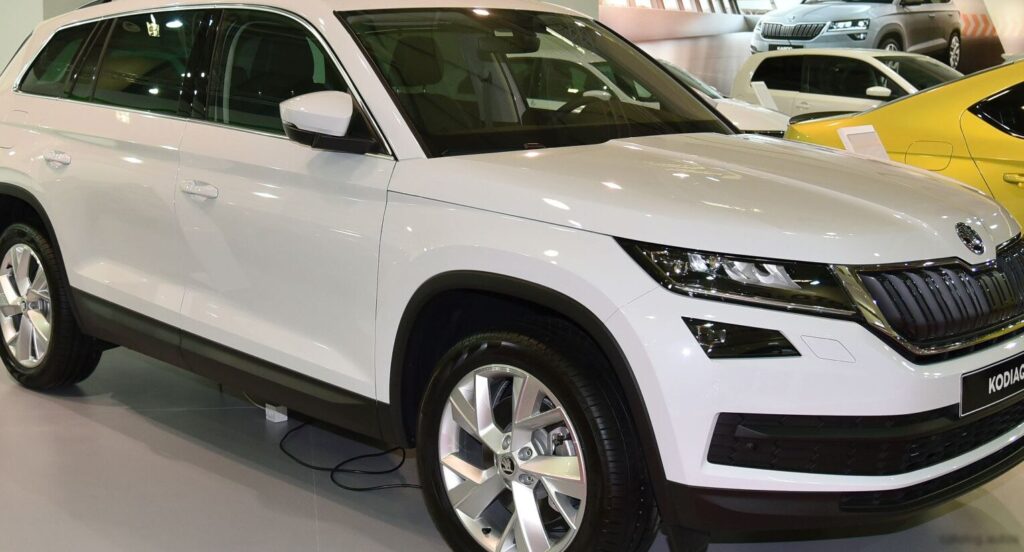
The Skoda Kodiaq RS 2.0 BiTDI 4×4 DSG, produced from 2018 to 2020, represents the performance-oriented variant of Skoda’s first seven-seater SUV. Positioned as the flagship trim within the Kodiaq I generation (designated internally as the 1NS), the RS model aimed to deliver a blend of practicality, space, and dynamic driving experience. It occupied the top tier of the Kodiaq lineup, offering a more powerful engine, sport-tuned suspension, and distinctive styling cues compared to the standard models like the 1.4 TSI or 2.0 TDI versions. The Kodiaq RS was primarily marketed in Europe, where demand for diesel-powered SUVs with all-wheel drive remained strong, offering a compelling alternative to premium German rivals.
Technical Specifications
| Brand | Skoda |
| Model | Kodiaq |
| Generation | Kodiaq I |
| Type | RS 2.0 BiTDI (240 Hp) 4×4 DSG |
| Start of production | 2018 |
| End of production | 2020 |
| Powertrain Architecture | Internal Combustion engine |
| Body type | SUV |
| Seats | 5 |
| Doors | 5 |
| Fuel consumption (urban) | 7.4 l/100 km (31.8 US mpg) |
| Fuel consumption (extra urban) | 5.8 l/100 km (40.6 US mpg) |
| Fuel consumption (combined) | 6.4 l/100 km (36.8 US mpg) |
| CO2 emissions | 167 g/km |
| Fuel Type | Diesel |
| Acceleration 0 – 100 km/h | 6.9 sec |
| Acceleration 0 – 62 mph | 6.9 sec |
| Acceleration 0 – 60 mph | 6.6 sec |
| Maximum speed | 221 km/h (137.32 mph) |
| Emission standard | Euro 6d – TEMP |
| Weight-to-power ratio | 7.5 kg/Hp |
| Weight-to-torque ratio | 3.6 kg/Nm |
| Power | 240 Hp @ 4000 rpm |
| Torque | 500 Nm @ 1750-2500 rpm (368.78 lb.-ft.) |
| Engine layout | Front, Transverse |
| Engine Model/Code | EA288 / CUAA |
| Engine displacement | 1968 cm3 (120.09 cu. in.) |
| Number of cylinders | 4 |
| Engine configuration | Inline |
| Cylinder Bore | 81 mm (3.19 in.) |
| Piston Stroke | 95.5 mm (3.76 in.) |
| Compression ratio | 15.5:1 |
| Number of valves per cylinder | 4 |
| Fuel injection system | Diesel Commonrail |
| Engine aspiration | BiTurbo, Intercooler |
| Engine oil capacity | 4.9 l (5.18 US qt | 4.31 UK qt) |
| Coolant capacity | 8 l (8.45 US qt | 7.04 UK qt) |
| Kerb Weight | 1805-1923 kg (3979.34 – 4239.49 lbs.) |
| Max. weight | 2421 kg (5337.39 lbs.) |
| Max load | 498-616 kg (1097.9 – 1358.05 lbs.) |
| Trunk (boot) space – minimum | 725 l (25.6 cu. ft.) |
| Trunk (boot) space – maximum | 1960 l (69.22 cu. ft.) |
| Fuel tank capacity | 60 l (15.85 US gal | 13.2 UK gal) |
| Max. roof load | 75 kg (165.35 lbs.) |
| Permitted trailer load with brakes (12%) | 2300 kg (5070.63 lbs.) |
| Permitted trailer load without brakes | 750 kg (1653.47 lbs.) |
| Permitted towbar download | 100 kg (220.46 lbs.) |
| Length | 4699 mm (185 in.) |
| Width | 1882 mm (74.09 in.) |
| Height | 1686 mm (66.38 in.) |
| Wheelbase | 2789 mm (109.8 in.) |
| Front track | 1579 mm (62.17 in.) |
| Rear track | 1567 mm (61.69 in.) |
| Ride height (ground clearance) | 197 mm (7.76 in.) |
| Drag coefficient (Cd) | 0.338 |
| Minimum turning circle | 12.2 m (40.03 ft.) |
| Drivetrain Architecture | All wheel drive (4×4) |
| Number of gears | 7 |
| Gearbox type | Automatic transmission DSG |
| Front suspension | Independent type McPherson, Transverse stabilizer |
| Rear suspension | Independent multi-link suspension, Transverse stabilizer |
| Front brakes | Ventilated discs |
| Rear brakes | Disc |
| Assisting systems | ABS (Anti-lock braking system) |
| Steering type | Steering rack and pinion |
| Power steering | Electric Steering |
| Tires size | 235/45 R20 100V |
| Wheel rims size | 20 |
Powertrain & Engine Architecture
The Kodiaq RS is powered by the EA288 2.0-liter four-cylinder turbocharged diesel engine, specifically the CUAA code variant. This engine utilizes a bi-turbocharger setup – a smaller turbo for quick response at low RPMs and a larger turbo for sustained power at higher speeds. This configuration delivers 240 horsepower at 4000 rpm and a substantial 500 Nm (368.78 lb.-ft.) of torque between 1750 and 2500 rpm. The engine features a common rail direct injection system, ensuring precise fuel delivery and efficient combustion. The 7-speed DSG (Direct-Shift Gearbox) automatic transmission is standard, providing quick and smooth gear changes. The DSG’s programming is specifically tuned for the RS model to prioritize performance and responsiveness. A particulate filter is included to meet stringent Euro 6d-TEMP emissions standards.
Driving Characteristics
The Kodiaq RS 2.0 BiTDI 4×4 DSG offers a noticeably more engaging driving experience than the lower-powered Kodiaq variants. The high torque output of the engine provides strong acceleration, with a 0-60 mph time of around 6.6 seconds. The DSG transmission contributes to this performance, offering rapid shifts and keeping the engine in its optimal power band. The all-wheel-drive system provides excellent traction, particularly in adverse weather conditions. While not a sports car, the RS model handles corners with confidence, thanks to its sport-tuned suspension and progressive steering. Compared to the 1.4 TSI, the BiTDI offers significantly more pulling power, making it better suited for towing or carrying a full load. Against the 2.0 TDI, the RS provides a substantial power increase and a more refined driving experience.
Equipment & Trim Levels
The Kodiaq RS came standard with a comprehensive list of features. Interior appointments included sport seats upholstered in Alcantara and leather, with RS-specific badging. The dashboard featured aluminum pedals and illuminated door sills. Standard technology included a touchscreen infotainment system with navigation, Apple CarPlay, and Android Auto compatibility. Safety features such as adaptive cruise control, lane assist, and automatic emergency braking were also standard. Optional extras included a panoramic sunroof, a Canton sound system, and electrically adjustable front seats with memory function. Exterior styling cues included a unique RS body kit, blacked-out grille and window surrounds, and 20-inch alloy wheels.
Chassis & Braking
The Kodiaq RS features a reinforced chassis and a sport-tuned suspension system. The front suspension utilizes McPherson struts with a transverse stabilizer, while the rear suspension employs a multi-link setup, also with a stabilizer bar. This configuration provides a balance between comfort and handling. Brakes consist of ventilated discs at the front and solid discs at the rear. The braking system is enhanced with ABS (Anti-lock Braking System) and electronic stability control. The RS model typically featured larger brake rotors and calipers compared to the standard Kodiaq trims.
Market Reception & Comparison
The Kodiaq RS was generally well-received by automotive critics. Reviewers praised its strong performance, spacious interior, and comprehensive equipment list. The diesel engine was noted for its refinement and fuel efficiency, achieving a combined fuel economy of around 36.8 US mpg. Compared to other trims, the RS offered a more premium driving experience but came at a higher price point. Its main competitors included the Volkswagen Tiguan R-Line and the BMW X3, offering similar levels of performance and practicality. Reliability reports suggest that the EA288 engine is generally robust, although regular maintenance is crucial to prevent issues with the diesel particulate filter and turbochargers.
Legacy
The Skoda Kodiaq RS 2.0 BiTDI 4×4 DSG remains a popular choice in the used car market. Its combination of practicality, performance, and value has made it a desirable option for families and drivers seeking a versatile SUV. The EA288 engine, while complex, has proven to be relatively reliable when properly maintained. However, potential buyers should be aware of the potential for issues with the diesel particulate filter and turbochargers, particularly on vehicles with high mileage. The Kodiaq RS paved the way for future performance-oriented Skoda models, demonstrating the brand’s ability to deliver engaging driving dynamics in a practical package.
