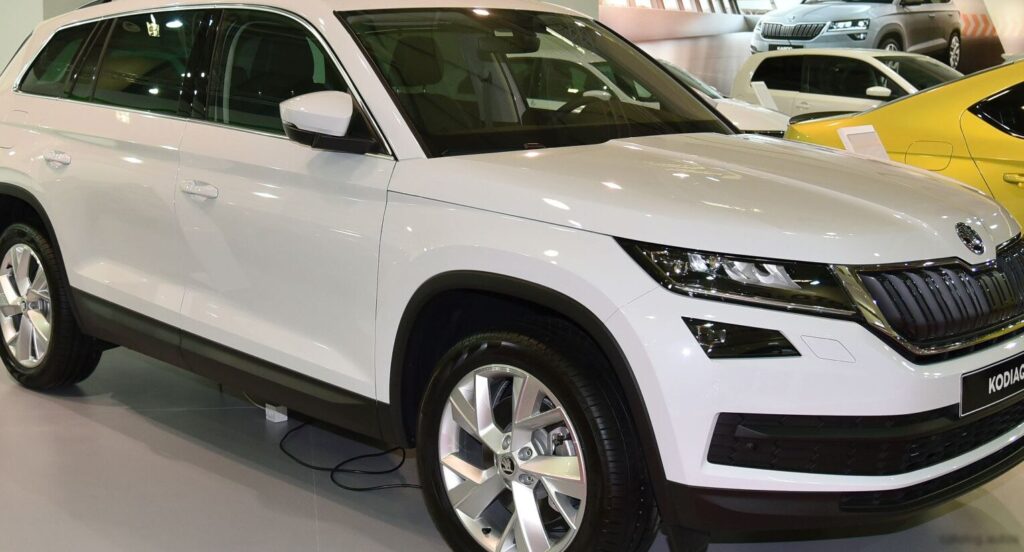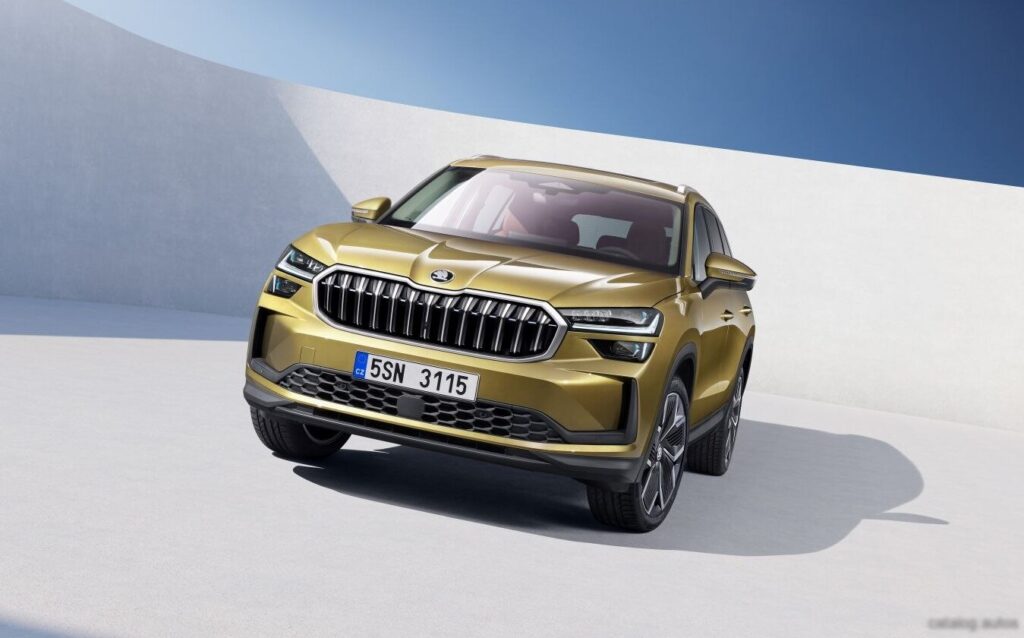
Technical Specifications
| Brand | Skoda |
| Model | Kodiaq |
| Generation | Kodiaq II |
| Type (Engine) | 1.5 TSI (150 Hp) Mild Hybrid DSG |
| Start of production | January, 2024 |
| Powertrain Architecture | MHEV (Mild Hybrid Electric Vehicle) |
| Body type | SUV |
| Seats | 5 |
| Doors | 5 |
| Combined fuel consumption (WLTP) | 5.9-6.6 l/100 km (39.9 – 35.6 US mpg, 47.9 – 42.8 UK mpg, 16.9 – 15.2 km/l) |
| CO2 emissions (WLTP) | 135-151 g/km |
| Fuel Type | Petrol (Gasoline) |
| Acceleration 0 – 100 km/h | 9.7 sec |
| Acceleration 0 – 62 mph | 9.7 sec |
| Acceleration 0 – 60 mph | 9.2 sec |
| Maximum speed | 207 km/h (128.62 mph) |
| Emission standard | Euro 6e |
| Weight-to-power ratio | 10.6 kg/Hp, 94.6 Hp/tonne |
| Weight-to-torque ratio | 6.3 kg/Nm, 157.6 Nm/tonne |
| Battery voltage | 48 V |
| Battery technology | Lithium-ion (Li-Ion) |
| Electric motor location | Front, Transverse |
| Power | 150 Hp @ 5000-6000 rpm |
| Power per litre | 100.1 Hp/l |
| Torque | 250 Nm @ 1500-3500 rpm (184.39 lb.-ft. @ 1500-3500 rpm) |
| Engine layout | Front, Transverse |
| Engine Model/Code | EA211 evo2 / DXDB |
| Engine displacement | 1498 cm3 (91.41 cu. in.) |
| Number of cylinders | 4 |
| Engine configuration | Inline |
| Cylinder Bore | 74.5 mm (2.93 in.) |
| Piston Stroke | 85.9 mm (3.38 in.) |
| Compression ratio | 12:1 |
| Number of valves per cylinder | 4 |
| Fuel injection system | Direct injection |
| Engine aspiration | Turbocharger, Intercooler |
| Valvetrain | DOHC |
| Engine oil capacity | 4.3 l (4.54 US qt | 3.78 UK qt) |
| Kerb Weight | 1586-1744 kg (3496.53 – 3844.86 lbs.) |
| Max. weight | 2178-2360 kg (4801.67 – 5202.91 lbs.) |
| Max load | 592-616 kg (1305.14 – 1358.05 lbs.) |
| Trunk (boot) space – minimum | 910 l (32.14 cu. ft.) |
| Trunk (boot) space – maximum | 2105 l (74.34 cu. ft.) |
| Fuel tank capacity | 55 l (14.53 US gal | 12.1 UK gal) |
| Max. roof load | 75 kg (165.35 lbs.) |
| Permitted trailer load with brakes (8%) | 1800 kg (3968.32 lbs.) |
| Permitted trailer load with brakes (12%) | 1800 kg (3968.32 lbs.) |
| Permitted trailer load without brakes | 750 kg (1653.47 lbs.) |
| Permitted towbar download | 100 kg (220.46 lbs.) |
| Length | 4758 mm (187.32 in.) |
| Width | 1864 mm (73.39 in.) |
| Width with mirrors folded | 1924 mm (75.75 in.) |
| Width including mirrors | 2133 mm (83.98 in.) |
| Height | 1659 mm (65.31 in.) |
| Wheelbase | 2791 mm (109.88 in.) |
| Front track | 1586 mm (62.44 in.) |
| Rear (Back) track | 1575 mm (62.01 in.) |
| Front overhang | 927 mm (36.5 in.) |
| Rear overhang | 1041 mm (40.98 in.) |
| Ride height (ground clearance) | 189 mm (7.44 in.) |
| Drag coefficient (Cd) | 0.281-0.309 |
| Minimum turning circle (turning diameter) | 11.2 m (36.75 ft.) |
| Approach angle | 17° |
| Departure angle | 17.6° |
| Drivetrain Architecture | ICE and electric motor drive the front wheels |
| Drive wheel | Front wheel drive |
| Number of gears and type of gearbox | 7 gears, automatic transmission DSG |
| Front suspension | Independent, type McPherson with coil spring and anti-roll bar |
| Rear suspension | Independent multi-link spring suspension with stabilizer |
| Front brakes | Ventilated discs |
| Rear brakes | Disc |
| Tires size | 215/65 R17; 235/55 R18; 235/50 R19; 235/45 R20 |
| Wheel rims size | 7J x 17; 7.5J x 18; 7.5J x 19; 8J x 20 |
The Skoda Kodiaq II 1.5 TSI (150 hp) Mild Hybrid DSG, launched in January 2024, represents a significant update to Skoda’s popular mid-size SUV. Positioned as a mainstream offering within the Kodiaq II range, it aims to balance fuel efficiency with acceptable performance for family transport. This variant builds upon the foundation of the original Kodiaq, which debuted in 2016 as Skoda’s first seven-seater SUV, and is based on the Volkswagen Group’s MQB platform. The “II” designation signifies a comprehensive redesign, incorporating updated technology, styling, and powertrain options. The 1.5 TSI Mild Hybrid with the DSG transmission is intended to appeal to buyers prioritizing economy and ease of driving over outright performance, slotting below the more powerful petrol and diesel options available in the Kodiaq II lineup.
Powertrain & Engine Architecture
At the heart of the Kodiaq II 1.5 TSI is the EA211 evo2 engine, a 1.5-liter turbocharged four-cylinder gasoline engine. This engine, designated DXDB, produces 150 horsepower at 5000-6000 rpm and 250 Nm (184 lb-ft) of torque between 1500 and 3500 rpm. The engine utilizes direct fuel injection and a turbocharger with an intercooler to enhance efficiency and power output. A key feature is its mild hybrid system, employing a 48V lithium-ion battery and a belt-integrated starter generator (BSG). This system allows for extended start-stop functionality, regenerative braking, and a limited amount of electric assistance during acceleration. The engine also incorporates cylinder deactivation technology, shutting down two cylinders under light load to further improve fuel economy. The engine is paired with a 7-speed dual-clutch transmission (DSG), known for its quick and smooth gear changes.
Driving Characteristics
The 1.5 TSI engine, coupled with the DSG transmission, provides adequate performance for everyday driving. Acceleration from 0-100 km/h (0-62 mph) takes approximately 9.7 seconds. While not particularly sporty, the engine delivers sufficient torque for comfortable highway cruising and overtaking. The DSG transmission contributes to a responsive driving experience, with quick shifts and a generally smooth operation. Compared to higher-output petrol or diesel variants of the Kodiaq II, this version feels less eager to accelerate, but it offers a more relaxed and fuel-efficient driving experience. The mild hybrid system is largely unobtrusive, providing subtle assistance during acceleration and enabling a smoother start-stop operation. The gear ratios are tuned for efficiency, prioritizing fuel economy over outright performance.
Equipment & Trim Levels
The Kodiaq II 1.5 TSI Mild Hybrid DSG typically comes well-equipped, even in base trim levels. Standard features generally include alloy wheels, an infotainment system with a touchscreen display (typically 8 or 10 inches), Apple CarPlay and Android Auto compatibility, automatic climate control, and a suite of safety features such as automatic emergency braking, lane departure warning, and adaptive cruise control. Interior upholstery is usually cloth, with options for leather upgrades. Higher trim levels add features like a panoramic sunroof, heated seats, a premium sound system, and more advanced driver-assistance systems. Optional extras often include metallic paint, parking sensors, and a tow hitch.
Chassis & Braking
The Kodiaq II utilizes an independent suspension setup, with McPherson struts at the front and a multi-link system at the rear. This configuration provides a comfortable ride quality, absorbing bumps and imperfections in the road effectively. Stabilizer bars are fitted to both axles to reduce body roll during cornering. Braking is handled by ventilated discs at the front and solid discs at the rear. ABS (Anti-lock Braking System) is standard, along with electronic brake-force distribution and brake assist. The steering system is an electric power steering setup, providing light and precise steering feel.
Market Reception & Comparison
The Skoda Kodiaq II 1.5 TSI Mild Hybrid DSG has been generally well-received by automotive critics. It’s praised for its fuel efficiency, comfortable ride, and spacious interior. However, some reviewers note that the engine can feel a bit underpowered when fully loaded or tackling steep inclines. Compared to the 2.0 TSI petrol or 2.0 TDI diesel variants, the 1.5 TSI offers lower running costs but sacrifices some performance. Its fuel economy of 5.9-6.6 l/100 km (39.9-35.6 US mpg) is competitive within its class, and the mild hybrid system contributes to reduced emissions. Reliability is expected to be good, based on Skoda’s reputation and the proven technology used in the powertrain.
Legacy
The EA211 engine family, including the 1.5 TSI variant, has become a mainstay in the Volkswagen Group’s lineup. Its combination of efficiency, reliability, and relatively low maintenance costs has made it a popular choice among consumers. The integration of mild hybrid technology further enhances its appeal in a market increasingly focused on fuel economy and emissions reduction. In the used car market, the Kodiaq II 1.5 TSI is expected to hold its value reasonably well, particularly models with a full service history and low mileage. The DSG transmission, while generally reliable, may require servicing at specific intervals to ensure optimal performance.