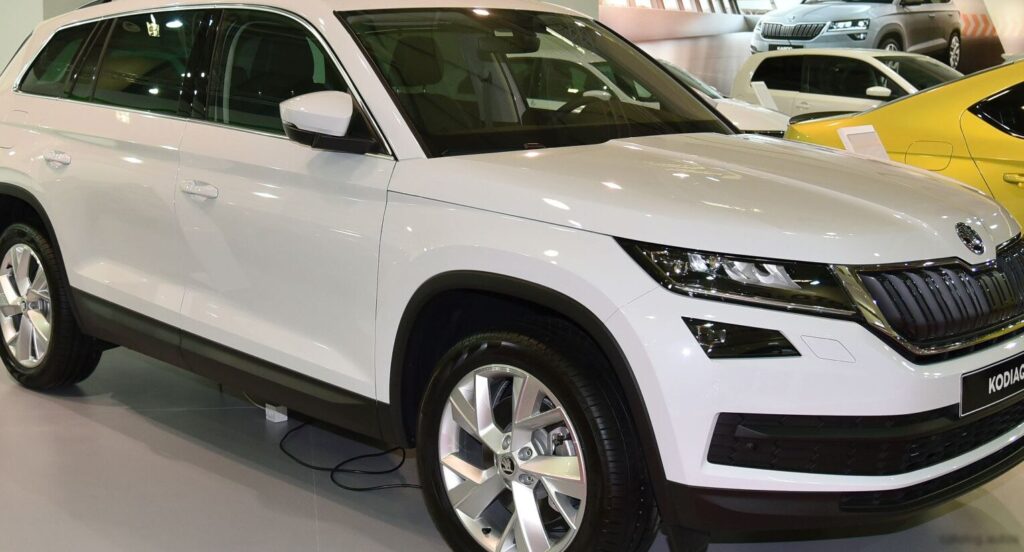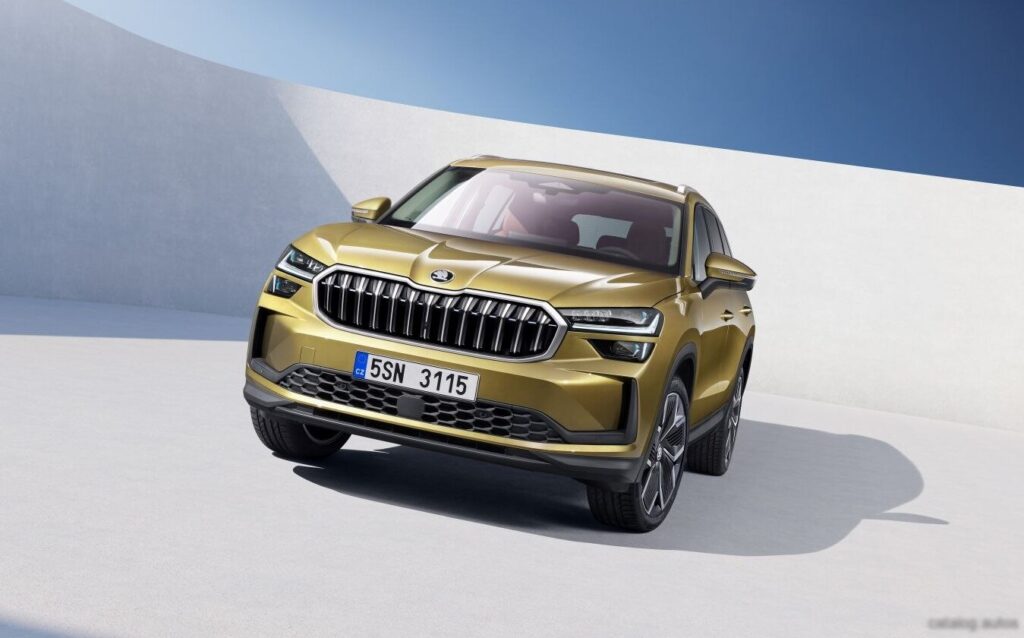
The Skoda Kodiaq II 2.0 TDI (193 Hp) 4×4 DSG represents a significant iteration in Skoda’s popular SUV lineup, launched in January 2024. Positioned as a mid-to-upper trim level within the second generation Kodiaq range, this variant combines a potent diesel engine with all-wheel drive and a dual-clutch transmission, aiming to deliver a balance of performance, efficiency, and practicality. It builds upon the foundation of the A7 platform, offering increased space and updated technology compared to its predecessor. The Kodiaq, in general, serves as Skoda’s flagship SUV, primarily targeting families and drivers seeking a versatile vehicle for both daily commutes and longer journeys, particularly within the European market.
Technical Specifications
| Brand | Skoda |
| Model | Kodiaq |
| Generation | Kodiaq II |
| Type (Engine) | 2.0 TDI (193 Hp) 4×4 DSG |
| Start of production | January, 2024 |
| Powertrain Architecture | Internal Combustion engine |
| Body type | SUV |
| Seats | 5 |
| Doors | 5 |
| Combined fuel consumption (WLTP) | 6-6.6 l/100 km (39.2 – 35.6 US mpg, 47.1 – 42.8 UK mpg, 16.7 – 15.2 km/l) |
| CO2 emissions (WLTP) | 157-174 g/km |
| Fuel Type | Diesel |
| Acceleration 0 – 100 km/h | 7.8 sec |
| Acceleration 0 – 62 mph | 7.8 sec |
| Acceleration 0 – 60 mph | 7.4 sec |
| Maximum speed | 200 km/h (124.27 mph) |
| Emission standard | Euro 6e |
| Weight-to-power ratio | 8.9 kg/Hp, 112 Hp/tonne |
| Weight-to-torque ratio | 4.3 kg/Nm, 232.2 Nm/tonne |
| Power | 193 Hp @ 3500-4200 rpm |
| Power per litre | 98.1 Hp/l |
| Torque | 400 Nm @ 1750-3250 rpm (295.02 lb.-ft. @ 1750-3250 rpm) |
| Engine layout | Front, Transverse |
| Engine Model/Code | EA288 evo / DXNB |
| Engine displacement | 1968 cm3 (120.09 cu. in.) |
| Number of cylinders | 4 |
| Engine configuration | Inline |
| Cylinder Bore | 81 mm (3.19 in.) |
| Piston Stroke | 95.5 mm (3.76 in.) |
| Compression ratio | 15.5:1 |
| Number of valves per cylinder | 4 |
| Fuel injection system | Diesel Commonrail |
| Engine aspiration | Turbocharger, Intercooler |
| Valvetrain | DOHC |
| Engine oil capacity | 5.5 l (5.81 US qt | 4.84 UK qt) |
| Kerb Weight | 1723-1925 kg (3798.56 – 4243.9 lbs.) |
| Trunk (boot) space – minimum | 910 l (32.14 cu. ft.) |
| Trunk (boot) space – maximum | 2105 l (74.34 cu. ft.) |
| Fuel tank capacity | 58 l (15.32 US gal | 12.76 UK gal) |
| Max. roof load | 75 kg (165.35 lbs.) |
| Permitted trailer load with brakes (8%) | 2300 kg (5070.63 lbs.) |
| Permitted trailer load with brakes (12%) | 2300 kg (5070.63 lbs.) |
| Permitted trailer load without brakes | 750 kg (1653.47 lbs.) |
| Permitted towbar download | 100 kg (220.46 lbs.) |
| Length | 4758 mm (187.32 in.) |
| Width | 1864 mm (73.39 in.) |
| Width with mirrors folded | 1924 mm (75.75 in.) |
| Width including mirrors | 2133 mm (83.98 in.) |
| Height | 1657 mm (65.24 in.) |
| Wheelbase | 2791 mm (109.88 in.) |
| Front track | 1586 mm (62.44 in.) |
| Rear (Back) track | 1575 mm (62.01 in.) |
| Front overhang | 927 mm (36.5 in.) |
| Rear overhang | 1041 mm (40.98 in.) |
| Ride height (ground clearance) | 187 mm (7.36 in.) |
| Drag coefficient (Cd) | 0.289-0.317 |
| Minimum turning circle (turning diameter) | 11.2 m (36.75 ft.) |
| Approach angle | 17° |
| Departure angle | 17.6° |
| Drivetrain Architecture | The Internal combustion engine (ICE) drives the front wheels permanently, and the rear wheels are driven through an electrically or mechanically operated clutch if necessary. |
| Drive wheel | All wheel drive (4×4) |
| Number of gears and type of gearbox | 7 gears, automatic transmission DSG |
| Front suspension | Independent, type McPherson with coil spring and anti-roll bar |
| Rear suspension | Independent multi-link spring suspension with stabilizer |
| Front brakes | Ventilated discs |
| Rear brakes | Disc |
| Assisting systems | ABS (Anti-lock braking system) |
| Steering type | Steering rack and pinion |
| Power steering | Electric Steering |
| Tires size | 215/65 R17; 235/55 R18; 235/50 R19; 235/45 R20 |
| Wheel rims size | 7J x 17; 7.5J x 18; 7.5J x 19; 8J x 20 |
INTRODUCTION
The Skoda Kodiaq II 2.0 TDI 4×4 DSG, introduced in January 2024, is a key variant within the second-generation Kodiaq range. It represents a refinement of Skoda’s successful mid-size SUV, offering a compelling blend of space, practicality, and performance. Built on the MQB Evo platform, the Kodiaq II aims to improve upon the original model’s strengths, providing a more sophisticated driving experience and enhanced technology. This particular configuration, with its 2.0-liter TDI engine, all-wheel drive, and seven-speed DSG transmission, is positioned as a versatile option for families and drivers who require all-weather capability and a comfortable ride.
Powertrain & Engine Architecture
At the heart of the Kodiaq II 2.0 TDI 4×4 DSG lies the EA288 evo series diesel engine, specifically the DXNB code. This is a four-cylinder, inline engine displacing 1968cc. It utilizes a common rail direct injection system, delivering fuel at pressures up to 2500 bar for optimized combustion. The engine features a turbocharger with an intercooler, boosting power output to 193 horsepower at 3500-4200 rpm and 400 Nm (295 lb-ft) of torque between 1750-3250 rpm. The engine also incorporates a particulate filter to meet stringent Euro 6e emission standards. The seven-speed DSG (Direct-Shift Gearbox) is a dual-clutch transmission known for its quick and smooth gear changes. It provides both fully automatic operation and the option for manual gear selection via steering wheel-mounted paddles. The 4×4 system employs a multi-plate clutch to distribute torque between the front and rear axles as needed, enhancing traction in various conditions.
Driving Characteristics
The 2.0 TDI 4×4 DSG variant delivers a composed and refined driving experience. While not overtly sporty, the engine provides ample power for everyday driving and overtaking maneuvers. The DSG transmission contributes to smooth acceleration, and the all-wheel-drive system inspires confidence on slippery surfaces. Compared to lower-powered Kodiaq variants, the 193 hp model offers noticeably stronger acceleration, achieving 0-100 km/h in 7.8 seconds. The DSG transmission’s gear ratios are tuned for a balance of fuel efficiency and performance. In typical driving scenarios, the transmission shifts smoothly and proactively, keeping the engine within its optimal torque band. Compared to a manual transmission, the DSG offers convenience and ease of use, particularly in stop-and-go traffic. However, some drivers may prefer the more direct engagement of a manual gearbox.
Equipment & Trim Levels
The Kodiaq II 2.0 TDI 4×4 DSG typically comes well-equipped, reflecting its mid-to-upper trim level positioning. Standard features generally include automatic climate control, a touchscreen infotainment system with Apple CarPlay and Android Auto compatibility, and a suite of safety features such as automatic emergency braking, lane departure warning, and adaptive cruise control. Interior upholstery is typically a combination of fabric and leather, with higher trims offering full leather options. Optional extras can include a panoramic sunroof, a premium sound system, and advanced driver-assistance systems like blind-spot monitoring and rear cross-traffic alert. The dashboard layout is modern and functional, with a focus on user-friendliness.
Chassis & Braking
The Kodiaq II utilizes an independent suspension setup, with McPherson struts at the front and a multi-link system at the rear. This configuration provides a comfortable ride quality, effectively absorbing bumps and imperfections in the road surface. Stabilizer bars are fitted to both axles to reduce body roll during cornering. Braking duties are handled by ventilated discs at the front and solid discs at the rear, providing ample stopping power. The anti-lock braking system (ABS) and electronic stability control (ESC) are standard features, enhancing safety and control. The 4×4 system contributes to improved braking performance, particularly on loose surfaces.
Market Reception & Comparison
The Skoda Kodiaq II 2.0 TDI 4×4 DSG has been generally well-received by automotive critics. It is praised for its spacious interior, comfortable ride, and efficient engine. The combination of all-wheel drive and the DSG transmission is seen as a significant advantage in regions with challenging weather conditions. Compared to other trims in the Kodiaq lineup, the 2.0 TDI 4×4 DSG offers a noticeable performance upgrade, but at a higher price point. Fuel economy is competitive for its class, typically ranging from 6.0 to 6.6 liters per 100 kilometers. Reliability is expected to be good, based on Skoda’s reputation for building durable vehicles.
Legacy
The EA288 evo engine family has proven to be a reliable and durable powertrain, and the seven-speed DSG transmission is also well-regarded. The Kodiaq II 2.0 TDI 4×4 DSG is expected to hold its value well in the used car market, due to its practicality, versatility, and all-weather capability. Regular maintenance, including oil changes and DSG fluid replacements, will be crucial to ensuring the long-term reliability of this powertrain. As with any modern vehicle, software updates will also play a role in maintaining optimal performance and functionality.