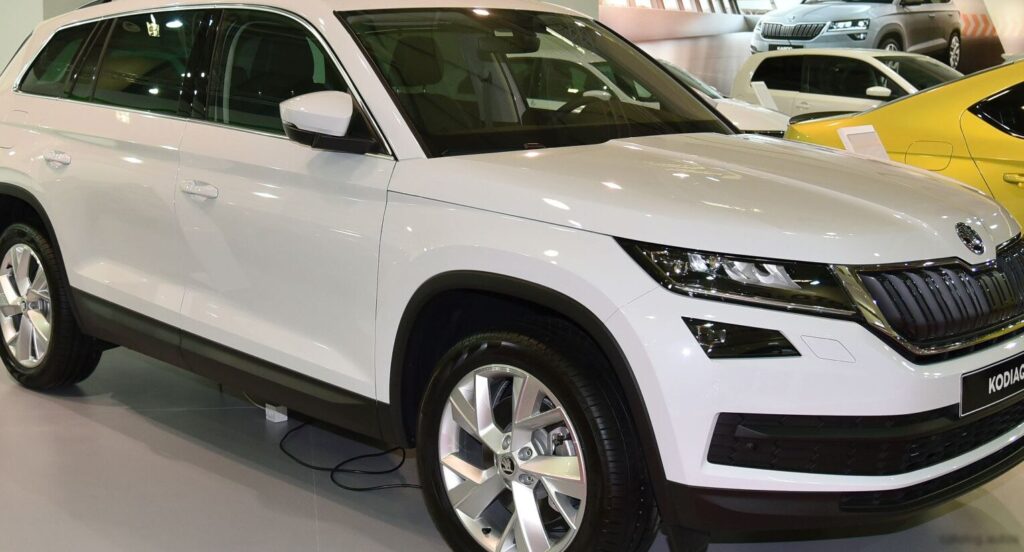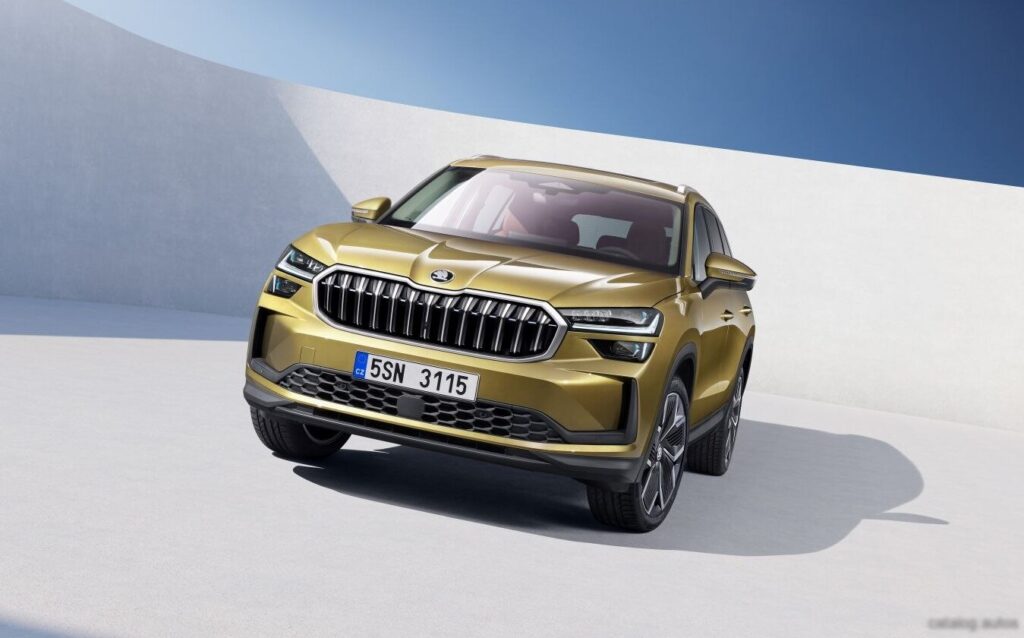
The Skoda Kodiaq II 2.0 TDI 4×4 DSG 7 Seat, introduced in January 2024, represents the latest iteration of Skoda’s flagship SUV. Positioned as a mid-to-upper trim level within the Kodiaq II range, this variant caters to buyers seeking a blend of performance, practicality, and all-weather capability. It builds upon the foundation of the Kodiaq, which first launched in 2016, becoming a key model for Skoda, particularly in the European market, offering a seven-seat option in a competitive segment. The Kodiaq II is built on the MQB Evo platform, shared with other Volkswagen Group vehicles, and aims to deliver enhanced technology and efficiency compared to its predecessor.
Technical Specifications
| Brand | Skoda |
| Model | Kodiaq |
| Generation | Kodiaq II |
| Type | 2.0 TDI (193 Hp) 4×4 DSG 7 Seat |
| Start of production | January, 2024 |
| Powertrain Architecture | Internal Combustion engine |
| Body type | SUV |
| Seats | 7 |
| Doors | 5 |
| Combined fuel consumption (WLTP) | 6-6.6 l/100 km (39.2 – 35.6 US mpg, 47.1 – 42.8 UK mpg, 16.7 – 15.2 km/l) |
| CO2 emissions (WLTP) | 157-174 g/km |
| Fuel Type | Diesel |
| Acceleration 0 – 100 km/h | 8 sec |
| Acceleration 0 – 62 mph | 8 sec |
| Acceleration 0 – 60 mph | 7.6 sec |
| Maximum speed | 217 km/h (134.84 mph) |
| Emission standard | Euro 6e |
| Weight-to-power ratio | 9.2 kg/Hp, 108.5 Hp/tonne |
| Weight-to-torque ratio | 4.4 kg/Nm, 225 Nm/tonne |
| Power | 193 Hp @ 3500-4200 rpm |
| Power per litre | 98.1 Hp/l |
| Torque | 400 Nm @ 1750-3250 rpm (295.02 lb.-ft. @ 1750-3250 rpm) |
| Engine layout | Front, Transverse |
| Engine Model/Code | EA288 evo / DXNB |
| Engine displacement | 1968 cm3 (120.09 cu. in.) |
| Number of cylinders | 4 |
| Engine configuration | Inline |
| Cylinder Bore | 81 mm (3.19 in.) |
| Piston Stroke | 95.5 mm (3.76 in.) |
| Compression ratio | 15.5:1 |
| Number of valves per cylinder | 4 |
| Fuel injection system | Diesel Commonrail |
| Engine aspiration | Turbocharger, Intercooler |
| Valvetrain | DOHC |
| Engine oil capacity | 5.5 l (5.81 US qt | 4.84 UK qt) |
| Kerb Weight | 1778-1974 kg (3919.82 – 4351.93 lbs.) |
| Trunk (boot) space – minimum | 845 l (29.84 cu. ft.) |
| Trunk (boot) space – maximum | 2035 l (71.87 cu. ft.) |
| Fuel tank capacity | 58 l (15.32 US gal | 12.76 UK gal) |
| Max. roof load | 75 kg (165.35 lbs.) |
| Permitted trailer load with brakes (8%) | 2300 kg (5070.63 lbs.) |
| Permitted trailer load with brakes (12%) | 2300 kg (5070.63 lbs.) |
| Permitted trailer load without brakes | 750 kg (1653.47 lbs.) |
| Permitted towbar download | 100 kg (220.46 lbs.) |
| Length | 4758 mm (187.32 in.) |
| Width | 1864 mm (73.39 in.) |
| Width with mirrors folded | 1924 mm (75.75 in.) |
| Width including mirrors | 2133 mm (83.98 in.) |
| Height | 1656 mm (65.2 in.) |
| Wheelbase | 2791 mm (109.88 in.) |
| Front track | 1586 mm (62.44 in.) |
| Rear (Back) track | 1576 mm (62.05 in.) |
| Front overhang | 927 mm (36.5 in.) |
| Rear overhang | 1041 mm (40.98 in.) |
| Ride height (ground clearance) | 187 mm (7.36 in.) |
| Drag coefficient (Cd) | 0.302-0.329 |
| Minimum turning circle (turning diameter) | 11.2 m (36.75 ft.) |
| Approach angle | 17° |
| Departure angle | 17.6° |
| Drivetrain Architecture | The Internal combustion engine (ICE) drives the front wheels permanently, and the rear wheels are driven through an electrically or mechanically operated clutch if necessary. |
| Drive wheel | All wheel drive (4×4) |
| Number of gears and type of gearbox | 7 gears, automatic transmission DSG |
| Front suspension | Independent, type McPherson with coil spring and anti-roll bar |
| Rear suspension | Independent multi-link spring suspension with stabilizer |
| Front brakes | Ventilated discs |
| Rear brakes | Disc |
INTRODUCTION
The Skoda Kodiaq II 2.0 TDI 4×4 DSG 7 Seat is a diesel-powered SUV designed for families and those requiring versatile space and all-weather traction. Introduced in 2024, it represents a significant update to the original Kodiaq, incorporating the latest Volkswagen Group technologies. This particular variant, equipped with the 2.0-liter TDI engine producing 193 horsepower and a seven-speed dual-clutch transmission (DSG), occupies a sweet spot in the Kodiaq lineup, offering a balance between performance, fuel efficiency, and price. It’s aimed at buyers who prioritize practicality and comfort over outright sportiness, and who frequently travel long distances or encounter challenging road conditions.
Powertrain & Engine Architecture
At the heart of the Kodiaq II 2.0 TDI 4×4 is the EA288 evo series diesel engine, specifically the DXNB code. This is a four-cylinder, inline engine displacing 1968cc. It utilizes a common rail direct injection system, delivering fuel at pressures up to 2500 bar for optimized combustion. The engine features a single turbocharger with an intercooler, enhancing power and efficiency. The valvetrain employs a dual overhead camshaft (DOHC) configuration with four valves per cylinder. The seven-speed DSG transmission is a crucial component, offering quick and smooth gear changes. This transmission utilizes two clutches, allowing for pre-selection of the next gear, resulting in seamless shifts and improved fuel economy. The 4×4 system is an on-demand all-wheel-drive system, utilizing a multi-plate clutch to distribute torque between the front and rear axles as needed, providing enhanced traction and stability.
Driving Characteristics
The 193 horsepower and 400 Nm (295 lb-ft) of torque delivered by the 2.0 TDI engine provide adequate performance for everyday driving and long-distance cruising. Acceleration from 0-100 km/h (0-62 mph) takes approximately 8 seconds. While not a sports SUV, the engine offers a broad torque band, making overtaking maneuvers relatively effortless. The DSG transmission contributes to a responsive driving experience, although some drivers may notice slight hesitation at low speeds. Compared to the lower-powered 1.5 TSI petrol engine options, the 2.0 TDI offers significantly more torque, resulting in stronger acceleration, particularly when fully loaded. Compared to higher-output TDI variants (e.g., 200hp or 240hp), this version prioritizes fuel economy and refinement over outright performance. The all-wheel-drive system provides confident handling in various weather conditions, enhancing stability and grip.
Equipment & Trim Levels
The Kodiaq II 2.0 TDI 4×4 DSG 7 Seat typically comes well-equipped as standard. Features generally include automatic climate control, a touchscreen infotainment system with Apple CarPlay and Android Auto compatibility, a digital instrument cluster, and a suite of safety features such as automatic emergency braking, lane departure warning, and adaptive cruise control. Interior upholstery is typically a combination of fabric and leather. Optional extras often include a panoramic sunroof, heated and ventilated front seats, a premium sound system, and advanced driver-assistance systems like park assist and blind-spot monitoring. The seven-seat configuration provides flexibility for families, although the third-row seats are best suited for children or shorter adults.
Chassis & Braking
The Kodiaq II utilizes an independent suspension setup on both the front and rear axles. The front suspension employs a McPherson strut design with a coil spring and anti-roll bar, while the rear features a multi-link setup, also with a stabilizer bar. This configuration provides a comfortable ride quality and good handling characteristics. Braking duties are handled by ventilated discs on the front wheels and solid discs on the rear. The vehicle is equipped with ABS (Anti-lock Braking System), electronic brake-force distribution, and brake assist. The steering system is an electric power steering system, providing a light and precise steering feel.
Market Reception & Comparison
The Skoda Kodiaq II 2.0 TDI 4×4 DSG 7 Seat has been generally well-received by automotive critics. It’s praised for its spacious interior, comfortable ride, and practical features. The diesel engine is noted for its fuel efficiency and strong torque output. Compared to competitors like the Hyundai Santa Fe, Kia Sorento, and Nissan X-Trail, the Kodiaq offers a compelling combination of value, space, and refinement. The 2.0 TDI variant strikes a good balance between performance and economy, making it a popular choice for buyers who prioritize practicality over outright speed. Some critics have noted that the infotainment system can be slightly complex to navigate, and the ride can become firm on rough roads.
Legacy
The EA288 engine family, including the DXNB code used in the Kodiaq II, has proven to be a reliable and durable powertrain. While diesel engines have faced increased scrutiny in recent years, the EA288 has undergone significant development to meet stringent emission standards. The DSG transmission, while generally reliable, can require more frequent servicing than traditional automatic transmissions. On the used car market, the Kodiaq II 2.0 TDI 4×4 DSG 7 Seat is expected to hold its value well due to its practicality, fuel efficiency, and all-weather capability. Regular maintenance, including oil changes and DSG transmission servicing, is crucial to ensure long-term reliability.