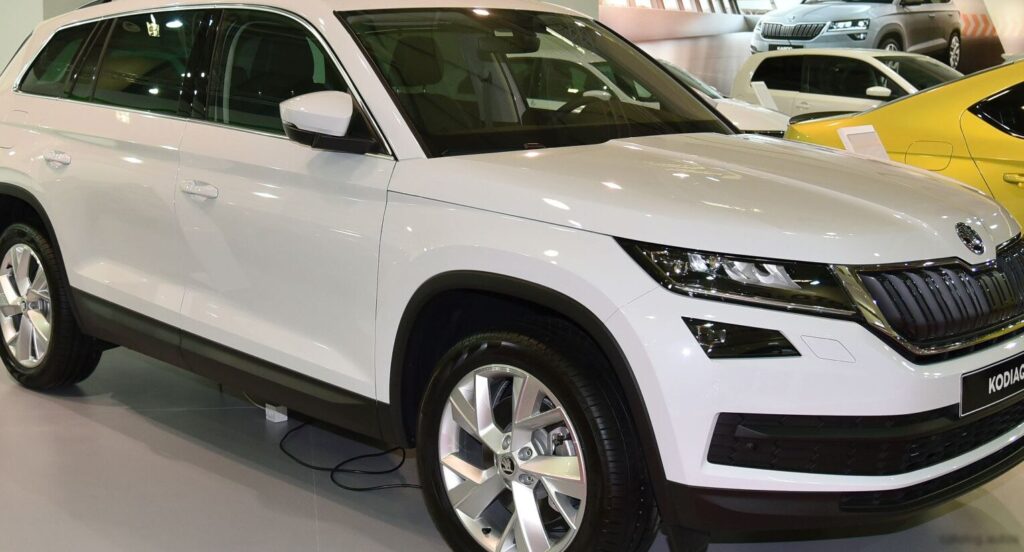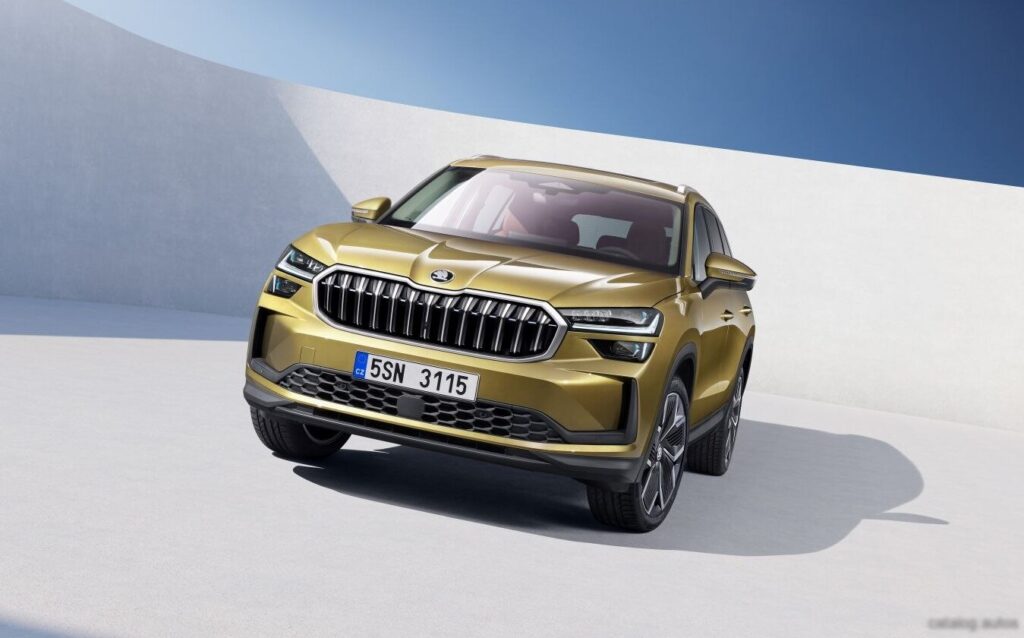
The Skoda Kodiaq II 2.0 TSI 4×4 DSG, launched in January 2024, represents the second generation of Skoda’s flagship SUV. Positioned as a mid-to-upper trim level within the Kodiaq II range, this variant combines a potent 2.0-liter turbocharged gasoline engine with a sophisticated all-wheel-drive system and a seven-speed dual-clutch transmission (DSG). It builds upon the foundation of the A7 platform, offering a blend of practicality, technology, and performance aimed at families and drivers seeking a versatile and capable SUV. The Kodiaq II continues Skoda’s tradition of providing value-oriented vehicles with a focus on spaciousness and functionality, appealing primarily to the European market, with limited availability in other regions.
Technical Specifications
| Brand | Skoda |
| Model | Kodiaq |
| Generation | Kodiaq II |
| Type (Engine) | 2.0 TSI (204 Hp) 4×4 DSG |
| Start of production | January, 2024 |
| Powertrain Architecture | Internal Combustion engine |
| Body type | SUV |
| Seats | 5 |
| Doors | 5 |
| Combined fuel consumption (WLTP) | 7.4-8 l/100 km (31.8 – 29.4 US mpg, 38.2 – 35.3 UK mpg, 13.5 – 12.5 km/l) |
| CO2 emissions (WLTP) | 168-181 g/km |
| Fuel Type | Petrol (Gasoline) |
| Acceleration 0 – 100 km/h | 7.3 sec |
| Acceleration 0 – 62 mph | 7.3 sec |
| Acceleration 0 – 60 mph | 6.9 sec |
| Maximum speed | 226 km/h (140.43 mph) |
| Emission standard | Euro 6e |
| Weight-to-power ratio | 8.3 kg/Hp, 120.7 Hp/tonne |
| Weight-to-torque ratio | 5.3 kg/Nm, 189.3 Nm/tonne |
| Power | 204 Hp @ 4500-6000 rpm |
| Power per litre | 102.8 Hp/l |
| Torque | 320 Nm @ 1500-4400 rpm (236.02 lb.-ft. @ 1500-4400 rpm) |
| Engine layout | Front, Transverse |
| Engine Model/Code | EA888 evo4 |
| Engine displacement | 1984 cm3 (121.07 cu. in.) |
| Number of cylinders | 4 |
| Engine configuration | Inline |
| Cylinder Bore | 82.5 mm (3.25 in.) |
| Piston Stroke | 92.8 mm (3.65 in.) |
| Compression ratio | 12.2:1 |
| Number of valves per cylinder | 4 |
| Fuel injection system | Direct injection |
| Engine aspiration | Turbocharger, Intercooler |
| Valvetrain | DOHC |
| Engine systems | Start & Stop System, Particulate filter |
| Kerb Weight | 1690-1889 kg (3725.81 – 4164.53 lbs.) |
| Max. weight | 2340-2390 kg (5158.82 – 5269.05 lbs.) |
| Max load | 501-650 kg (1104.52 – 1433 lbs.) |
| Trunk (boot) space – minimum | 910 l (32.14 cu. ft.) |
| Trunk (boot) space – maximum | 2105 l (74.34 cu. ft.) |
| Fuel tank capacity | 58 l (15.32 US gal | 12.76 UK gal) |
| Max. roof load | 75 kg (165.35 lbs.) |
| Permitted trailer load with brakes (8%) | 2300 kg (5070.63 lbs.) |
| Permitted trailer load with brakes (12%) | 2300 kg (5070.63 lbs.) |
| Permitted trailer load without brakes | 750 kg (1653.47 lbs.) |
| Permitted towbar download | 100 kg (220.46 lbs.) |
| Length | 4758 mm (187.32 in.) |
| Width | 1864 mm (73.39 in.) |
| Width with mirrors folded | 1924 mm (75.75 in.) |
| Width including mirrors | 2133 mm (83.98 in.) |
| Height | 1657 mm (65.24 in.) |
| Wheelbase | 2791 mm (109.88 in.) |
| Front track | 1586 mm (62.44 in.) |
| Rear (Back) track | 1575 mm (62.01 in.) |
| Front overhang | 927 mm (36.5 in.) |
| Rear overhang | 1041 mm (40.98 in.) |
| Ride height (ground clearance) | 187 mm (7.36 in.) |
| Drag coefficient (Cd) | 0.285-0.314 |
| Minimum turning circle (turning diameter) | 11.2 m (36.75 ft.) |
| Approach angle | 17° |
| Departure angle | 17.6° |
| Drivetrain Architecture | The Internal combustion engine (ICE) drives the front wheels permanently, and the rear wheels are driven through an electrically or mechanically operated clutch if necessary. |
| Drive wheel | All wheel drive (4×4) |
| Number of gears and type of gearbox | 7 gears, automatic transmission DSG |
| Front suspension | Independent, type McPherson with coil spring and anti-roll bar |
| Rear suspension | Independent multi-link spring suspension with stabilizer |
| Front brakes | Ventilated discs |
| Rear brakes | Disc |
| Assisting systems | ABS (Anti-lock braking system) |
| Steering type | Steering rack and pinion |
| Power steering | Electric Steering |
| Tires size | 235/55 R18; 235/50 R19; 235/45 R20 |
| Wheel rims size | 7.5J x 18; 7.5J x 19; 8J x 20 |
Powertrain & Engine Architecture
At the heart of the Kodiaq II 2.0 TSI 4×4 DSG lies the EA888 evo4 engine, a 1.984-liter (121.07 cubic inches) inline-four cylinder gasoline engine. This engine is a staple in the Volkswagen Group, known for its blend of performance and efficiency. The ‘evo4’ designation signifies the fourth evolution of this engine family, incorporating advancements in fuel injection, turbocharging, and thermal management. It utilizes direct fuel injection, delivering fuel directly into the combustion chamber for improved combustion efficiency and reduced emissions. The engine is turbocharged, employing a twin-scroll turbocharger to minimize turbo lag and enhance responsiveness. The valvetrain features a dual overhead camshaft (DOHC) configuration with four valves per cylinder, optimizing airflow for increased power output. The engine also incorporates a particulate filter to further reduce emissions, meeting stringent Euro 6e standards. The seven-speed dual-clutch transmission (DSG) provides rapid and seamless gear changes, contributing to both performance and fuel economy. The 4×4 system utilizes a multi-plate clutch to distribute torque between the front and rear axles as needed, providing enhanced traction and stability in various driving conditions.
Driving Characteristics
The 204 horsepower and 320 Nm (236 lb-ft) of torque delivered by the 2.0 TSI engine, coupled with the DSG transmission and all-wheel drive, result in a capable and refined driving experience. Acceleration from 0 to 100 km/h (0-62 mph) takes approximately 7.3 seconds. The DSG transmission is programmed for smooth shifts in normal driving modes, but can be shifted manually for more engaging control. The all-wheel-drive system provides excellent grip and stability, particularly on slippery surfaces. Compared to lower-powered Kodiaq variants, such as those equipped with the 1.5 TSI engine, the 2.0 TSI offers significantly more responsive acceleration and effortless cruising ability. While not a sports SUV, the 2.0 TSI provides ample power for overtaking and tackling varied terrain. The gear ratios in the DSG transmission are optimized for both fuel efficiency and performance, providing a good balance between the two.
Equipment & Trim Levels
The Kodiaq II 2.0 TSI 4×4 DSG typically comes well-equipped as a mid-range to upper-range trim. Standard features generally include automatic climate control, a touchscreen infotainment system with smartphone integration (Apple CarPlay and Android Auto), a digital instrument cluster, and a suite of safety features such as automatic emergency braking, lane departure warning, and adaptive cruise control. Interior upholstery is typically a combination of fabric and leather, with options for full leather upholstery available. Optional extras may include a panoramic sunroof, a premium sound system, heated and ventilated front seats, and advanced driver-assistance systems such as blind-spot monitoring and rear cross-traffic alert.
Chassis & Braking
The Kodiaq II utilizes an independent suspension setup at all four corners. The front suspension employs a McPherson strut design with coil springs and an anti-roll bar, while the rear suspension features a multi-link setup, also with coil springs and a stabilizer bar. This configuration provides a comfortable ride quality while maintaining good handling characteristics. Braking duties are handled by ventilated discs at the front and solid discs at the rear, providing ample stopping power. The vehicle is equipped with ABS (Anti-lock Braking System) and electronic stability control as standard safety features. The electric power steering provides precise and responsive steering feel.
Market Reception & Comparison
The Skoda Kodiaq II 2.0 TSI 4×4 DSG has been generally well-received by automotive critics, praised for its spacious interior, comfortable ride, and strong performance. Compared to other SUVs in its class, such as the Volkswagen Tiguan Allspace and the Hyundai Santa Fe, the Kodiaq offers a compelling combination of value, practicality, and technology. Fuel economy is competitive for its class, with combined fuel consumption ranging from 7.4 to 8 liters per 100 kilometers (29.4 to 31.8 US mpg). Reliability is expected to be good, based on Skoda’s reputation for building durable and well-engineered vehicles.
Legacy
The EA888 engine family has a proven track record of reliability, and the Kodiaq II’s robust construction suggests it will be a durable vehicle. The 2.0 TSI engine, when properly maintained, is known to be a long-lasting powertrain. On the used car market, the Kodiaq II 2.0 TSI 4×4 DSG is expected to hold its value well, due to its desirable combination of features, performance, and practicality. Its all-wheel-drive system and spacious interior will likely make it a popular choice for families and drivers seeking a versatile and capable SUV.