
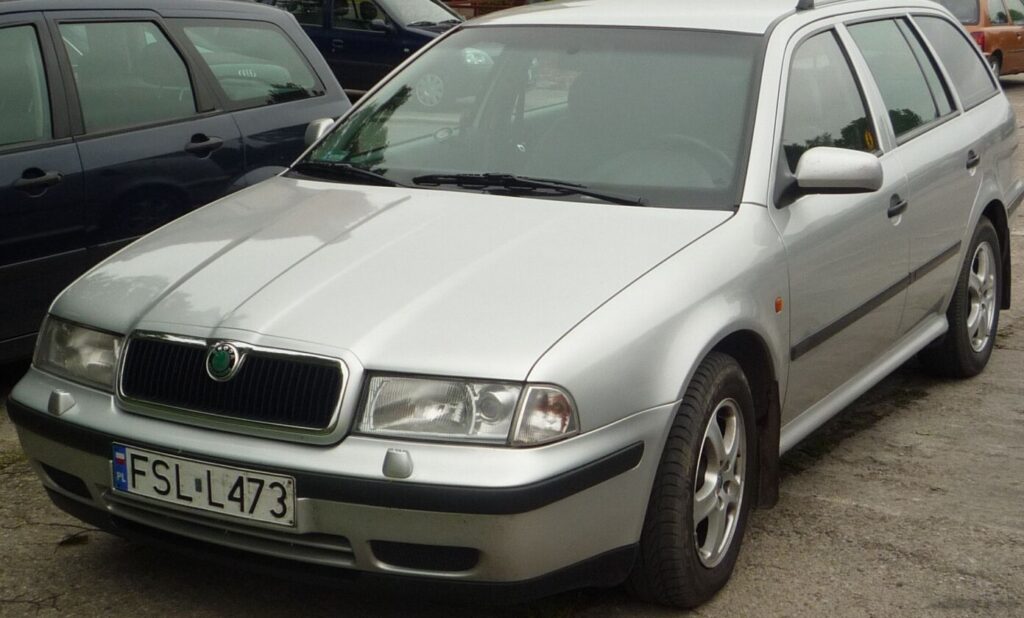
The Skoda Octavia I Combi Tour 1.8 T, produced between December 1997 and July 2000, represented a significant offering in the compact estate car segment. Built on the Volkswagen Group’s 1HX0/A3 platform – shared with the Volkswagen Golf, Audi A3, and SEAT Leon – the Octavia Combi Tour expanded the practicality of the already popular Octavia liftback by adding a spacious station wagon body style. This particular 1.8-liter turbocharged variant, delivering 150 horsepower, occupied a mid-range position within the Octavia lineup, appealing to buyers seeking a balance of performance, fuel efficiency, and family-friendly versatility. It was a key model for Skoda as they established themselves as a mainstream brand in Western European markets.
Technical Specifications
| Brand | Skoda |
| Model | Octavia |
| Generation | Octavia I Combi Tour |
| Type (Engine) | 1.8 T (150 Hp) |
| Start of production | December, 1997 |
| End of production | July, 2000 |
| Powertrain Architecture | Internal Combustion engine |
| Body type | Station wagon (estate) |
| Seats | 5 |
| Doors | 5 |
| Fuel consumption (urban) | 10.9 l/100 km (21.6 US mpg, 25.9 UK mpg, 9.2 km/l) |
| Fuel consumption (extra urban) | 6.3 l/100 km (37.3 US mpg, 44.8 UK mpg, 15.9 km/l) |
| Fuel consumption (combined) | 7.9 l/100 km (29.8 US mpg, 35.8 UK mpg, 12.7 km/l) |
| Fuel Type | Petrol (Gasoline) |
| Acceleration 0 – 100 km/h | 8.6 sec |
| Acceleration 0 – 62 mph | 8.6 sec |
| Acceleration 0 – 60 mph | 8.2 sec |
| Maximum speed | 219 km/h (136.08 mph) |
| Weight-to-power ratio | 8.7 kg/Hp, 115.4 Hp/tonne |
| Weight-to-torque ratio | 6.2 kg/Nm, 161.5 Nm/tonne |
| Power | 150 Hp @ 5700 rpm |
| Power per litre | 84.2 Hp/l |
| Torque | 210 Nm @ 1750 rpm (154.89 lb.-ft. @ 1750 rpm) |
| Engine layout | Front, Transverse |
| Engine Model/Code | AGU, ARZ, AUM |
| Engine displacement | 1781 cm3 (108.68 cu. in.) |
| Number of cylinders | 4 |
| Engine configuration | Inline |
| Cylinder Bore | 81 mm (3.19 in.) |
| Piston Stroke | 86.4 mm (3.4 in.) |
| Compression ratio | 9:1 |
| Number of valves per cylinder | 5 |
| Fuel injection system | Multi-port manifold injection |
| Engine aspiration | Turbocharger |
| Valvetrain | DOHC |
| Engine oil capacity | 4.5 l (4.76 US qt | 3.96 UK qt) |
| Coolant | 6.3 l (6.66 US qt | 5.54 UK qt) |
| Kerb Weight | 1300 kg (2866.01 lbs.) |
| Max. weight | 1850 kg (4078.55 lbs.) |
| Max load | 550 kg (1212.54 lbs.) |
| Trunk (boot) space – minimum | 548 l (19.35 cu. ft.) |
| Trunk (boot) space – maximum | 1512 l (53.4 cu. ft.) |
| Fuel tank capacity | 55 l (14.53 US gal | 12.1 UK gal) |
| Length | 4511 mm (177.6 in.) |
| Width | 1731 mm (68.15 in.) |
| Height | 1457 mm (57.36 in.) |
| Wheelbase | 2512 mm (98.9 in.) |
| Front track | 1516 mm (59.69 in.) |
| Rear (Back) track | 1492 mm (58.74 in.) |
| Drivetrain Architecture | The Internal combustion engine (ICE) drives the front wheels of the vehicle. |
| Drive wheel | Front wheel drive |
| Number of gears and type of gearbox | 5 gears, manual transmission |
| Front suspension | Coil spring |
| Rear suspension | Coil spring |
| Front brakes | Ventilated discs |
| Rear brakes | Disc |
| Assisting systems | ABS (Anti-lock braking system) |
| Steering type | Steering rack and pinion |
| Power steering | Hydraulic Steering |
| Tires size | 195/65 R15 |
| Wheel rims size | 6.5J X 15 |
Powertrain & Engine Architecture
The heart of the Octavia Combi Tour 1.8 T was the 1781cc, inline-four cylinder engine, identifiable by engine codes AGU, ARZ, and AUM. This engine was a member of Volkswagen Group’s EA827 family, known for its robust construction and tuning potential. The key feature was its single turbocharger, providing forced induction to significantly boost power output. Fuel delivery was managed by a multi-port fuel injection system, ensuring precise fuel metering for optimal combustion. The engine utilized a double overhead camshaft (DOHC) valvetrain with five valves per cylinder (three intake, two exhaust), enhancing volumetric efficiency and contributing to a broad powerband. The 5-speed manual transmission was the standard offering, providing a direct connection between the engine and the front wheels. The transmission’s gear ratios were tuned for a balance of acceleration and fuel economy, though some drivers found the shift action to be slightly notchy compared to competitors.
Driving Characteristics
The 150 horsepower and 155 lb-ft of torque produced by the 1.8T engine provided brisk acceleration for the Octavia Combi Tour. Zero to 60 mph was achievable in around 8.2 seconds, and the car felt responsive in everyday driving situations. Compared to the base 1.6-liter engine, the 1.8T offered a noticeable performance upgrade, making overtaking maneuvers and highway cruising significantly easier. However, it didn’t possess the outright punch of the higher-spec VR6 models. The turbocharger did introduce a degree of turbo lag, meaning there was a slight delay between pressing the accelerator and feeling the full surge of power. The manual transmission allowed for greater driver control, but the gear ratios were spaced to prioritize fuel efficiency over outright performance. The suspension, while comfortable, was tuned for a balance between ride quality and handling, resulting in a slightly less engaging driving experience than some of its rivals.
Equipment & Trim Levels
The 1.8 T Combi Tour typically came equipped with features such as power windows, central locking, and an adjustable steering column. Interior upholstery was generally cloth, though leather options were available. Air conditioning was a common option, and higher trim levels could include features like alloy wheels, a sunroof, and an upgraded audio system. The dashboard layout was functional and straightforward, reflecting the Octavia’s focus on practicality. Safety features included ABS brakes and driver and passenger airbags. The specific trim level – Classic, Comfort, or Elegance – dictated the level of standard equipment.
Chassis & Braking
The Octavia Combi Tour utilized a MacPherson strut front suspension and a twist-beam rear suspension. This setup provided a comfortable ride and predictable handling. Front brakes were ventilated discs, offering good stopping power, while rear brakes were solid discs. The ABS system helped to maintain steering control during hard braking. The steering was rack and pinion, providing precise and responsive steering feel. The chassis was designed to accommodate the increased weight of the estate body style while maintaining a reasonable level of agility.
Market Reception & Comparison
The Octavia Combi Tour 1.8 T was generally well-received by automotive critics. It was praised for its spacious interior, practical estate car body style, and strong engine performance. Fuel economy was considered respectable for its class. Compared to the 1.6-liter Octavia, the 1.8 T offered a significant performance boost, making it a more appealing option for drivers who frequently carried passengers or cargo. However, some critics noted that the interior materials were not as refined as those found in some of its competitors, such as the Ford Focus Estate. The 1.8T offered a compelling alternative to diesel models, providing similar fuel economy with a more refined driving experience.
Legacy
The Skoda Octavia I Combi Tour 1.8 T has proven to be a reliable and durable vehicle. The 1.8T engine, while capable of being tuned for increased power, is generally robust when maintained properly. Common issues include occasional turbocharger failure and oil leaks. Today, these Octavias are relatively affordable on the used car market, making them a practical and economical choice for buyers seeking a spacious and reliable estate car. The 1.8T engine’s reputation for reliability and tuning potential has ensured a continued following among enthusiasts. The Octavia Combi Tour 1.8 T played a crucial role in establishing Skoda as a respected and competitive brand in the European automotive market.
