
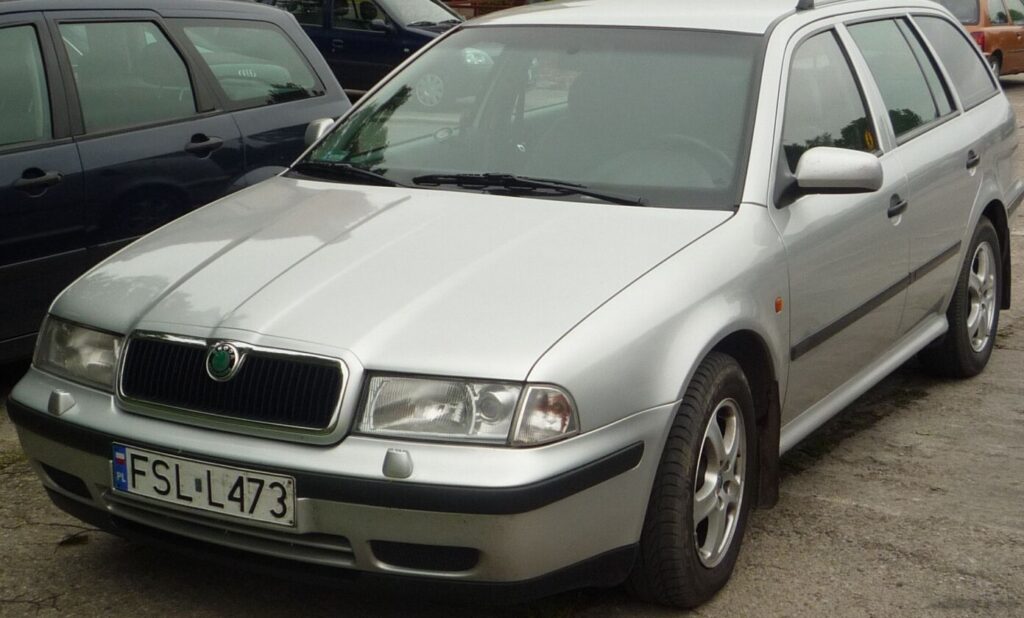
The Skoda Octavia I Combi Tour 1.9 TDI with 90 horsepower and an automatic transmission, produced between October 1996 and July 2000, represented an important entry point into the increasingly popular compact estate car segment. Part of the first generation Octavia (1HX0/A3 platform) – a model that marked Skoda’s transition under Volkswagen Group ownership – this variant offered practicality and fuel efficiency, appealing to families and those needing a versatile vehicle. It was positioned as a more affordable and economical alternative to higher-powered Octavia models and other competitors in the European market.
Technical Specifications
| Brand | Skoda |
| Model | Octavia |
| Generation | Octavia I Combi Tour |
| Type (Engine) | 1.9 TDI (90 Hp) Automatic |
| Start of production | October, 1996 |
| End of production | July, 2000 |
| Powertrain Architecture | Internal Combustion engine |
| Body type | Station wagon (estate) |
| Seats | 5 |
| Doors | 5 |
| Fuel consumption (urban) | 8.9 l/100 km (26.4 US mpg, 31.7 UK mpg, 11.2 km/l) |
| Fuel consumption (extra urban) | 4.8 l/100 km (49 US mpg, 58.9 UK mpg, 20.8 km/l) |
| Fuel consumption (combined) | 5.1 l/100 km (46.1 US mpg, 55.4 UK mpg, 19.6 km/l) |
| Fuel Type | Diesel |
| Acceleration 0 – 100 km/h | 15.2 sec |
| Acceleration 0 – 62 mph | 15.2 sec |
| Acceleration 0 – 60 mph | 14.4 sec |
| Maximum speed | 176 km/h (109.36 mph) |
| Emission standard | Euro 3 |
| Weight-to-power ratio | 14.5 kg/Hp, 69 Hp/tonne |
| Weight-to-torque ratio | 6.2 kg/Nm, 160.9 Nm/tonne |
| Power | 90 Hp @ 4000 rpm |
| Power per litre | 47.5 Hp/l |
| Torque | 210 Nm @ 1900 rpm (154.89 lb.-ft. @ 1900 rpm) |
| Engine layout | Front, Transverse |
| Engine Model/Code | AGR |
| Engine displacement | 1896 cm3 (115.7 cu. in.) |
| Number of cylinders | 4 |
| Engine configuration | Inline |
| Cylinder Bore | 79.5 mm (3.13 in.) |
| Piston Stroke | 95.5 mm (3.76 in.) |
| Compression ratio | 19:1 |
| Number of valves per cylinder | 2 |
| Fuel injection system | Direct injection |
| Engine aspiration | Turbocharger, Intercooler |
| Valvetrain | OHC |
| Engine oil capacity | 4.5 l (4.76 US qt | 3.96 UK qt) |
| Coolant | 6.3 l (6.66 US qt | 5.54 UK qt) |
| Kerb Weight | 1305 kg (2877.03 lbs.) |
| Max. weight | 1855 kg (4089.57 lbs.) |
| Max load | 550 kg (1212.54 lbs.) |
| Trunk (boot) space – minimum | 548 l (19.35 cu. ft.) |
| Trunk (boot) space – maximum | 1512 l (53.4 cu. ft.) |
| Fuel tank capacity | 55 l (14.53 US gal | 12.1 UK gal) |
| Length | 4511 mm (177.6 in.) |
| Width | 1731 mm (68.15 in.) |
| Height | 1457 mm (57.36 in.) |
| Wheelbase | 2512 mm (98.9 in.) |
| Front track | 1516 mm (59.69 in.) |
| Rear (Back) track | 1492 mm (58.74 in.) |
| Drivetrain Architecture | The Internal combustion engine (ICE) drives the front wheels of the vehicle. |
| Drive wheel | Front wheel drive |
| Number of gears and type of gearbox | 4 gears, automatic transmission |
| Front suspension | Independent type McPherson |
| Rear suspension | Coil spring |
| Front brakes | Disc |
| Rear brakes | Drum |
| Assisting systems | ABS (Anti-lock braking system) |
| Steering type | Steering rack and pinion |
| Power steering | Hydraulic Steering |
| Tires size | 195/65 R15 |
| Wheel rims size | 6.5J x 15 |
INTRODUCTION
The Skoda Octavia I Combi Tour 1.9 TDI 90 hp Automatic, launched in late 1996, was a crucial model for Skoda as it sought to establish itself as a mainstream European car manufacturer. Building on the success of the initial Octavia liftback, the Combi Tour (estate) variant added significantly to the car’s practicality. This particular engine and transmission combination was aimed at buyers prioritizing fuel economy and ease of driving over outright performance. It occupied the lower-mid range of the Octavia lineup, sitting below the more powerful petrol and TDI variants, and above the base-level engine options.
Powertrain & Engine Architecture
The heart of this Octavia variant is the 1.9-liter, four-cylinder AGR engine. This engine is a direct-injection diesel, utilizing a Bosch VE pump and mechanical injectors. The AGR code signifies a specific iteration of the 1.9 TDI engine, known for its relatively robust design. The engine features an overhead camshaft (OHC) valvetrain operating two valves per cylinder. A turbocharger with an intercooler is employed to boost power and torque, delivering 90 horsepower at 4000 rpm and 210 Nm (155 lb-ft) of torque at a low 1900 rpm. The automatic transmission is a four-speed unit, designed to provide smooth and convenient gear changes. While not known for its sportiness, it was a reliable unit for its time. The transmission’s gear ratios were optimized for fuel efficiency and comfortable cruising rather than rapid acceleration.
Driving Characteristics
The 1.9 TDI 90 hp Automatic Octavia Combi Tour offered a comfortable, if not exhilarating, driving experience. Acceleration was modest, taking around 15.2 seconds to reach 62 mph (100 km/h). The automatic transmission, while convenient, did contribute to some power loss compared to the manual versions. The engine’s strong low-end torque made it well-suited for everyday driving and hauling loads, but overtaking required careful planning. The gear ratios were spaced to prioritize fuel economy, meaning the engine often operated at higher revs during acceleration. Compared to the more powerful 1.8 petrol or 1.9 TDI 110 hp variants, this model felt noticeably slower, but it compensated with significantly better fuel economy.
Equipment & Trim Levels
The Octavia Combi Tour 1.9 TDI Automatic typically came with a reasonable level of standard equipment. This included central locking, power steering, electric front windows, and an adjustable steering column. Interior upholstery was typically cloth, with a functional, if somewhat basic, dashboard layout. Optional extras included air conditioning, alloy wheels, a radio/cassette player, and upgraded interior trim. Trim levels varied slightly depending on the market, but generally, this variant was positioned as a mid-range offering, providing a good balance of features and affordability.
Chassis & Braking
The Octavia Combi Tour utilized a McPherson strut front suspension and a coil spring rear suspension. This setup provided a comfortable ride, although it wasn’t particularly sporty. The front brakes were discs, while the rear brakes were drums – a common configuration for this class of vehicle at the time. ABS (Anti-lock Braking System) was standard, enhancing safety. The suspension was tuned for comfort and stability, prioritizing ride quality over handling precision. Stabilizer bars were fitted to both the front and rear axles to reduce body roll.
Market Reception & Comparison
The Octavia Combi Tour 1.9 TDI Automatic was well-received by critics and buyers alike, particularly for its practicality, fuel efficiency, and affordability. It was often praised for its spacious interior and large boot capacity. Compared to rivals like the Ford Focus Estate or Vauxhall/Opel Astra Estate, the Octavia offered a compelling combination of value and versatility. The automatic transmission was seen as a positive for drivers who preferred convenience over sporty driving dynamics. Fuel economy was a major selling point, with combined figures around 5.1 l/100 km (46.1 US mpg) making it an attractive option for high-mileage drivers. Reliability was generally good, although the direct-injection diesel engine required regular maintenance to prevent issues with the fuel injectors.
Legacy
The Skoda Octavia I Combi Tour 1.9 TDI Automatic has proven to be a durable and reliable vehicle. Many examples are still on the road today, testament to the robust engineering of the AGR engine and the overall build quality of the Octavia. In the used car market, these models are often sought after for their affordability and practicality. While maintenance costs can increase with age, particularly for the fuel injection system, the Octavia remains a popular choice for those seeking a dependable and economical estate car. The 1.9 TDI engine, in particular, has a reputation for longevity, provided it has been properly maintained. This variant played a significant role in establishing Skoda as a credible and respected car manufacturer in Europe.
