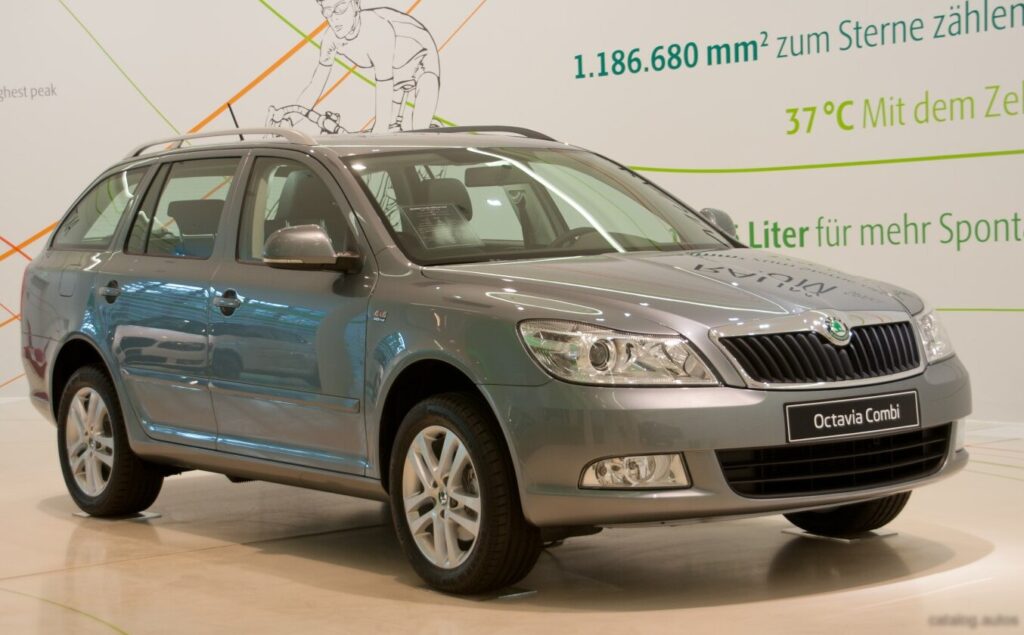
The Skoda Octavia II Combi, specifically the facelifted version introduced in 2009, represented a significant offering in the compact estate (station wagon) segment. The 1.4 MPI (80 horsepower) variant, produced from 2009 through June 2013, served as the entry-level engine option for buyers prioritizing fuel efficiency and affordability over outright performance. This model was built on the Volkswagen Group’s A5 (1HX0) platform, shared with the Volkswagen Golf Mk5 and Mk6, Audi A3, and other vehicles. The Combi body style, or estate, provided a practical and spacious alternative to the standard hatchback, appealing to families and those requiring increased cargo capacity.
The 1.4 MPI (80 hp) Octavia Combi: Positioning and Overview
Within the Octavia II Combi range, the 1.4 MPI 80 hp model occupied the base trim level. It was positioned below the more powerful 1.6 MPI, 1.8 TSI, and diesel variants (1.9 TDI and 2.0 TDI). Skoda deliberately offered this engine to attract budget-conscious buyers who still desired the practicality of an estate car. It was often chosen by individuals and families who primarily used the vehicle for commuting and occasional longer journeys, where fuel economy was a key consideration. The facelift in 2009 brought subtle styling updates to the Octavia II, including revised headlights, a redesigned grille, and interior enhancements, but the core mechanicals of the 1.4 MPI engine remained largely unchanged.
Powertrain & Engine Architecture
The heart of this Octavia variant is the CGGA engine code, a 1.4-liter inline-four cylinder gasoline engine. This engine utilizes a naturally aspirated configuration, meaning it doesn’t employ a turbocharger or supercharger. It features multi-point fuel injection, delivering fuel directly into the intake manifold. The engine’s valvetrain is a double overhead camshaft (DOHC) design with four valves per cylinder, contributing to improved breathing and efficiency. The engine displaces 1390 cm³ (84.82 cubic inches) and produces a maximum power output of 80 hp (57.6 hp/liter) at 5000 rpm, and 132 Nm (97.36 lb-ft) of torque at 3800 rpm. The engine’s compression ratio is 10.5:1.
The 1.4 MPI engine was typically paired with a five-speed manual transmission, although a four-speed automatic transmission was also available as an option. The automatic transmission, while offering convenience, was known to slightly diminish fuel economy and performance compared to the manual counterpart. The transmission is front-wheel drive, typical for vehicles in this class.
Driving Characteristics
The driving experience in the 1.4 MPI Octavia Combi is best described as adequate rather than exhilarating. With 80 hp propelling a vehicle weighing around 1300 kg (2866 lbs), acceleration is modest. 0-100 km/h (0-62 mph) takes approximately 14.3 seconds, and 0-60 mph is achieved in around 13.6 seconds. The engine feels strained when accelerating hard, particularly when fully loaded or climbing hills. The five-speed manual transmission helps to keep the engine in its optimal power band, but the automatic transmission can feel sluggish due to its limited number of gears and relatively wide gear ratios. The focus is clearly on fuel efficiency, and the engine delivers a smooth and relatively quiet driving experience at cruising speeds. Compared to the 1.8 TSI or TDI variants, the 1.4 MPI lacks the punch and responsiveness needed for more dynamic driving.
Equipment & Trim Levels
The base trim level of the 1.4 MPI Octavia Combi typically included features such as power windows, central locking, an adjustable steering column, and a basic audio system. Safety features included ABS (Anti-lock Braking System) and driver and passenger airbags. Interior upholstery was generally cloth, and the dashboard featured a functional but relatively simple design. Optional extras included alloy wheels, air conditioning, a more advanced audio system with CD player, and parking sensors. Higher trim levels, available with the more powerful engines, offered features like climate control, leather upholstery, and upgraded infotainment systems, but these were generally not available or were limited options on the base 1.4 MPI model.
Chassis & Braking
The Octavia II Combi’s chassis utilizes an independent McPherson strut suspension at the front, providing a comfortable ride and decent handling. The rear suspension employs an independent multi-link setup, further enhancing ride quality and stability. Front brakes are ventilated discs, offering good stopping power, while rear brakes are solid discs. The steering is rack and pinion with electric power assistance, providing a light and easy steering feel. The standard tire size was 195/65 R15, mounted on 6J x 15 inch steel or alloy wheels. Stabilizer bars are present at both the front and rear, helping to reduce body roll during cornering.
Market Reception & Comparison
The 1.4 MPI Octavia Combi was generally well-received by critics as a practical and affordable estate car. However, its performance was often criticized as being underwhelming, particularly when compared to the more powerful engine options. Fuel economy was a strong point, with combined fuel consumption figures of around 7 l/100 km (33.6 US mpg, 40.4 UK mpg). Reliability was generally good, although the automatic transmission was sometimes reported to have issues. Compared to competitors like the Ford Focus Estate and Vauxhall/Opel Astra Estate, the Octavia Combi offered a more spacious interior and larger cargo area, making it a popular choice for families. The 1.8 TSI offered a significant performance upgrade, but at a higher price point. The diesel variants (1.9 TDI and 2.0 TDI) provided even better fuel economy and torque, but were also more expensive to purchase.
Technical Specifications
| Engine Code | CGGA |
| Engine Displacement | 1390 cm³ (84.82 cu. in.) |
| Number of Cylinders | 4, Inline |
| Power Output | 80 hp @ 5000 rpm |
| Torque | 132 Nm @ 3800 rpm (97.36 lb.-ft. @ 3800 rpm) |
| Fuel Injection | Multi-point manifold injection |
| Compression Ratio | 10.5:1 |
| Fuel Type | Petrol (Gasoline) |
| Transmission | 5-speed manual or 4-speed automatic |
| Drive Wheels | Front |
| Kerb Weight | 1300 kg (2866.01 lbs.) |
| Maximum Weight | 1885 kg (4155.71 lbs.) |
| Trunk Space (min/max) | 605 l / 1655 l (21.37 cu. ft. / 58.45 cu. ft.) |
| Fuel Tank Capacity | 55 l (14.53 US gal | 12.1 UK gal) |
| Acceleration 0-100 km/h | 14.3 sec |
| Maximum Speed | 172 km/h (106.88 mph) |
Legacy
The 1.4 MPI engine in the Octavia II Combi, while not known for its performance, proved to be a reliable and economical powerplant. Today, used examples of this variant are readily available and generally represent good value for money. The engine is relatively simple to maintain, and spare parts are widely available. However, potential buyers should be aware of the potential for issues with the automatic transmission. The Octavia II Combi, in general, has earned a reputation for being a practical, spacious, and dependable estate car, and the 1.4 MPI variant remains a viable option for those seeking an affordable and fuel-efficient vehicle.