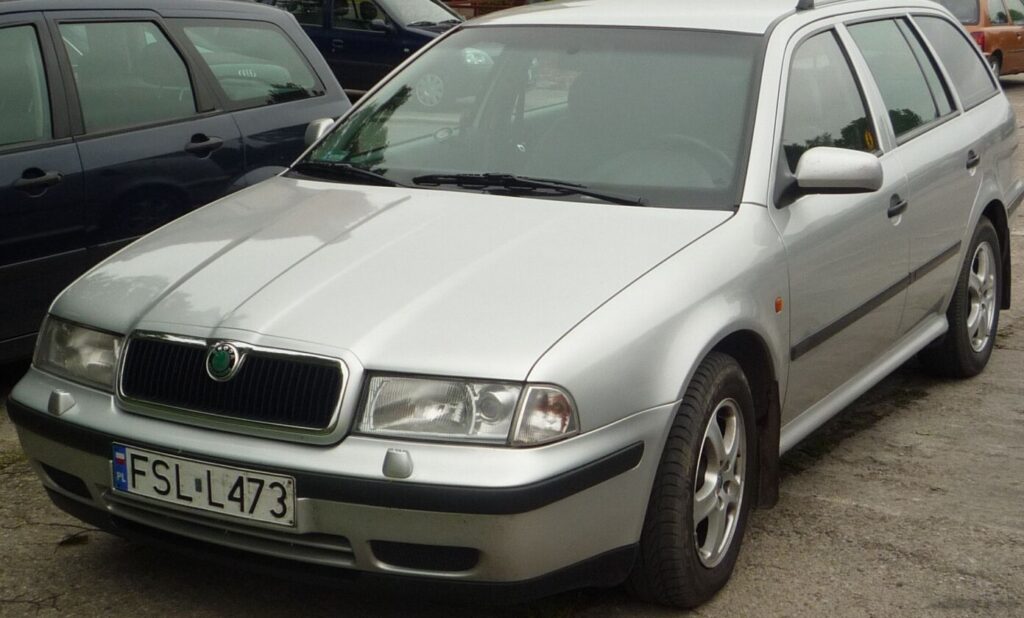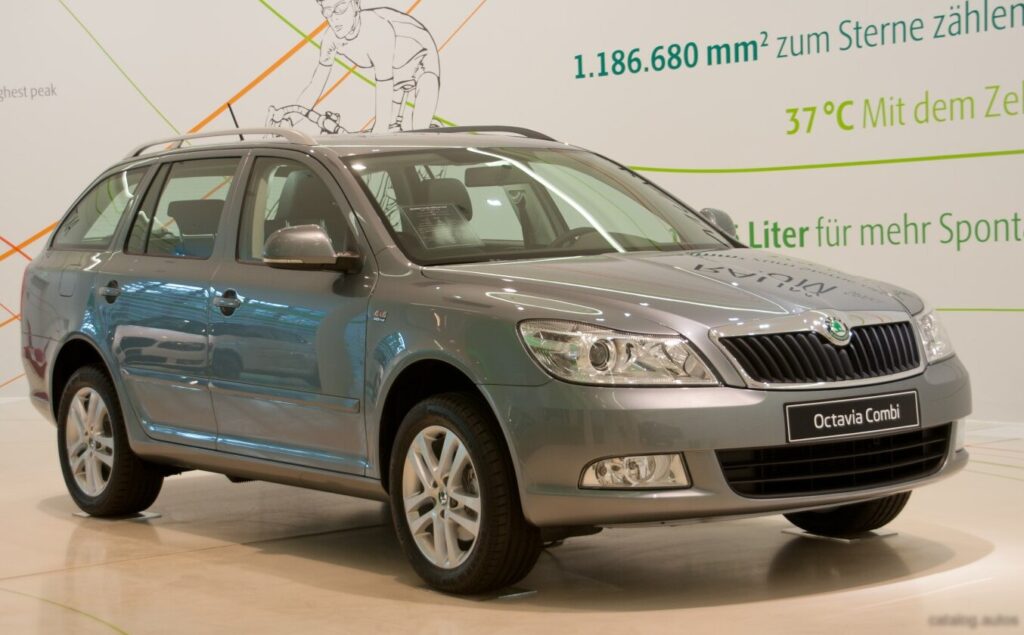
The Skoda Octavia II Combi, particularly the facelifted version introduced in 2009, marked a significant advancement for Skoda’s popular compact estate car. Among the diverse engine and transmission options, the 1.8 TSI (160 hp) variant paired with a six-speed manual transmission held a prominent position in the lineup. It offered a compelling blend of performance, fuel efficiency, and practicality. Production of this configuration spanned from 2009 until April 2013, built on the Volkswagen Group’s A5 (or 1Z) platform, internally designated as 1HX0 for the Combi body style. This model was designed to attract buyers desiring a versatile family vehicle with a more engaging driving experience than the diesel alternatives.
The 1.8 TSI Engine and its Position in the Octavia II Combi Lineup
The 1.8 TSI engine was a key element of the Octavia II’s appeal, providing a substantial upgrade in power and refinement compared to the earlier naturally aspirated engines. Positioned above the base 1.6 MPI engine, it delivered a noticeable performance boost without incurring the higher running costs associated with the range-topping 2.0 TSI. In comparison to the diesel variants, such as the 1.9 TDI and 2.0 TDI, the 1.8 TSI offered a more responsive and enjoyable driving experience, although with slightly increased fuel consumption. It catered to drivers who prioritized a smoother, quieter ride and quicker acceleration over maximizing fuel economy.
Powertrain & Engine Architecture
At the heart of this Octavia variant lies the 1.8-liter, four-cylinder, turbocharged gasoline engine, identified by the Skoda/Volkswagen code CDAA. This engine belongs to the EA886 family, renowned for its robust design and potential for tuning. It features direct fuel injection (FSI – Fuel Stratified Injection), enabling precise fuel delivery and enhanced combustion efficiency. The engine employs a double overhead camshaft (DOHC) valvetrain with four valves per cylinder, optimizing airflow for increased power output. A turbocharger with an intercooler further boosts performance by forcing more air into the cylinders. The engine’s displacement is 1798 cm³ (109.72 cubic inches), generating a maximum power output of 160 hp (118 kW) at 5000 rpm and a peak torque of 250 Nm (184.39 lb-ft) available from a low 1500 rpm. This broad torque curve contributes to strong acceleration in everyday driving scenarios. The engine requires 4.6 liters (4.86 US quarts) of engine oil, adhering to Volkswagen’s specified standards.
Driving Characteristics
The 1.8 TSI engine, coupled with the six-speed manual transmission, delivers a noticeably more spirited driving experience than the lower-powered Octavia models. Acceleration from 0 to 100 km/h (0-62 mph) takes approximately 7.9 seconds, and 0-60 mph is achieved in around 7.5 seconds. While not a sports car, the Octavia 1.8 TSI offers ample power for overtaking and merging onto highways. The six-speed gearbox is well-matched to the engine’s characteristics, providing precise shifts and allowing the driver to maintain the engine within its optimal power band. The turbocharger provides a noticeable power surge, but it’s delivered in a linear and predictable manner, making it easy to control. Compared to the 2.0 TSI, the 1.8 TSI feels less urgent, but it offers a more accessible and forgiving power delivery. The front-wheel-drive configuration provides good traction in most conditions, although torque steer can be perceptible under hard acceleration.
Equipment & Trim Levels
The 1.8 TSI variant of the Octavia II Combi was typically offered in mid-range trim levels, often designated as ‘Elegance’ or ‘Style’ depending on the specific market. Standard equipment generally included air conditioning, alloy wheels (typically 16-inch, with 17-inch options available), a multi-function steering wheel, electric windows and mirrors, and a basic audio system. Higher trim levels added features such as automatic climate control, parking sensors, a more advanced audio system with a touchscreen display, and upgraded interior upholstery. Optional extras included a sunroof, leather seats, and a navigation system. Interior materials were generally of good quality for the price point, emphasizing durability and practicality. The dashboard layout was functional and user-friendly, with clear instrumentation and logically placed controls.
Chassis & Braking
The Octavia II Combi’s chassis was engineered to provide a comfortable and stable ride. The front suspension utilizes an independent McPherson strut setup with coil springs and an anti-roll bar, while the rear suspension employs an independent multi-link system. This configuration strikes a good balance between ride comfort and handling precision. The steering is a rack and pinion system with electric power assistance, offering a light and responsive feel. Braking is handled by ventilated discs on the front wheels and solid discs on the rear. An Anti-lock Braking System (ABS) is standard, enhancing safety and control during emergency braking. The suspension tuning was generally softer than that of the higher-performance 2.0 TSI models, prioritizing ride comfort over outright handling prowess. Wheel sizes typically ranged from 6J x 15 to 7J x 17, with tire sizes varying accordingly (195/65 R15, 205/55 R16, 225/45 R17).
Market Reception & Comparison
The Skoda Octavia II Combi 1.8 TSI received generally favorable reviews from automotive critics. It was lauded for its spacious interior, practical estate car body style, and the responsive performance of the 1.8 TSI engine. Fuel economy was considered respectable, with combined figures around 7.0 l/100 km (33.6 US mpg). Compared to the diesel models, the 1.8 TSI was often viewed as a more enjoyable driving experience, albeit with slightly higher fuel costs. Reliability was generally good, although some owners reported issues with the turbocharger and fuel injectors over the long term. The Octavia II Combi 1.8 TSI offered a compelling alternative to other compact estate cars, such as the Ford Focus Estate and the Vauxhall/Opel Astra Estate, often providing more space and a more refined driving experience at a competitive price point.
Technical Specifications
| Brand | Skoda |
| Model | Octavia II Combi |
| Engine Type | 1.8 TSI (Turbocharged Direct Injection) |
| Engine Code | CDAA |
| Displacement | 1798 cm³ (109.72 cu. in.) |
| Number of Cylinders | 4 (Inline) |
| Valves per Cylinder | 4 |
| Fuel Injection | Direct Injection |
| Turbocharger | Yes, with Intercooler |
| Maximum Power | 160 hp (118 kW) @ 5000 rpm |
| Maximum Torque | 250 Nm (184.39 lb-ft) @ 1500 rpm |
| Transmission | 6-speed Manual |
| Drive Type | Front-Wheel Drive |
| 0-100 km/h | 7.9 sec |
| 0-62 mph | 7.9 sec |
| Top Speed | 222 km/h (137.94 mph) |
| Fuel Consumption (Urban) | 9.6 l/100 km (24.5 US mpg) |
| Fuel Consumption (Extra Urban) | 5.6 l/100 km (42 US mpg) |
| Fuel Consumption (Combined) | 7.0 l/100 km (33.6 US mpg) |
| Kerb Weight | 1395 kg (3075.45 lbs) |
| Fuel Tank Capacity | 55 l (14.53 US gal) |
| Trunk Space (Minimum) | 605 l (21.37 cu. ft.) |
| Trunk Space (Maximum) | 1655 l (58.45 cu. ft.) |
Legacy
The 1.8 TSI engine proved to be a reliable and durable powerplant when properly maintained. While some early examples experienced issues with the timing chain tensioner, these were generally addressed through software updates and revised components. Today, used Octavia II Combi 1.8 TSI models represent a good value proposition, offering a spacious and practical estate car with a reasonably powerful and efficient engine. Regular maintenance, including oil changes and timing chain inspection, is crucial to ensure long-term reliability. The CDAA engine is known to respond well to tuning, offering potential for increased power output, but this should be undertaken by a qualified professional. The Octavia II Combi 1.8 TSI remains a popular choice for buyers seeking a versatile and affordable family vehicle.