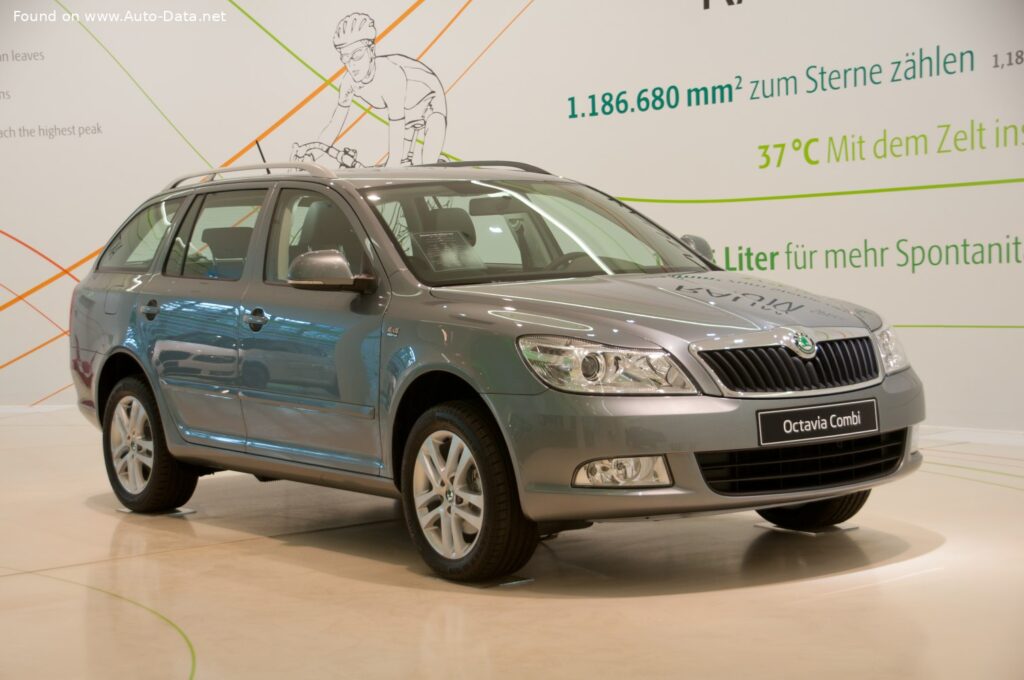
The Skoda Octavia II Combi, specifically the facelifted version introduced in 2009, represented a significant evolution of Skoda’s popular compact estate car. Production of the 2.0 TDI CR (140 hp) variant ran from February 2010 to May 2013. This model occupied a mid-range position within the Octavia II Combi lineup, offering a balance between fuel efficiency, performance, and practicality. It was positioned above the lower-powered diesel options and the gasoline engines, but below the more potent diesel variants and the performance-oriented RS model. The Octavia II Combi, built on the Volkswagen Group’s A5 (1HX0) platform, shared its underpinnings with the Volkswagen Golf Mk5 and Mk6, Audi A3, and SEAT Leon.
Powertrain & Engine Architecture
The 2.0 TDI CR (140 hp) Octavia Combi was powered by the CFHC and CLCB engine codes, both representing iterations of Volkswagen Group’s common rail direct injection diesel engine. This 1968 cc (120.09 cu. in.) inline-four cylinder engine featured a turbocharger with an intercooler to enhance power and efficiency. The ‘CR’ designation signifies the use of Common Rail direct fuel injection, a system that delivers fuel at extremely high pressure for improved atomization and combustion. This engine utilized a 16-valve (4 valves per cylinder) configuration and a compression ratio of 18.5:1.
The fuel injection system was a Bosch-supplied Common Rail system, capable of multiple injections per combustion cycle. This allowed for precise control over the combustion process, optimizing for both power and reduced emissions. The engine’s valvetrain employed overhead camshafts, contributing to its relatively smooth operation. Engine oil capacity was 4.3 liters (4.54 US qt | 3.78 UK qt), and the recommended oil specification adhered to Volkswagen Group standards. The engine’s transverse mounting within the engine bay facilitated a front-wheel-drive configuration.
Transmission
The 2.0 TDI CR (140 hp) Octavia Combi was primarily equipped with a 6-speed manual transmission. This gearbox was chosen for its balance of efficiency and driver engagement. The gear ratios were tuned to maximize fuel economy during highway cruising while providing sufficient acceleration in urban environments. While a Direct-Shift Gearbox (DSG) was available as an option on some Octavia models, it was less commonly paired with this specific engine output.
Driving Characteristics
The 2.0 TDI CR (140 hp) Octavia Combi offered a practical and efficient driving experience. With 140 horsepower at 4000 rpm and 320 Nm (236.02 lb-ft) of torque available from 1750 rpm, the engine provided ample pulling power for everyday driving and load-carrying. Acceleration from 0 to 100 km/h (0-62 mph) took approximately 9.7 seconds, and top speed was rated at 207 km/h (128.62 mph).
Compared to the lower-powered 1.6 TDI variants, the 2.0 TDI offered noticeably improved acceleration and responsiveness. However, it didn’t possess the outright performance of the higher-output 2.0 TDI models or the sporty character of the Octavia RS. The 6-speed manual transmission allowed drivers to maintain optimal engine speed for efficient cruising or to exploit the engine’s torque for quicker overtaking maneuvers. The turbocharger provided a noticeable boost in power, but turbo lag was minimal thanks to the common rail injection system and intercooler.
Equipment & Trim Levels
The 2.0 TDI CR (140 hp) Octavia Combi was typically offered in several trim levels, including Active, Ambition, and Elegance. The Active trim served as the entry point, featuring standard equipment such as air conditioning, electric front windows, a basic audio system, and ABS brakes. The Ambition trim added features like alloy wheels, front fog lights, a multi-function steering wheel, and cruise control. The top-of-the-line Elegance trim included upgrades such as leather upholstery, automatic climate control, a more advanced audio system, and parking sensors.
Optional extras available for this variant included a sunroof, navigation system, heated seats, and a rear parking camera. Interior upholstery typically consisted of fabric seats in the Active trim, with higher trims offering options for leather or Alcantara. The dashboard layout was functional and ergonomically designed, with a clear instrument cluster and intuitive controls.
Chassis & Braking
The Octavia II Combi’s chassis featured an independent suspension setup at both the front and rear. The front suspension utilized a McPherson strut design with coil springs and an anti-roll bar, while the rear suspension employed a multi-link system. This configuration provided a good balance between ride comfort and handling stability. The steering system was a rack and pinion type with electric power assistance, offering precise steering feel and reduced driver effort.
Braking duties were handled by ventilated discs at the front and solid discs at the rear. The braking system was equipped with ABS (Anti-lock Braking System) as standard, enhancing safety and control during emergency braking situations. Tire sizes varied depending on the trim level, with common options including 195/65 R15 and 205/55 R16. Wheel rim sizes typically ranged from 6J x 15 to 6.5J x 16.
Market Reception & Comparison
The Skoda Octavia II Combi 2.0 TDI CR (140 hp) was generally well-received by automotive critics. It was praised for its spacious interior, practical estate car body style, and fuel-efficient diesel engine. Critics noted that the 140 hp output provided a good balance between performance and economy, making it suitable for both commuting and long-distance travel. Fuel economy figures were competitive, with combined fuel consumption averaging around 5.7 l/100 km (41.3 US mpg / 49.6 UK mpg).
Compared to the lower-powered 1.6 TDI Octavia Combi, the 2.0 TDI offered a more refined driving experience and superior performance. However, it was slightly more expensive to purchase and maintain. Compared to the higher-output 2.0 TDI variants, the 140 hp version offered a more affordable entry point into the Octavia Combi range, albeit with a slight compromise in performance. Reliability was generally good, with the 2.0 TDI engine proving to be a durable and long-lasting unit.
Technical Specifications
| Brand | Skoda |
| Model | Octavia II Combi |
| Type | 2.0 TDI CR (140 Hp) |
| Start of production | February, 2010 |
| End of production | May, 2013 |
| Engine Displacement | 1968 cm3 (120.09 cu. in.) |
| Engine Code | CFHC, CLCB |
| Number of Cylinders | 4 |
| Engine Configuration | Inline |
| Power | 140 Hp @ 4000 rpm |
| Torque | 320 Nm @ 1750 rpm (236.02 lb.-ft. @ 1750 rpm) |
| Fuel Consumption (Urban) | 7.2 l/100 km (32.7 US mpg / 39.2 UK mpg) |
| Fuel Consumption (Extra Urban) | 4.8 l/100 km (49 US mpg / 58.9 UK mpg) |
| Fuel Consumption (Combined) | 5.7 l/100 km (41.3 US mpg / 49.6 UK mpg) |
| Acceleration 0-100 km/h | 9.7 sec |
| Maximum Speed | 207 km/h (128.62 mph) |
| Kerb Weight | 1425 kg (3141.59 lbs) |
| Max. Weight | 2010 kg (4431.29 lbs) |
| Trunk Space (Minimum) | 605 l (21.37 cu. ft.) |
| Trunk Space (Maximum) | 1655 l (58.45 cu. ft.) |
| Fuel Tank Capacity | 55 l (14.53 US gal | 12.1 UK gal) |
Legacy
The Skoda Octavia II Combi 2.0 TDI CR (140 hp) has proven to be a reliable and durable vehicle in the used car market. The 2.0 TDI engine, while not without its potential issues (such as diesel particulate filter clogging and dual-mass flywheel wear), is generally considered to be a robust unit when properly maintained. These vehicles continue to be popular choices for buyers seeking a practical, fuel-efficient, and spacious estate car. The availability of spare parts and relatively affordable maintenance costs contribute to its ongoing appeal. The Octavia II Combi, in general, helped solidify Skoda’s reputation as a manufacturer of well-built and value-for-money vehicles.